
$BRUN — A GPU cloud priced as if the financing never comes, Boost Run Deep Dive
Contents
- EXECUTIVE SUMMARY
- 1. SNAPSHOT
- 2. BUSINESS DESCRIPTION
- 3. THE TECHNOLOGY: WHAT A GPU CLOUD IS MADE OF, AND WHERE BOOST RUN FITS
- 4. THE CONTRACT BOOK: FROM $120 MILLION TO MORE THAN $2.6 BILLION IN NINE MONTHS
- 5. POWER AND SITES: MEGAWATTS ARE NOT THE CONSTRAINT
- 6. THE BALANCE SHEET AND THE FINANCING QUESTION: THE EXISTING BOOK IS FUNDED, THE NEXT BILLION IS NOT
- 7. GROWTH DRIVERS
- 1. Converting the signed book: about $430 million a year from six filed contracts
- 2. ARR from $145 million to about $400 million by December
- 3. The $4 to $5 billion procurement
- 4. Pricing that has held on Blackwell
- 5. On-demand as a margin lever
- 6. Regulated and sovereign demand
- 7. NVIDIA's programs
- 8. LEADERSHIP ANALYSIS
- 9. FORWARD OUTLOOK: TAILWINDS, GUIDANCE AND THE Q3 PRINT
- 10. BULL CASE
- 11. BEAR CASE
- 12. SCORING
- 13. PRICE TARGET FRAMEWORK AND VERDICT
- 14. THESIS FIT
- 15. KEY CATALYSTS
- 16. WHAT I DO NOT KNOW YET
Date: October 16, 2026 Price: $10.08 (Nasdaq close, October 15, 2026; intraday low that day $8.95) Method: My six-dimension framework (Revenue Quality, Revenue Growth, Moat, Leadership, Asymmetry, Conviction Gap), which weighs a probability-weighted value against the spot price. I value each scenario at end-2027 as a multiple of 2028 adjusted EBITDA and deduct the debt the fleet will carry by then: equipment leases, the software payment plan and any extra funding the plan needs. Share counts include the September RSU grants and any equity a scenario has to issue.
Verdict: Investable at $10.08 (EV/spot 3.47x), and probably the most asymmetric opportunity I have covered so far at current prices. It is still best to proceed with caution and not size it too aggressively. The reasons are size and structure: a market cap of about $0.85 billion, a float of about 29 million shares, a founder who holds 87% of the vote, no committed financing for the next billion dollars of hardware, and a 16% fall on October 14 on other companies' news. More risk-averse investors can wait for the Q3 print in mid-November and a named financing facility; for those willing to take more risk, the risk/reward at $10.08 is attractive.
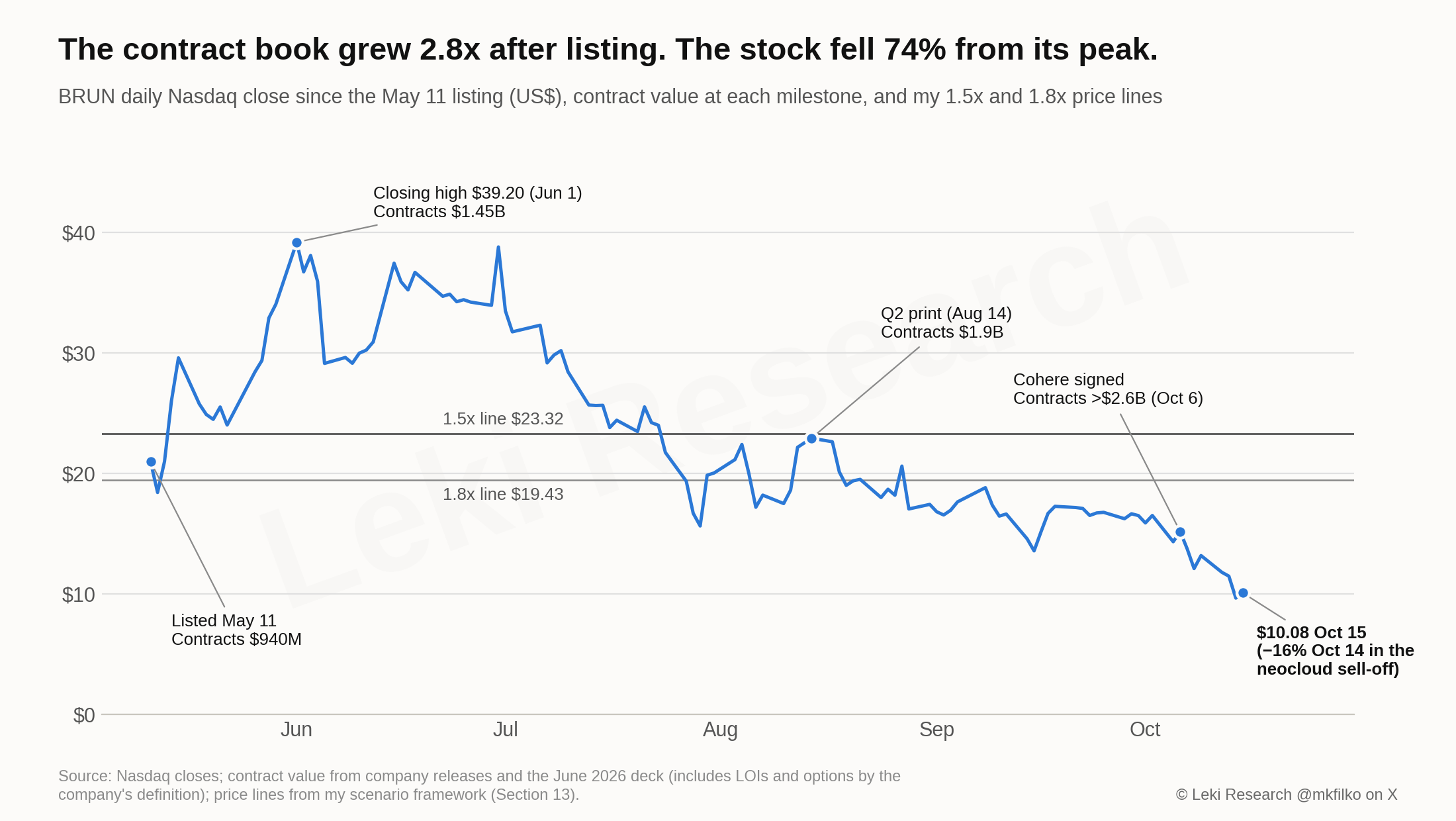
Boost Run listed on Nasdaq on May 11 with $940 million of signed contracts. It closed at $39.20 on June 1, gave the whole move back by the end of July, and closed at $10.08 on October 15, 74% below that high and about half of its first-day close. The business went the other way. Contract value is now more than $2.6 billion, 2.8 times the listing figure. The company has signed two AI labs, Thinking Machines Lab in May and Cohere at the end of September. Annualized revenue went from $30 million at the end of 2025 to $145 million in June, and management guides to about $400 million by December. On October 8 it put a 2026 revenue projection of $170 to $180 million into a filing for the first time.
The last week explains the price better than anything the company did. On October 14 CoreWeave's 2031 notes briefly yielded more than 15%, CoreWeave fell 15.5%, and Gartner's forecast that more than 80% of neocloud providers will not survive as independent businesses much beyond 2030 was widely reported. The next day those notes yielded more than 16%. Boost Run fell 15.9% to $9.65, its lowest close since listing, with no news of its own. It traded as low as $8.95 the next morning before closing at $10.08. The market is asking one question of every GPU landlord, and Boost Run is the smallest of them: who pays for the next billion dollars of GPUs, and at what price?
My conclusion is that the price already charges for a bad answer. At $10.08 the probability-weighted value of $34.98 is 3.47 times the price. I put half the weight on the Bull and Moonshot, because management has hit or beaten its forward targets on contracts, ARR and power, and 20% on a Bear case in which the ramp slips and the next round of funding comes as equity at $5. The swing factor is the financing the CFO promised "over the next quarter" in August, which has not arrived. The Q3 print in mid-November is where that gets tested.
EXECUTIVE SUMMARY
Boost Run is a GPU cloud based in Chicago, what the market now calls a neocloud: a cloud that is neither Amazon, Microsoft nor Google, renting NVIDIA compute to AI companies. It buys servers built to NVIDIA's reference designs, installs them in colocation halls it leases, and rents them as dedicated bare-metal clusters on take-or-pay contracts of three to five years, plus a smaller on-demand book on its own platform. Every multi-year contract carries a cash prepayment, about 22% of contract value on average. It owns no buildings and no power plants. It finances the servers with 30 to 36 month equipment leases at 6.62%, which are repaid inside the customer contract. It listed through the Willow Lane SPAC with no redemptions and no PIPE, and it is one of the clouds NVIDIA has certified as an Exemplar Cloud on its B300 platform.
The founder's story is the business model. Andrew Karos built Blue Fire Capital, a trading firm that ran its own low-latency systems in thirteen data centers on more than $500 million of credit lines, sold it to Galaxy Digital in 2020, and started Boost Run in 2023 by buying GPUs with cash. It began where the market was loosest, renting servers by the hour, and lengthened its contracts step by step: two months, three months, a year, three years, four, and five with Cohere. Prices rose along the way, from $3.45 per GPU-hour in March to $4.13 in July. Short rentals are easy to sign and nearly impossible to finance. Long prepaid rentals are something a lender will fund.
The headline numbers hide three things. First, the reported 94.5% gross margin is an accounting artifact. Boost Run books its rentals as a lessor, so the GPUs reach the income statement as depreciation and the rent for space and power sits below gross profit. After colocation the comparable margin is 60.6%, adjusted EBITDA was $12.3 million (39.5%), and the operating line was a $12.9 million loss. Second, the contract value is softer than the headline. Of the more than $2.6 billion, $1.55 billion is in filed contracts, about $1.0 billion of it with the two named labs; the rest is letters of intent, options and unfiled orders by the company's own definition. Third, the business has not yet shown the cash margin it promises. Operating cash flow in the first half was $114.2 million, but $112.9 million of that was customer deposits.
The technology question is narrower than for a chip company. Boost Run makes none of the parts: NVIDIA makes the GPUs and the reference design, Dell and Lenovo build the servers, colocation landlords supply the buildings and power. What it does is buy ahead of demand, build clusters to NVIDIA's template fast, get them validated, and hand them to a customer on a contract that pays for the hardware. The edge is speed, validation and a self-funding contract structure, and all three can be copied by a better-funded rival. That is why I score the moat at 6, and why the financing is the variable that matters most.
At $10.08 the market cap is $845 million on 83.85 million shares, or $891 million including the September RSUs. Enterprise value is about $953 million after adding $238 million of GPU finance leases and $78 million of software and insurance obligations and subtracting about $209 million of pro forma liquidity, or $1.07 billion including the colocation leases. On the lease-inclusive basis the listed peers are measured on, Boost Run trades at 7.4 times June ARR, 2.7 times its December target and 0.69 times its filed contracts. CoreWeave, IREN and Nebius trade at 4.4, 3.5 and 6.7 times their own year-end targets. Five firms rate the stock Buy or Outperform with targets of $36 to $45; two of them have banking relationships or expect to seek them.
I value each scenario at end-2027 on 2028 adjusted EBITDA, net of everything the fleet will owe by then:
| Scenario | Value | Probability | Exit-2027 ARR / 2028 EBITDA | Multiple |
|---|---|---|---|---|
| Bear | $5.40 | 20% | ~$520M / $336M, with ~$265M of equity raised at $5 | 4.0x |
| Base | $20.50 | 30% | ~$850M / $651M | 4.5x |
| Bull | $42 | 35% | ~$1.2B / $977M | 5.5x |
| Moonshot | $87 | 15% | ~$2.0B / ~$1.66B | 6.5x |
The probability-weighted value is $34.98, or 3.47x the $10.08 price. The composite is 7.33 (RQ 6.5, RG 9, M 6, L 6, A 9, CG 7.5). The 1.8x line is $19.43 and the 1.5x line $23.32, so the stock sits 48% below the 1.8x line.
At $10.08 a buyer pays about $1 billion of enterprise value for a GPU cloud already running at $145 million of ARR and guiding to about $400 million by December. That buys more than $2.6 billion of contracts with prepayments attached, two named AI labs, rising contract prices and access to 253 MW of power, about three times what my Base needs by end-2027. In exchange the buyer accepts thin per-contract economics that depend on what the hardware earns after month 36, no committed financing for the next billion dollars of GPUs, three unremediated material weaknesses, a founder who can issue shares without anyone else's vote, and a stock that falls 16% on a peer's bond yield.
I think the market is pricing Boost Run as if the financing will not come, or will come as equity at these prices. That is a real risk, and it is why the Bear still carries 20% for a team that has hit or beaten its forward targets on contracts, ARR and power. But the price already sits close to that outcome. At my Base multiple, $10.08 needs only about $440 million of 2028 EBITDA, about $690 million of 2028 revenue, against the $1.0 billion my Base gets from the signed book plus modest new signings. The stock does not need the $4 to $5 billion procurement to work. It needs the contracts already signed to go live on roughly the dates already given, and the next financing to cost something closer to the 6.6% the current leases cost than an equity raise at $5 that adds two-thirds more shares. It is investable, but I would not size it aggressively. More risk-averse investors can wait for the Q3 print and a named facility. For those willing to take more risk, the risk/reward at $10.08 is attractive.
1. SNAPSHOT
| Metric | Value | Note |
|---|---|---|
| Price | $10.08 | Nasdaq close, October 15. −15.9% on October 14 to $9.65; intraday low $8.95 on October 15. −74% from the $39.20 closing high (June 1); −56% from the Q2-print close of $22.93 (August 14) |
| Shares | 83.85M basic (September 25) | 54.31M Class A plus 29.53M Class B with ten votes each. Plus 4.59M RSUs granted September 29, vesting May 2027 to September 2029 |
| Market cap | $845M basic; $891M with RSUs | Insiders ~63%, institutions ~23%. Float ~29M shares |
| Voting control | Founder ~87% of votes | Controlled company. Karos holds all Class B plus 7.875M earnout shares, about 48% of the shares outstanding |
| Liquidity | ~$209M pro forma | $120.2M cash at June 30, ~$85M of warrant cash received after quarter end and a $3.85M receivable. Separately, $13.0M of restricted cash backs a letter of credit |
| Debt-like obligations | $316.6M | $238.1M GPU finance leases (30-36 months, 6.62%) and $78.5M of financial obligations ($76.3M PV of a $100M software plan paid $20M a year from October 2026, plus $2.2M of insurance financing). No bank debt |
| Operating leases | $119.5M | Colocation. Excludes two seven-year leases ($42.8M and $184.0M of payments) and Rock Island, signed but not commenced at June 30, and Pryor, signed August 13 |
| Enterprise value | ~$953M | ~$1.07B including operating leases |
| Q2 2026 revenue | $31.1M (+270% y/y) | $30.4M lease revenue, $0.7M blockchain rewards. Q1 $11.0M. FY2025 $26.9M |
| Q2 profitability | Adjusted EBITDA $12.3M (39.5%); operating loss −$12.9M | Colocation $10.6M (34% of revenue). D&A $18.1M. Net loss −$75.0M includes a $55.7M one-time deferred-tax charge |
| ARR | $145M at June 30 | $30M at December 2025; $96M at April 30. Exit-2026 target "approximately $400 million" |
| Contract value (TCV) | >$2.6B (October 6) | $120M at December 2025; $1.9B at June 30. Includes LOIs and options by the company's definition; $1.55B is in filed contracts |
| Customer deposits | $128.4M | $34.9M current, $93.5M long-term. Plus ~$93.5M of contracted prepayments still to arrive |
| 2026 guidance | Revenue ~$170-180M; capex ~$1.0-1.2B; exit ARR ~$400M | Revenue and capex from the October 8 amendment; total operating costs $102-108M |
| Power | 253 MW accessible | 33 MW locked plus 125 MW under LOI in June; 10X Infrastructure adds 20 MW in Q4 2026 and up to 111 MW through 2027 |
| Hardware commitment | Dell purchase agreement, $1.44B over five years | Year-1 minimum of $578M already exceeded; $215.5M a year from April 2027, with a shortfall payment if missed |
| Valuation (lease-inclusive EV) | 7.4x June ARR; 2.7x exit-2026 target; 1.9x 2027 consensus revenue; 0.69x filed contracts; 0.41x headline TCV | $4.2M of EV per accessible MW |
| Consensus | FY2026 revenue $175M (range $170-178M); FY2027 $551M; Q3 EPS −$0.22 (one estimate) | BTIG: Q3 $56.0M, Q4 $81.2M, FY2027 $428M |
| Analysts | BTIG Buy $45; D.A. Davidson Buy $45; Craig-Hallum Buy $45; Northland Outperform $36; Odeon Buy $40; Weiss Sell | S&P average of four $42.75. BTIG was the SPAC's bookrunner and expects to seek banking fees; Odeon's analysts disclose holding the stock |
| Short interest | ~5.0M shares (September 30) | ~17% of float, 2.3 days to cover. In the Russell 2000 from the close of September 18 |
| Insider activity | Director Goodrich sold 198,200 at $20.15 (August 27) and 500,000 at $14.00 (September 14), after exercising 1.10M warrants at $11.50 on August 19 | ~$11M in total; still holds ~4.44M. No sales by the CEO. No open-market purchases by anyone |
| Controls | Three material weaknesses; disclosure controls "not effective" | Late-filing notices for both quarters; Q1 10-Q amended for the controls conclusion |
| Next print | Q3 2026, mid-November (not yet scheduled) | Q2 was reported August 14 and the 10-Q filed August 18 |
The ramp, quarter by quarter (US$ millions):
| Q1 2025 | Q2 2025 | H2 2025 | Q1 2026 | Q2 2026 | Q3 2026E (my Base) | Q4 2026E (my Base) | |
|---|---|---|---|---|---|---|---|
| Revenue | 4.1 | 8.4 | 14.3 | 11.0 | 31.1 | ~49 | ~78 |
| Adjusted EBITDA | n/a | n/a | n/a | 2.25 | 12.3 | ~20.5 | ~33 |
| Adjusted EBITDA margin | n/a | n/a | n/a | 20.5% | 39.5% | ~42% | ~42% |
| ARR at period end | 30 | 96 (April 30) | 145 | ~245 | ~380 | ||
| TCV at period end | 120 | n/a | 1,900 | >2,600 |
Adjusted EBITDA uses the company's definition: after colocation, before stock compensation and one-off items. The company did not report ARR at March 31; the April 30 figure is shown in its place. The Q3 and Q4 figures are my Base case, not guidance.
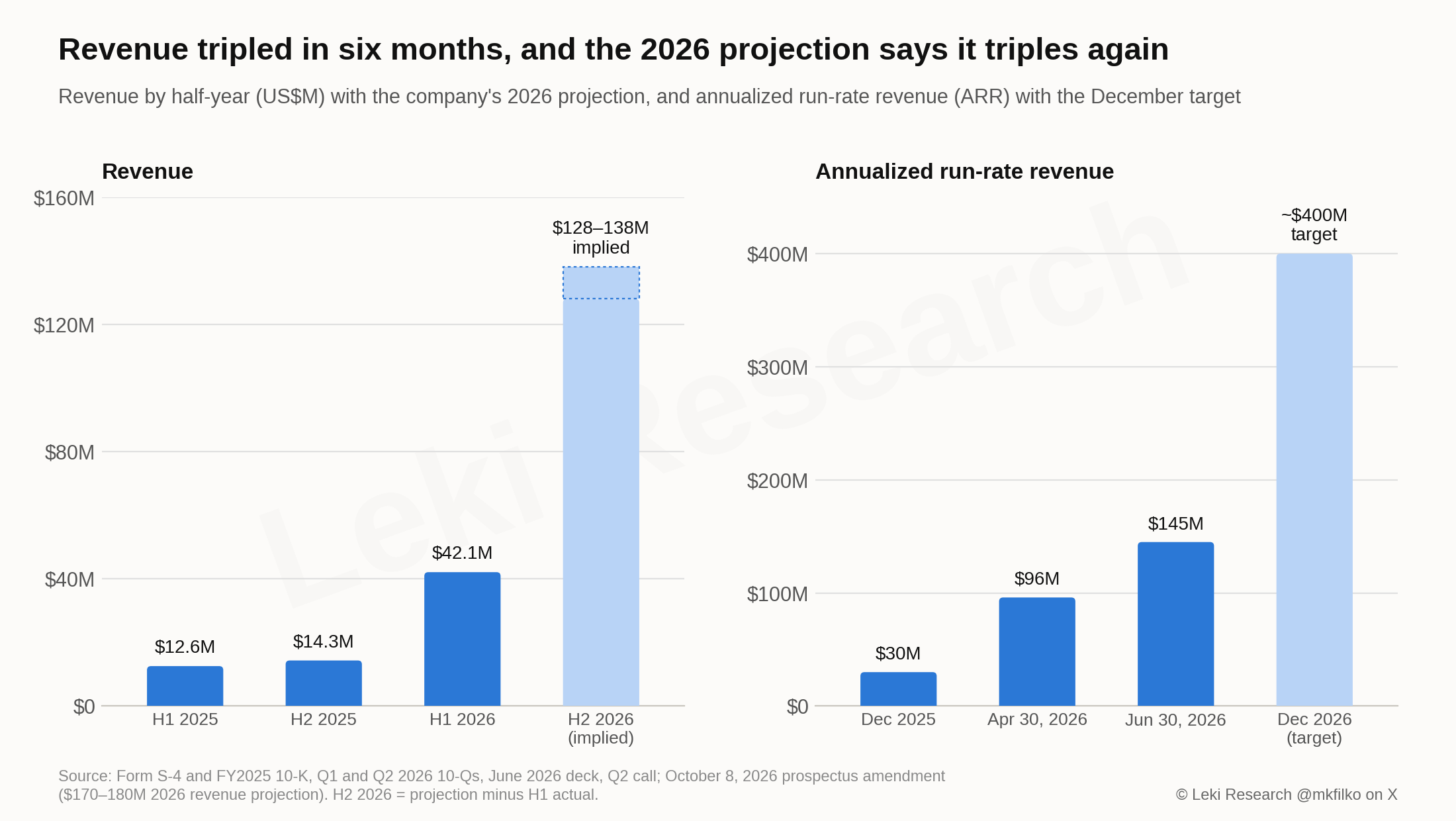
Revenue tripled between the second half of 2025 and the first half of 2026, and the October 8 projection says it triples again in the second half. With $42.1 million booked in the first half, $170 to $180 million for the year implies $128 to $138 million for July to December. The ARR line tells the same story faster: $30 million in December, $96 million at April 30, $145 million at June 30, and a target of about $400 million in December. What the chart cannot show is how much of the step from $145 million to $400 million is already contracted and simply waiting for a data hall, which is most of it (Section 4).
2. BUSINESS DESCRIPTION
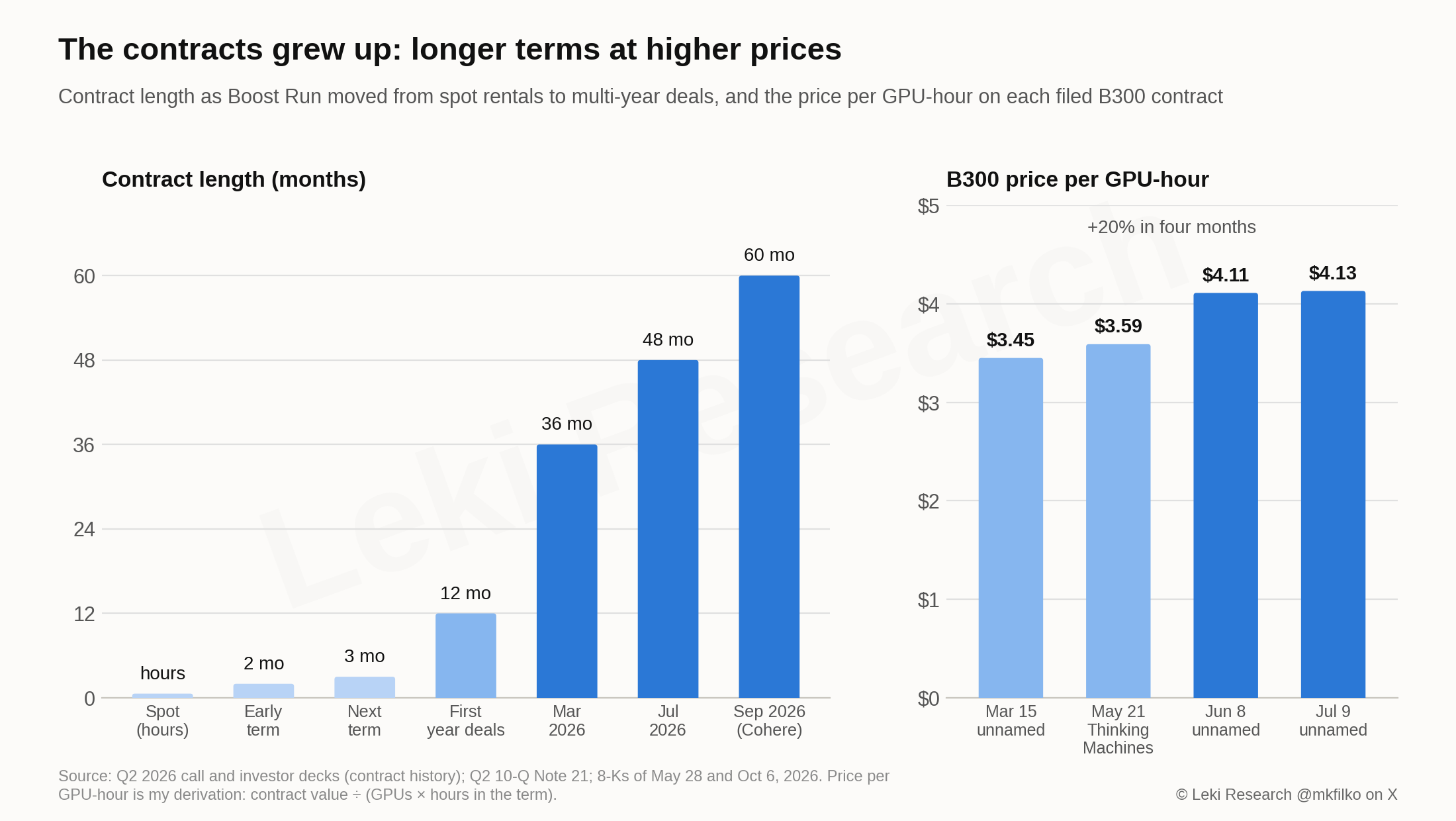
A trader builds a cloud. Karos came to GPUs from trading. Blue Fire Capital ran its own low-latency systems across thirteen data centers in six countries, and Galaxy Digital bought it in 2020. He ran electronic trading at Galaxy and sat on its executive committee until 2023, then started Boost Run and paid for its first GPUs with cash. The first customers were GPU marketplaces and on-demand renters, the loosest end of the market. Then the contracts lengthened: two months, three months, one year, three years with the March B300 contracts and Thinking Machines, four years with the July order, and about five years per rack with Cohere.
That staircase is the business model in one picture. A lender will not fund hardware against a customer who can leave next month. A lender will fund hardware against a three-year take-or-pay contract with a fifth of the value paid in cash up front. Every step up the staircase made the next build cheaper to finance. Prices climbed alongside the terms: $3.45 per GPU-hour on the March Charlotte contract, $3.59 with Thinking Machines in May, and $4.11 and $4.13 on the June and July orders, 20% higher in four months while much of the market was writing that GPU rental prices could only fall.
Management describes the business as four inputs: customers, reached through direct sales, channel partners and its own on-demand platform; colocation, since it owns no data centers; hardware, mainly Dell and Lenovo servers built to NVIDIA's reference architecture and bought ahead of demand; and finance, meaning customer prepayments, equipment leases and, where needed, the company's own balance sheet.
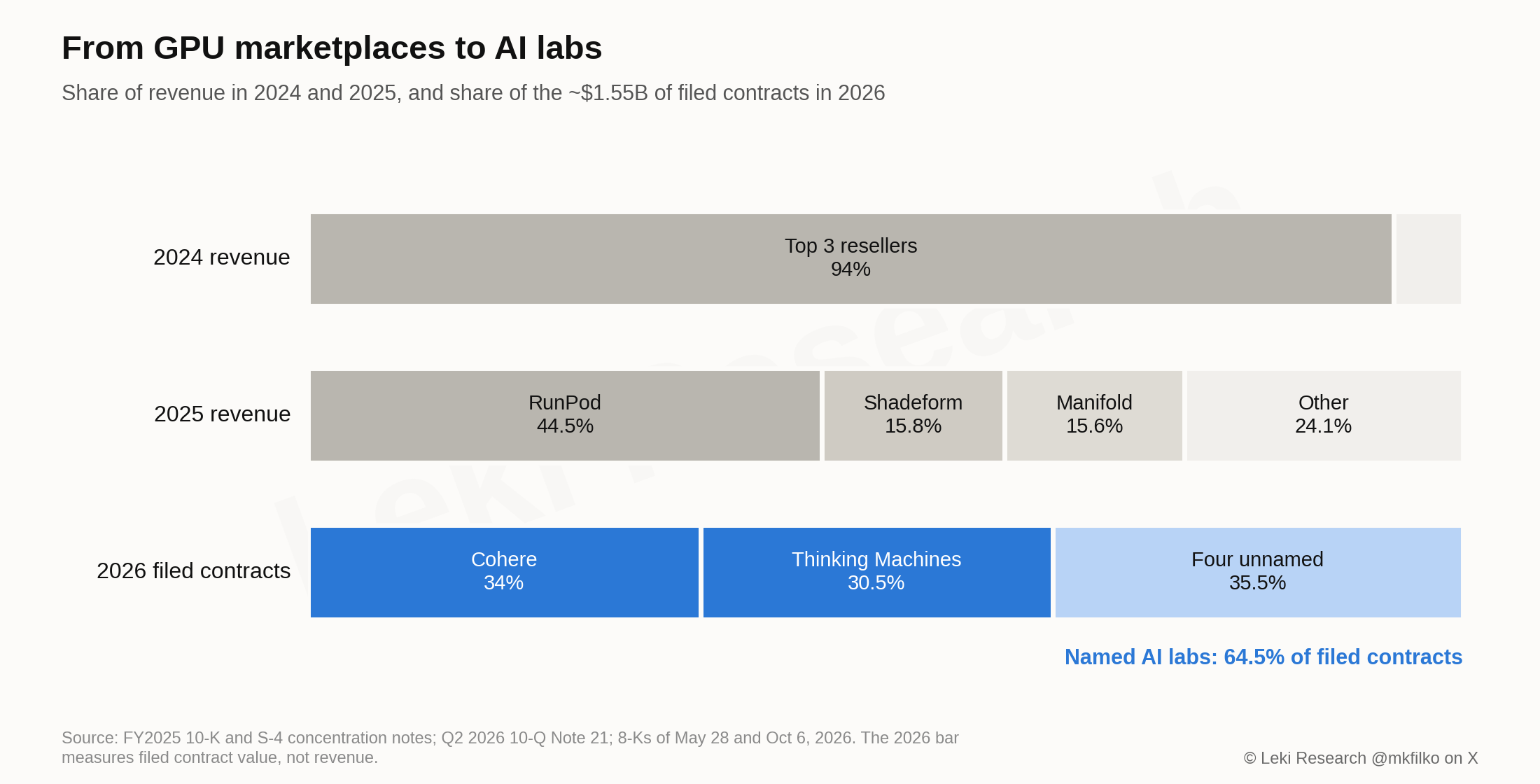
Who it sells to. For most of its life Boost Run was a wholesaler. In 2024 three GPU marketplaces made up 94% of revenue. In 2025 it was still 76%: RunPod alone was 44.5%, with Shadeform at 15.8% and Manifold Labs at 15.6%. Those marketplaces resell Boost Run's GPUs to their own users, and their master agreements allow termination on 90 days' notice after the initial term. That revenue is real, and it can walk.
2026 is the year the customer list changed. Of the $1.55 billion of filed contracts, 64.5% now sits with two named AI labs. Thinking Machines Lab, Mira Murati's lab, signed for $471.7 million over 36 months on 5,000 B300 GPUs, with no termination for convenience. Cohere, which sells models that governments and regulated industries can run under their own control, signed $525.6 million for GB300 NVL72 racks at about five years per rack. The other four filed contracts carry no customer name. The June customer slide also lists Nebius, Baseten, DRW, fal, Fireworks AI, Fluidstack, Prime Intellect and Higgsfield, without sizing any of them. There is no 2026 concentration note in the 10-Q, although Thinking Machines alone may be close to half of 2026 revenue.
How the revenue is booked, and why the margin looks the way it does. Once a cluster is handed over, the customer controls the servers, so Boost Run books the rental as lease income under ASC 842. Lease income was $30.4 million of the $31.1 million in Q2; the remaining $0.7 million was bitcoin mined on idle capacity, a line that shrinks as the fleet fills. Lessor accounting has a mechanical effect. Cost of revenue holds almost nothing ($1.7 million in Q2), because the GPUs reach the income statement as depreciation and interest, and colocation has its own line below gross profit. That is why the reported gross margin is 94.5%.
Walk down from there and each line says something. After data-center rent the margin is 60.6%, because colocation cost $10.6 million, 34% of revenue; that is the figure comparable with neoclouds that carry power and space in cost of revenue, and it is below CoreWeave's. Cash overhead was about $6.5 million, which leaves adjusted EBITDA of $12.3 million, a 39.5% margin, up from 20.5% in Q1. Depreciation of $18.1 million and $7.1 million of stock compensation take the operating line to a $12.9 million loss. The Shawarma Capital bear series made the accounting point in August, and it is right: the 94.5% is a booking boundary, not an advantage.
The operating line sits so far below EBITDA because of timing. Rent on a new site starts the day the lease does. Depreciation starts when the hardware is installed. Revenue starts only when the customer accepts the cluster. In a quarter in which the fleet grew this fast, a lot of hardware carried costs before it earned anything: at June 30, $28.0 million of equipment sat on the balance sheet as "not in service", up from $8.1 million in December. The better test is one contract once it is running, which the right-hand panel below shows and Section 3 works through per GPU.
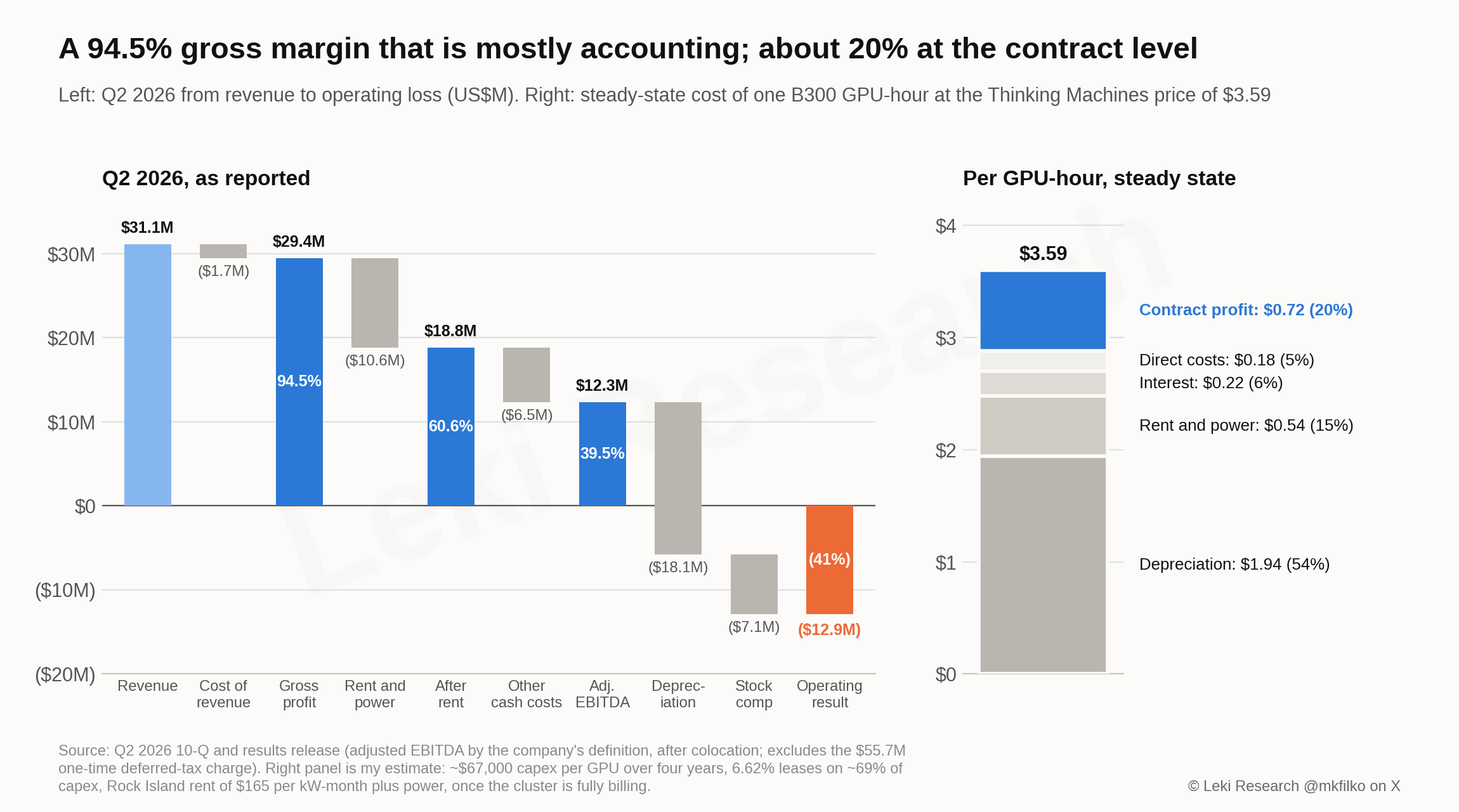
At the Thinking Machines price of $3.59, depreciation over four years, the most conservative life in the sector, takes about 54% of each GPU-hour. Rent and power take about 15%, roughly $0.54 an hour, of which Rock Island's rent of $165 per kW-month alone is about $0.40. Interest at 6.62% on roughly 69% of the capex takes about 6%, and direct costs about 5%. About 20% is left as contract-level profit, roughly 14% after cash overhead, which is where management's 15-20% "net cash flow margin" goal sits. So each GPU makes money, but not much. The equity's return comes from what the hardware earns after it is paid off.
The site strategy. Management's line is "four 25 MW sites over one 100 MW site, every time". It prefers smaller, already-powered colocation sites near population centers, each built to a templated cluster design that has passed NVIDIA's architecture review board. The case for it is speed to revenue, contained single-site failure and lower latency for inference. The cost is that there is no gigawatt campus to point at and every site comes with its own lease (Section 5).
Why NVIDIA matters more here than at most neoclouds. Boost Run was named an NVIDIA Exemplar Cloud on HGX B300 in April, which means it ran NVIDIA's benchmarking recipes on its own clusters and landed within 5% of NVIDIA's reference targets. The status is not exclusive. The same April release named CoreWeave, Nebius, Oracle and Azure as Exemplar Clouds, IREN was certified on B300 in June, and Nebius on B300 in October. Every Boost Run cluster also passes NVIDIA's architecture review board before going live. Management links this to handoff quality, since rented compute that underdelivers against spec is the most common complaint in this market, and to lender comfort. I think NVIDIA is also a sales channel, though the company has never said so. A company spending about $6.5 million a quarter on cash overhead, with engineers rather than a sales force, does not usually land Thinking Machines and Cohere by cold outreach, and NVIDIA is an investor in Thinking Machines with a gigawatt-scale Vera Rubin partnership. I treat that channel as an inference, not a fact.
3. THE TECHNOLOGY: WHAT A GPU CLOUD IS MADE OF, AND WHERE BOOST RUN FITS
The AI build-out is usually described from the chip outward: NVIDIA's GPUs, the memory stacked beside them, the optics and switches between them, the power and cooling around them. Boost Run sits at the other end. It is one of the companies that turns all of those parts into something an AI lab can rent by the hour or by the year. Understanding what it does, and what it does not do, is the whole moat question.
What a GPU cloud is made of
A GPU cloud has six layers, and Boost Run plays a different role at each. At the bottom is capital: the money that buys the hardware before anyone pays to use it. Boost Run arranges that, through customer prepayments that cover about 31% of the hardware and 30-36 month equipment leases at 6.62% that cover the rest and are repaid inside the contract. Above it is space, power and cooling, which Boost Run rents from colocation landlords at nine US sites, including a twelve-year lease at Pryor, Oklahoma, plus the 10X Infrastructure capacity. A GPU hall needs about 1.6 MW of grid power for every megawatt of IT load once cooling and losses are counted; that is the ratio in the one site filing that gives both figures, Rock Island.
Then come the servers, which Boost Run owns. An HGX B300 server holds eight Blackwell Ultra GPUs joined by NVLink. A GB300 NVL72, the system Cohere is buying, is a whole rack: 72 GPUs and 36 Grace CPUs joined into one NVLink domain, liquid-cooled and drawing about 132 kW. Dell builds most of them under a $1.44 billion five-year purchase agreement, and Lenovo supplies others. Networking joins servers into a cluster over a 400-800 Gb/s fabric, which Boost Run buys from NVIDIA through the server makers. On top of that sits validation and operations: building every cluster to NVIDIA's reference architecture, clearing the review board, benchmarking, and then running the fleet, with SOC 2, HIPAA and ISO 27001 and 27701 certifications for regulated buyers. The top layer is the customer contract, which Boost Run sells.
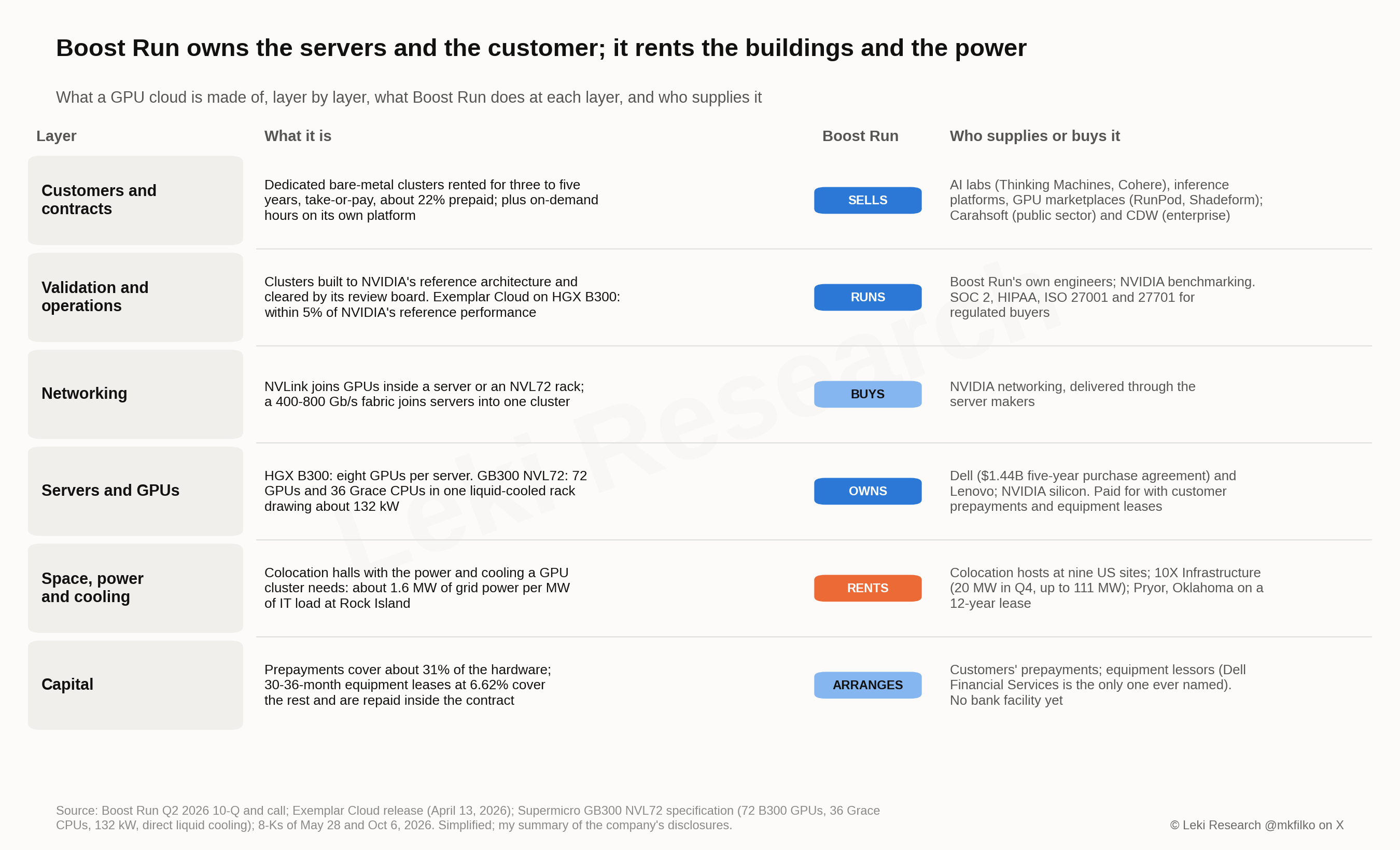
What the customer receives is bare metal: whole servers or whole racks, with no virtualization layer between the lab's software and the GPUs. The lab runs its own scheduler and training or inference stack on top. That is why the contracts read like equipment leases and are accounted for as leases. It also explains what a lab is paying Boost Run for. It is not paying for software it could not write. It is paying for capacity that exists now, at a validated performance level, on a contract whose cash terms let the hardware be bought at all.
Where Boost Run sits in the chain
Seen as a flow, the chain runs from NVIDIA's chips to Dell and Lenovo's servers, through Boost Run, to the customers and the products they build: model training, inference and agents, sovereign and regulated AI, public-sector work through Carahsoft and enterprise work through CDW. Boost Run makes none of the parts. It does not make chips, servers, networking, buildings, power or AI models. Its place is the middle: buying and owning the servers, building and validating the clusters, running them in rented halls and renting them out.
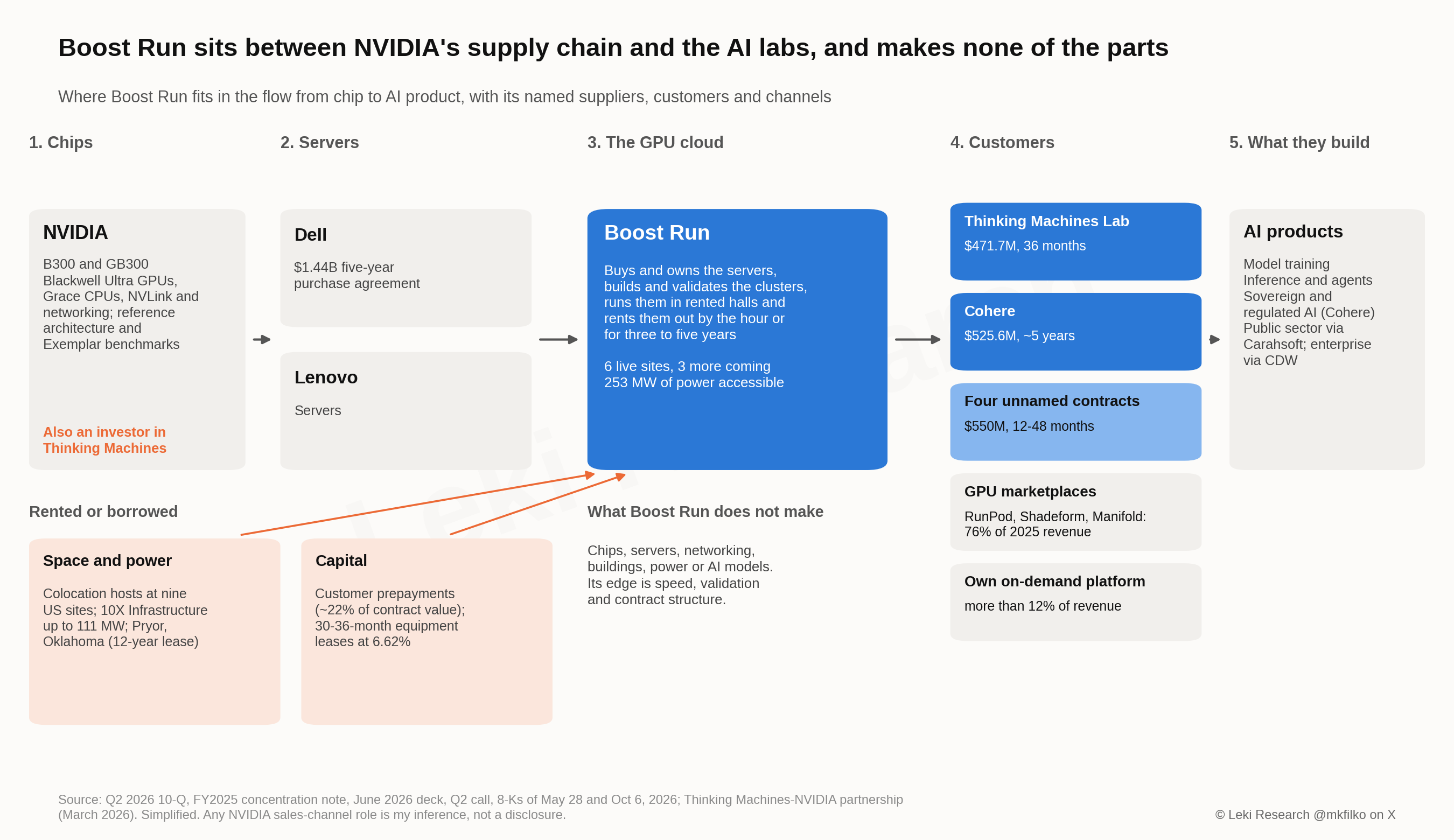
That middle position has a structural weakness and a structural strength. The weakness is that everyone on either side is larger. NVIDIA decides allocation and runs its own programs for cloud partners. The labs can and do sign with several clouds at once; Thinking Machines signed a single-digit-billions agreement with Google Cloud in April. The strength is that in a market where the binding constraint has been how fast capacity can be energized and handed over, a company that buys ahead of demand and builds to a template in small, already-powered halls can deliver before larger rivals finish their campuses. That is what the contract book says customers have been paying for.
How one contract works, per GPU
The Thinking Machines contract is the cleanest example: 5,000 B300 GPUs at $471.7 million over 36 months, about $94,300 of contract value per GPU, against about $67,000 of capex per GPU. Contract value covers capex about 1.4 times, the ratio management quotes. The prepayment of about 22% of contract value is $20,800 per GPU, which covers about 31% of the hardware. The other $46,200 is leased at 6.62% over 36 months, a payment of about $1,419 a month. Rent, power and direct costs run about $524 a month. The customer's remaining payments come to about $2,042 a month. So once the cluster is live, each GPU throws off about $100 a month after the lease, and about $3,600 over the life of the contract.
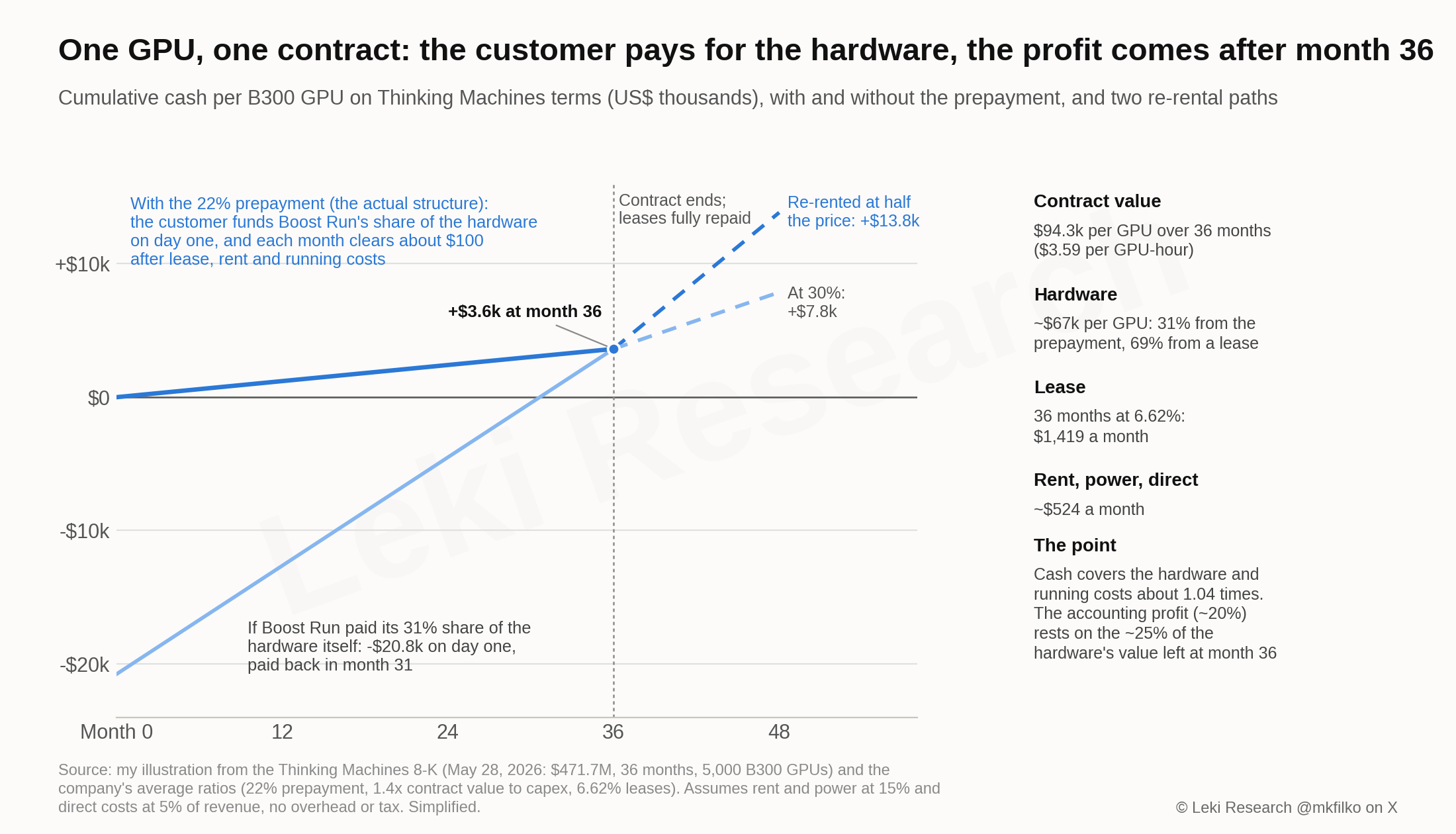
Two things follow. The first is that the prepayment is what makes the model work. With it, the equity funds almost nothing up front and the customer's cash pays for the hardware. Without it, the equity puts in $20,800 per GPU and waits until month 31 to get it back. The second is that the profit comes after month 36. Re-rented at half the contract price, a paid-off GPU adds about $10,000 more in its fourth year; at 30% of the price it adds about $4,200. That residual is where the equity's return sits, and it is the part a bear case attacks.
The newer contracts are better on both counts. The June 8 and July 9 orders price at about $4.11 and $4.13 per GPU-hour, and the July order runs 48 months, while Cohere's runs about five years per rack. A longer contract at a higher price on the same hardware is pure margin. Shawarma's second piece argued that Boost Run loses 17% per GPU-hour even at scale, but that figure divides the Q2 income statement by hours. It charges a full quarter of rent and depreciation on hardware that was not yet billing, and it does not describe a running contract.
Why the labs signed
Seven things win a multi-year GPU contract, and Boost Run has evidence on six of them. On speed, it says it has delivered more than 3,000 GPUs a quarter this year, into six small, already-powered sites with three more coming. On validated performance, it holds Exemplar status on B300. On a contract that funds itself, every deal is take-or-pay with about 22% prepaid and the leases are repaid inside the term. On price, its multi-year B300 rates of $3.45 to $4.13 are about half the $7.10 to $9.50 on-demand rates at Modal, RunPod and Nebius, the discount a customer earns for underwriting the hardware. On power, 253 MW is accessible, about seven times what the December target needs. On compliance and channels, it has the certifications plus Carahsoft and CDW, and Cohere is a sovereign-AI vendor.
The seventh is capital at scale, and that is the gap. The existing book is funded by prepayments and leases. There is no committed facility for the next billion, while peers have raised $2.4 to $6.5 billion each since June.
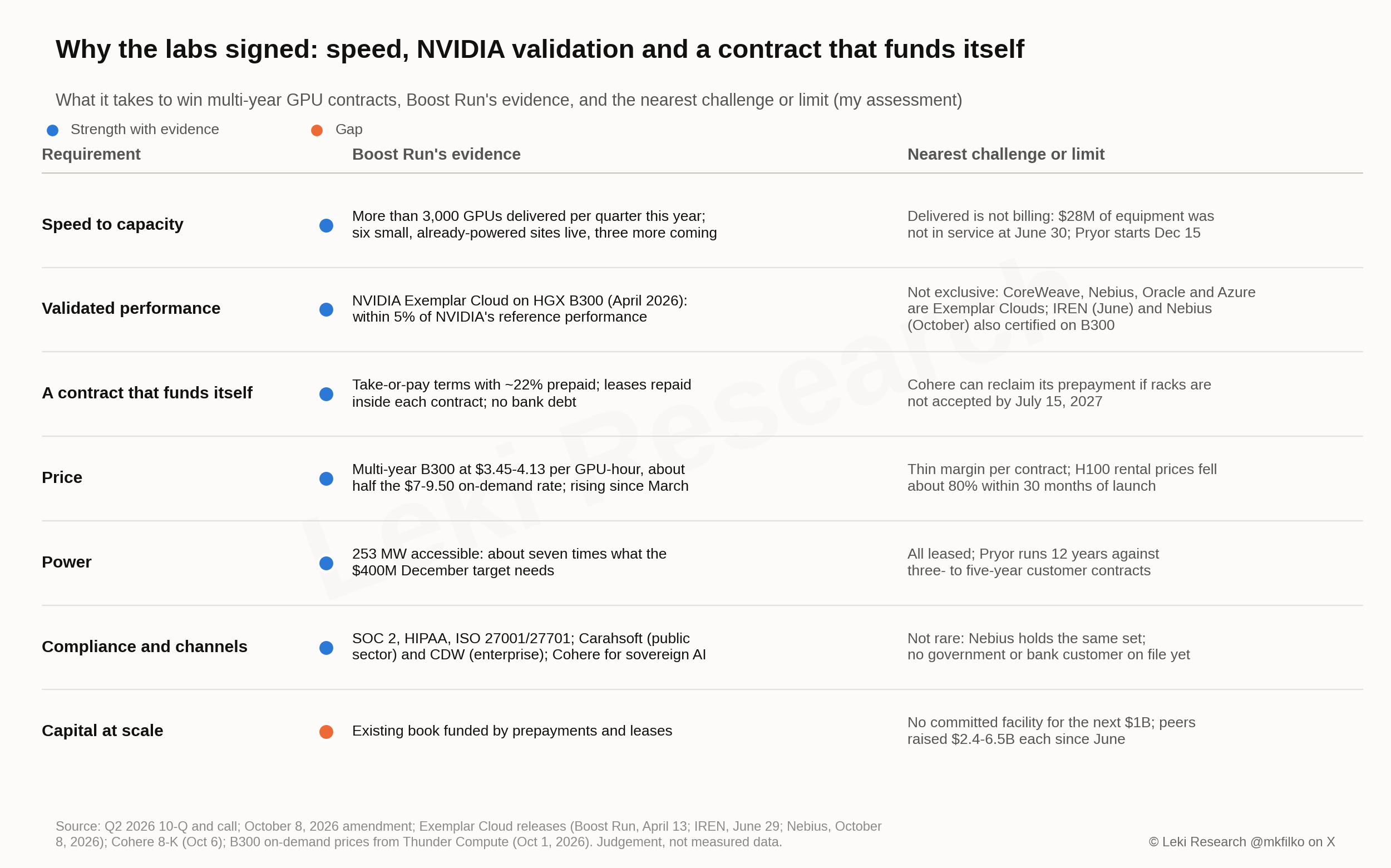
Every strength on that list has a limit beside it. Delivered GPUs are not billing GPUs, and $28 million of equipment was not in service at June 30. Exemplar status is shared with the largest clouds. Cohere can reclaim its prepayment if racks are not accepted by July 15, 2027. The price is half the on-demand rate because the margin per contract is thin, and H100 rental prices fell about 80% within 30 months of launch. All the power is leased, and Pryor's lease runs twelve years against three-to-five-year customer contracts. The certifications are not rare; Nebius holds the same set. None of these is a reason the model fails. Together they are the reason it can be copied.
What could break the position
Five things could break it. The first is the residual. If B300 rental prices follow the H100 curve once Vera Rubin ships in volume in 2027, the hardware earns much less after month 36, and the thin per-contract margin becomes the only margin. The second is the cost of money. The contract economics above assume leases at 6.62%. At 11%, interest rises from about 6% of revenue to about 10%, and the contract-level profit falls from about 20% to about 16%. Financed with equity at today's prices, the growth belongs mostly to new shareholders. The third is counterparty credit. The largest contract is with a lab less than two years old, and four of six filed contracts carry no name. The fourth is the duration mismatch: customer contracts run three to five years, while the colocation leases run five to twelve. The fifth is execution on the newest hardware. GB300 NVL72 racks draw about 132 kW each and need direct liquid cooling, a different build from the air-cooled B300 servers that make up most of the fleet, and the company has not said which site will host Cohere's racks before the July 2027 deadline.
How I treat the technology in the numbers
I score the moat at 6: no proprietary silicon or software of consequence, a real process advantage in speed and validation, and a contract structure others can copy. I give NVIDIA's possible role as a sales channel and as a financier no value in the Base. I use capex of about $2.20 per $1 of new ARR in the Base, Bull and Moonshot and $2.80 in the Bear, where the hardware arrives on schedule but bills late. I let colocation fall from 34% of revenue toward about 17-18% as sites fill, which takes the fleet's adjusted EBITDA margin from 40% toward 64% in the Base by 2028; a running contract earns about 75% at the EBITDA line, so that leaves room for ramp drag and overhead. And I value the business at 4.0 to 6.5 times EBITDA, well below what landlords with matched-duration leases command, because the buildings outlast the contracts and the hardware loses value fast.
4. THE CONTRACT BOOK: FROM $120 MILLION TO MORE THAN $2.6 BILLION IN NINE MONTHS
Contract value went from $120 million at the end of 2025 to $360 million at April 30, $940 million at the May 11 listing, $1.45 billion on June 1, $1.9 billion at June 30 and more than $2.6 billion on October 6. More than $1 billion was signed in Q2 alone. The definition matters. The June deck's appendix says contract value is remaining performance obligations plus executed letters of intent, and that it "additionally includes renewal options and LOI volume not yet a performance obligation". The Q2 materials put firm backlog at about $440 million at June 30. So the headline is a ceiling: what the signed and nearly signed relationships are worth if every option is exercised.
Read carefully, the headline splits into three pieces: $997 million filed and named (Thinking Machines and Cohere), $550 million filed but unnamed (four contracts with full terms on file and no customer name), and $1,053 million not filed at all.
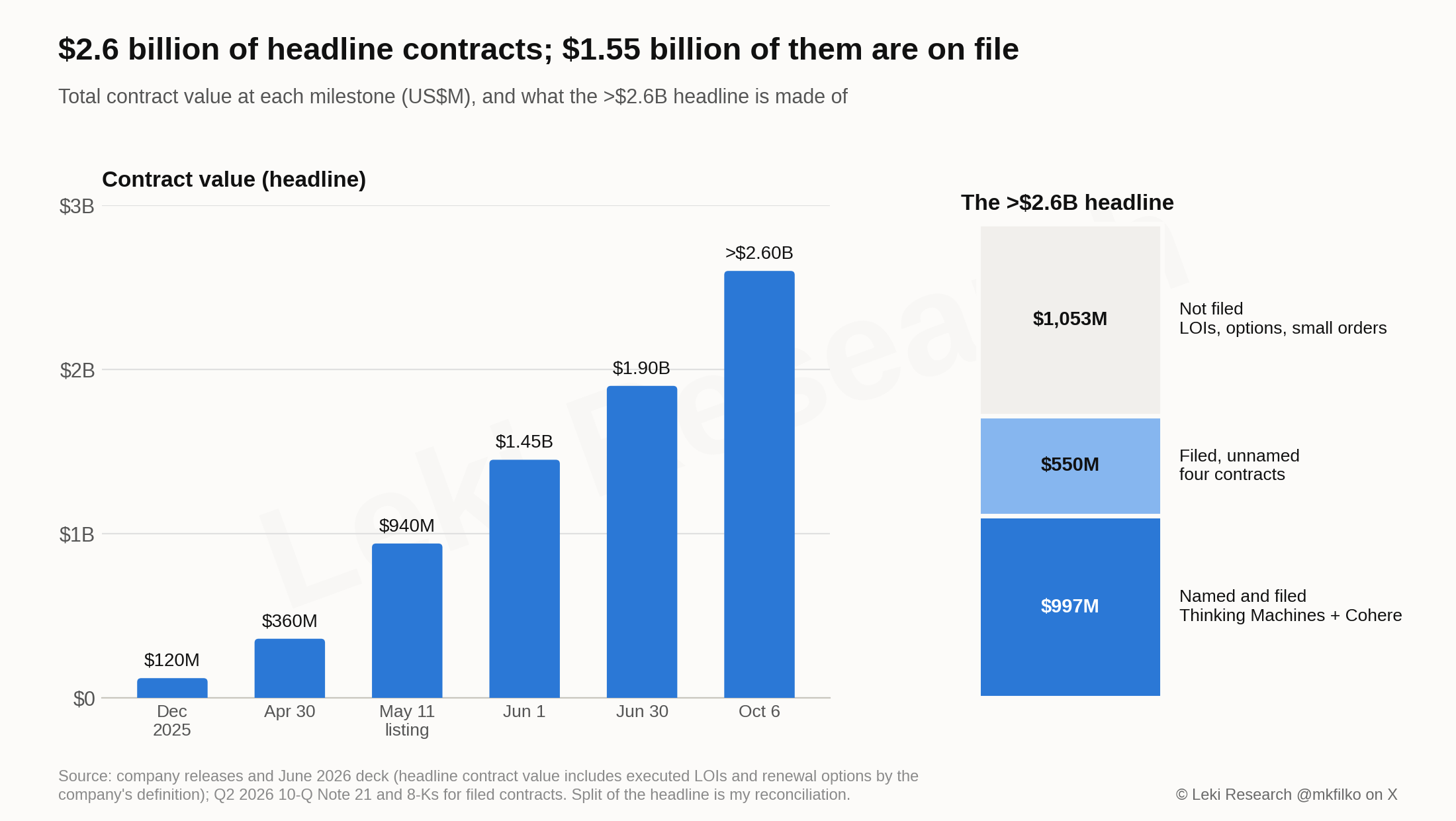
What is filed. Six customer contracts are on file with their terms. Together they total about $1.55 billion, or about $430 million a year at full deployment, three times the June ARR:
| Signed | Customer | Value | Term | Hardware | Prepayment | Implied price | Annual run-rate |
|---|---|---|---|---|---|---|---|
| March 15 | Unnamed (Charlotte) | $116.0M | 36 months | 1,280 B300 | 30% | ~$3.45/GPU-hr | ~$38.7M |
| March 16 | Unnamed (Raleigh) | $3.7M | 12 months | 256 H200 | 100% | ~$1.65/GPU-hr | ~$3.7M |
| May 21 | Thinking Machines Lab | $471.7M | 36 months from May 21 | 5,000 B300 | Not disclosed; no termination for convenience | ~$3.59/GPU-hr | ~$157.2M |
| June 8 (amended June 27) | Unnamed | $207.6M | 36 months from November 30 | 240 servers, 18 CPU nodes, 6.27 PB storage | $19.0M before start + $37.9M at start (~27%) | ~$4.11/GPU-hr | ~$69.2M |
| July 9 | Unnamed | $222.5M | 48 months from March 2027 | 1,536 B300 | 25% non-refundable, in installments | ~$4.13/GPU-hr | ~$55.6M |
| September 30 | Cohere | $525.6M | ~5 years per rack from acceptance (Q2 2027 start) | GB300 NVL72 | Part prepaid; refundable if minimum not accepted by July 15, 2027 | n/a | ~$105.1M |
| Total filed | ~$1,547M | ~$429.5M |
That leaves roughly $1.05 billion of the headline outside a filed contract. Some of it will be orders not material enough to file, some is letters of intent and renewal options, and some is relationships the company has not named. I discount it in every scenario. My Base assumes about 60% of it converts, roughly $190 million of ARR by end-2027, and that new signings during 2027 add about $150 million more.
One relationship has gone the other way. A Fluidstack contract filed at $63.6 million in the January S-4, which a press release at the time described at about $127 million, has not appeared in any filing since the merger, and the company has not explained why. Fluidstack is still on the June customer slide. It is a small amount, but it is the reason I do not take the unfiled balance at face value.
The two named labs. Thinking Machines is the stronger contract and the weaker credit. The master agreement has no termination for convenience, and the fees run for the full term whether or not the GPUs are used. But the counterparty is less than two years old, with annualized revenue reported in the hundreds of millions, and its $157 million a year to Boost Run is a large share of that. It is not exclusive: Thinking Machines signed with Google Cloud in April. Its reported raise of $5 to $6 billion at a pre-money valuation of $40 billion or more, about half of it from NVIDIA, was in talks in early September, and I have not found confirmation that it has closed. If it closes, the largest counterparty risk in the book largely goes away.
Cohere is the better credit and the tighter contract. Its term is about five years per rack, and Boost Run's parent company guarantees its subsidiary's obligation to refund any prepayment not yet applied to fees. But the agreement lets Cohere terminate and recover its prepayment if a specified minimum of infrastructure has not been accepted by July 15, 2027. It can also cancel any racks not accepted by then, and it may terminate "in certain other circumstances" that the 8-K does not describe. That date is now the most important operating deadline in the company.
The deployment calendar the book implies. Thinking Machines started on May 21 and is ramping. Fees begin when Boost Run gives notice that capacity is ready, not when the contract is signed, and its full $157 million run-rate is larger than the whole company's June ARR, so most of it was not live at June 30. The June 8 contract starts November 30, the July 9 contract in March 2027 and Cohere in Q2 2027. The $400 million exit target depends on Thinking Machines being fully billing by December and the June 8 contract starting on time. Most of the 2027 growth is already contracted, and its timing is set by data-center deliveries rather than by sales.
The duration mismatch. This is the structural point in the bear case, and it holds. Customer contracts run 36 to 60 months. GPU leases run 30 to 36. The hardware is depreciated over 48. The software plan runs 60. The colocation leases run longer: Rock Island 60 months with an 80% minimum-usage floor; two leases starting in Q3, seven years each, with $226.8 million of payments between them; and Pryor, Oklahoma, 144 months from December 15, at about $2.36 million a month at full use, escalating 2.5% a year, about $391 million over the term. The company has signed for up to twelve years of space to house hardware rented for three to five. If demand softens before those buildings fill, the rent does not soften with it. Two things narrow the gap: the on-demand book absorbs hardware coming off contract, and each new contract has been longer than the last.
5. POWER AND SITES: MEGAWATTS ARE NOT THE CONSTRAINT
The September 2025 SPAC deck showed 4 MW of contracted power and a plan for "20MW+" in 2026. By June 2, 2026 the company had 33 MW locked and 125 MW under letters of intent, 158 MW in all. On August 14 the company put accessible power at about 253 MW, including a lease with 10X Infrastructure: 20 MW at an already-powered site in Q4 2026, scaling to up to 111 MW across two more sites through 2027. The 253 MW is the company's own figure, not a simple sum; some of the 10X capacity may overlap the June letters of intent, and the company has not said whether Pryor, whose lease was signed on August 13, is the first 10X site. The only megawatt figure in a filing is Rock Island, 6.5 MW total and 4 MW critical from September 1. That ratio, about 1.6 MW of grid power per MW of IT load, is the one I use to convert between the two. The July resale registration still said 16 MW of secure capacity would be added over twelve months; the difference between that and 253 MW is the difference between capacity under lease and capacity the company can call on.
Six sites are live: Seattle, Eagan near Minneapolis, Fort Worth, Richardson, Charlotte and Durham. Rock Island, Illinois, and Marietta, Georgia, come on in the second half of 2026, Pryor, Oklahoma, starts on December 15, and the first 10X site lands in Q4. None of them is owned.
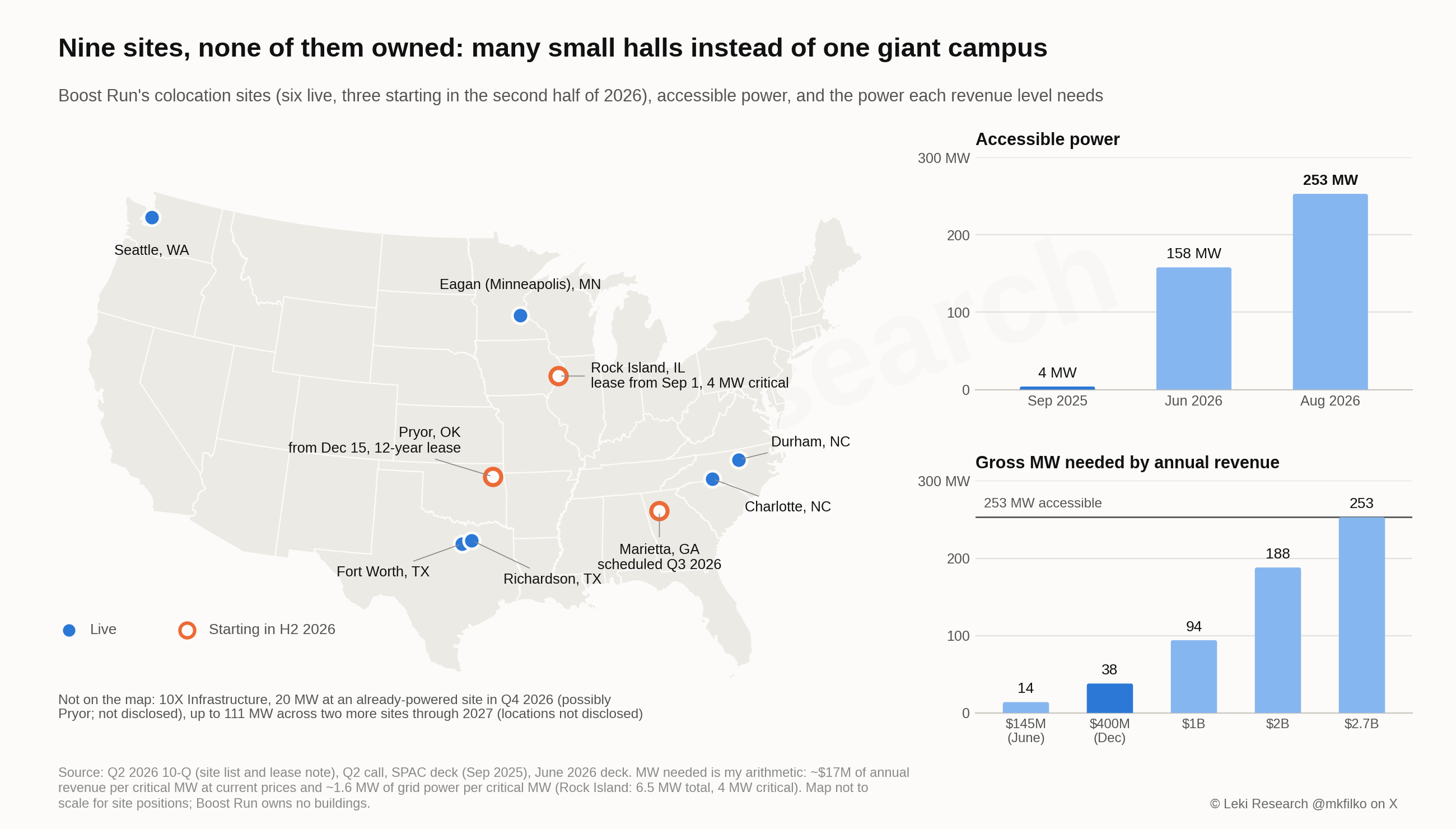
A B300 or GB300 GPU draws about 1.8 to 1.9 kW of IT load with its networking. At $3.60 to $4.10 an hour, each critical megawatt carries about $17 million of ARR. So the $400 million December target needs about 24 MW critical, or about 38 MW of grid power. My Base exit-2027 ARR of $850 million needs about 80 MW, the Bull's $1.2 billion about 113 MW, and even the Moonshot's $2.0 billion about 188 MW, inside the 253 MW already accessible. That power would support about $2.7 billion of annual revenue, almost seven times the December target.
Power in aggregate is not what limits this company. Two things do. The first is power on the date it is needed: Pryor starts December 15, and management describes the 10X rollout as one that "can stem over a multi-month period". The second is money: about $2.20 of capex for every $1 of ARR.
The deployment pace is the bridge between the two. The October 8 amendment says the company has "delivered more than 3,000 GPUs per quarter YTD across multiple architectures", and that it continues "to be in process to deploy significantly higher quantities through the remainder of 2026 and into 2027 in line with our existing backlog". Delivered is not billing. At June 30 the balance sheet carried $28.0 million of owned equipment not in service, up from $8.1 million at December. Against $328.5 million of finance-lease GPU assets in service, that is about 8% of the fleet. If that line falls in the Q3 10-Q, the install queue is clearing. If it rises, the hardware is arriving faster than the sites can take it, and December is at risk.
6. THE BALANCE SHEET AND THE FINANCING QUESTION: THE EXISTING BOOK IS FUNDED, THE NEXT BILLION IS NOT
How a project is funded today. Each contract carries a prepayment of about 22% of contract value, which at 1.4 times contract value to capex covers about 31% of the hardware. The rest has come from 30-36 month finance leases. The company signed 34 of them in the first half, with $296 million of payments, discounted at 6.62%. The leases are paid off before the customer contract ends. This structure is what the $1.44 billion Dell agreement, which management calls "essentially fully committed and allocated", has been built on, and it is why the balance sheet has no bank debt.
Liquidity against what is already signed. At June 30 Boost Run had $120.2 million of cash, and about $85 million more arrived after quarter end as warrant holders exercised, so pro forma liquidity is about $209 million. Against it sit $238.1 million of GPU finance leases, $76.3 million for the software plan, $128.4 million of customer deposits, which it owes back as service, $119.5 million of colocation leases already running, and signed leases not yet started: the two seven-year leases at $226.8 million and Pryor at about $391 million. The next twelve months of fixed payments come to about $202 million: $97.2 million of finance-lease payments, $27.8 million of operating-lease payments, $32.4 million on the two seven-year leases, $22.2 million for the first year at Rock Island and Pryor, and $22.2 million for the first software installment, due this month, and insurance financing.
Shawarma's second piece runs cash to zero around April or May 2027 on a no-growth case. That conclusion leaves out two things. About $93.5 million of contracted prepayments is still to arrive: $37.9 million at the June 8 contract's November 30 start and $55.6 million from the July 9 order in installments. And the lease payments in that bill belong to hardware already rented under signed, prepaid contracts. Against $202 million of payments sit about $303 million of liquidity and contracted prepayments. On my numbers, the book that exists today pays for itself.
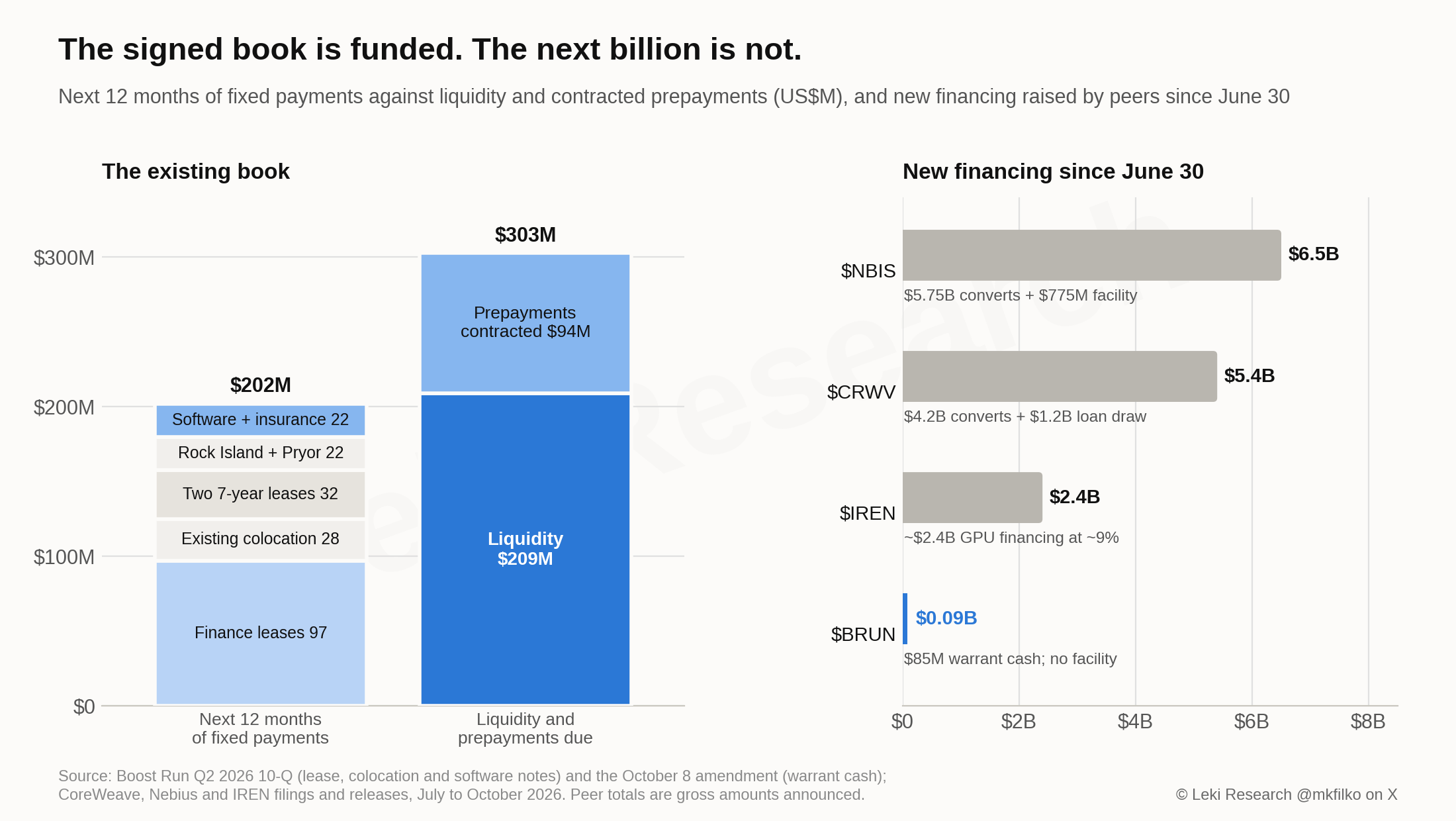
What is not funded. The 2026 capex guide is $1.0 to $1.2 billion, and $4 to $5 billion more is "in process" with several manufacturers. Against that the company has no committed credit facility, no revolver or delayed-draw loan, no S-3 shelf and so no at-the-market program, and no lessor named in a filing. The only financing partner ever named is Dell Financial Services, in one sentence of an April press release. On August 14 the CFO said: "We continue to innovate on financing structures beyond the equipment financing approach used to date and expect to provide additional color and progress on this over the next quarter." That quarter ends around the Q3 print.
The contrast with the larger neoclouds is stark. Since June 30 Nebius has raised about $6.5 billion through $5.75 billion of convertibles and a $775 million facility, CoreWeave about $5.4 billion through $4.2 billion of convertibles and a $1.2 billion loan draw, and IREN about $2.4 billion of GPU financing at about 9%. Boost Run has collected $85 million of warrant cash.
What the money will cost. That answer decides the equity. Shawarma's second piece treated the 13-14% rate implied by the software obligation as "what Dell thinks of Boost Run's credit". I do not accept that reading. The rate is the company's own estimate of its unsecured borrowing cost under ASC 835-30, not a price the vendor charged; GPU financing is secured on the hardware, and the actual leases cost 6.62%. But the point behind it stands. Every large GPU financing of 2026 was priced off a named, investment-grade end customer: CoreWeave borrowed against Microsoft and OpenAI contracts, and Lambda's facility was rated Baa2 because of who sat on the other side. Boost Run's book has two named labs, neither investment grade, and four unnamed contracts. The 30-year Treasury touched 5.7% on October 8, and on October 14 CoreWeave's 2031 notes briefly yielded more than 15%, and more than 16% the next day. The credit market that has to fund the next billion turned against GPU landlords this week.
My Base assumes new equipment debt at 9%, close to what IREN just paid, and about $160 million of extra funding by end-2027 beyond the equipment leases. My Bear assumes 11% leases and about $265 million of new equity at $5 a share, about 56 million new shares. That one assumption is most of the difference between a $20 Base and a $5 Bear.
The Dell commitment runs the other way. The $1.44 billion agreement is Boost Run's obligation to buy, not Dell's obligation to lend. The year-1 minimum of $578 million was exceeded by June. From April 2027 the company owes $215.5 million of qualifying purchases a year, or a shortfall payment. In a growth case that is a formality. In a stall it is a fixed cost the company cannot cut.
7. GROWTH DRIVERS
1. Converting the signed book: about $430 million a year from six filed contracts
The six filed contracts carry about $429.5 million of annual run-rate at full deployment, three times the June ARR, before the on-demand and reseller base and before any of the unfiled $1.05 billion. Most of it starts on known dates: Thinking Machines is ramping now, the June 8 order starts November 30, the July 9 order in March 2027 and Cohere in Q2 2027. This is the most visible growth any small-cap neocloud has, and it is why my Base needs none of the $4 to $5 billion procurement to reach about $850 million of ARR by end-2027. The evidence against is timing. Q2 revenue missed consensus by about 9% on deployment timing, the company has never disclosed how much of any contract is live, and Cohere's July 15, 2027 deadline puts a date on the risk.
2. ARR from $145 million to about $400 million by December
The exit target has been raised and then held. The SPAC deck path had $275 million. It became "$375M+" at the May listing, "$400M+" in the June deck and "approximately $400 million" on the Q2 call. The October 8 revenue projection of $170 to $180 million is consistent with that path: a straight ramp from $145 million to $400 million gives about $52 million in Q3 and $84 million in Q4, about $178 million for the year. My own bridge from the filed book is lower. Start from $145 million, add Thinking Machines fully live and the June 8 contract from November 30, and the exit run-rate comes to about $330 to $370 million, depending on how much of Thinking Machines was already billing in June; on-demand and smaller orders fill the rest. My Base exit is $380 million, close enough to keep the 2027 numbers intact and short enough that landing on $400 million would beat my numbers modestly.
3. The $4 to $5 billion procurement
Management is negotiating $4 to $5 billion of additional hardware with several manufacturers, sized against "active discussions with some of the largest GPU consumers in the world, with requirements ranging from 10,000-50,000 GPUs". A single 50,000-GPU customer would be larger than the whole current fleet. Nothing is signed, and the company has so far announced contracts only when they are contracts, as the Cohere 8-K shows. But the arithmetic shows why the procurement dominates the upside, and why the financing dominates the procurement.
Start with what is already locked in for end-2027: the $400 million December target plus the $55.6 million a year July order, about $460 million. Then add the procurement at the company's ratio of about 1.4 times contract value to hardware. On three-year terms, the average so far, $4 to $5 billion of hardware adds $1.9 to $2.3 billion a year, for an end-2027 run-rate of $2.3 to $2.8 billion, capped at about $2.7 billion by the 253 MW already accessible. On five-year terms like Cohere's, the same hardware adds $1.1 to $1.4 billion a year, for $1.6 to $1.9 billion.
Nobody builds $5 billion of GPUs for free, so add the bill. If prepayments cover about 31% and the other 69% is lease debt, that is $2.8 to $3.5 billion of new debt, plus about $0.5 billion for the rest of the 2026 plan. On today's lease-inclusive enterprise value of $1.07 billion, the funded enterprise value becomes $4.3 to $5.0 billion. That is about 1.9 times the end-2027 run-rate on the company's three-year math and about 2.7 times on five-year terms, or about 4.7 and 6.9 times EBITDA at Q2's 39.5% margin. Those are the multiples the market would need to pay at the end of 2027 just for the stock to hold $10.08, and both are below the 3.5 to 4.4 times that IREN and CoreWeave trade on today for their 2026 targets. The figures lean conservative: they count no lease paydown and no cash from operations during 2027, and the peers are not charged for the debt their own targets need.
Run it the other way and the leverage shows in both directions. At IREN's 3.5 times, after subtracting all the new debt and counting the RSUs, the end-2027 arithmetic comes to roughly $23 to $26 a share on five-year terms and $53 to $60 on the company's three-year math. At 2 times, the three-year case is worth about $13 to $14 a share and the five-year case close to nothing. With 69% of the hardware funded by debt, the equity is a thin slice on top of a large fleet. None of it happens unless the procurement is contracted, financed as debt and switched on inside fifteen months. That is why my Moonshot carries it at about $2.0 billion of exit-2027 ARR, cut back for timing, at a 15% probability.
4. Pricing that has held on Blackwell
Boost Run's contracted B300 prices of $3.45 to $4.13 per GPU-hour are about half the $7.10 to $9.50 listed on-demand at Modal, RunPod and Nebius on October 1. The discount is what a customer receives for underwriting the hardware's life with a prepayment. The more useful fact is that pricing on new contracts has risen with each signing, from $3.45 in March to $4.13 in July. Elsewhere the market is also firm: CoreWeave said in September that it was signing short-dated contracts at about $40 million per megawatt, Nebius reportedly raised H100 pricing 17% from October 1, and IREN reported more than $20 million per megawatt on three-year contracts. The evidence against is history. H100 rental prices fell about 80% within 30 months of launch, and Vera Rubin arrives in volume in 2027.
5. On-demand as a margin lever
More than 12% of revenue comes from short-term, on-demand rentals through the platform, at roughly twice the multi-year price per megawatt. Lenders do not finance uncontracted capacity, so only an operator that funded itself from the start can keep inventory on that shelf. This is also how the residual risk gets managed in practice: hardware coming off a 36-month contract can be re-rented on demand rather than sold. If on-demand holds at 10-15% of a much larger fleet, it is worth several points of margin.
6. Regulated and sovereign demand
The company holds SOC 2 Type I and II, HIPAA, ISO 27001 and ISO 27701. It sells to the public sector through Carahsoft and to enterprises through CDW, whose CEO named Boost Run on CDW's Q1 call. Cohere is the first contract on file that matches the compliance story the company has told since its SPAC deck. The evidence against: these certifications are not rare, and the named book is still AI-native, with no bank, hospital or government on file.
7. NVIDIA's programs
On the Q2 call the CEO referred three times to NVIDIA's AI Cloud Partner program and to its ecosystem financing effort ("at the appropriate time, we can get into more details"). NVIDIA has written rent-back backstops for CoreWeave, Lambda, Firmus and Sharon AI, and an arrangement like that would turn the funding question from "can they?" into "how much?". The evidence against is current: NVIDIA's compute partnership program was reported paused in August after partner pushback, which NVIDIA denied, and on October 5 it was reported to be under fundamental redesign. I give it no value in the Base, and only part of the Bull depends on it.
8. LEADERSHIP ANALYSIS
Key executives
Andrew Karos, founder, CEO and Chairman. Karos founded and ran Blue Fire Capital, an algorithmic trading firm that ran on its own infrastructure across thirteen data centers in six countries, on more than $500 million of credit facilities. Galaxy Digital bought it in 2020, and he ran electronic trading at Galaxy and sat on its executive committee until 2023. He comes from mathematics and derivatives. On the Q2 call he worked through the prepayment-to-capex arithmetic live and described NVIDIA's certification protocol unprompted. He draws a $1 salary under an employment agreement signed at closing and has sold no stock. His pay was 7.875 million earnout shares that vested when the share price cleared $12.50, $15.00 and $17.50, all within one quarter. He holds all 29.53 million Class B shares plus the earnout shares: about 48% of the shares outstanding and about 87% of the votes. The Shawarma series raises regulatory matters at Blue Fire between 2011 and 2017 on FINRA BrokerCheck, several about supervisory controls. I note them as history at a prior firm, not as findings against him, and I have not been able to verify the full detail.
Harry Georgakopoulos, COO since April 2024. A former Managing Director at Galaxy Digital and Karos' co-builder at Blue Fire, he is the author of Quantitative Trading with R and holds an MS in Financial Mathematics from the University of Chicago. Same bench, second company.
Erik Guckel, CFO. He holds a PhD in Chemical Engineering from Illinois and a Chicago MBA, has closed more than $2 billion of corporate transactions, managed a $3 billion debt portfolio and financed a first-of-a-kind facility build. He owns the financing promise.
Daniel Gormley-Rahn, CTO, runs the GPU deployments and network architecture, and Karim Ali, CIO, built low-latency trading networks on four continents and led a FedRAMP certification at a SaaS security company. The Shawarma series notes, from public profiles, that the team below these five is small and light on hyperscale data-center experience. That is fair as a direction, though much of the installation work likely sits with Dell and the colocation providers.
Insider ownership
Insiders own about 63% of the shares, almost all of it Karos. Director Sean Goodrich exercised 1.10 million warrants at $11.50 on August 19, then sold 198,200 shares at $20.15 on August 27 and 500,000 at $14.00 on September 14, below that day's trading range, which suggests a negotiated block. In all he sold about 698,000 shares for about $11 million, and he still holds about 4.44 million. No officer or director has bought in the open market. On September 29 the compensation committee granted time-vested RSUs: 2.89 million to the CFO, worth $48.1 million at the $16.65 close, 1.40 million to the CTO ($23.3 million) and 300,000 to the COO ($5.0 million), vesting from May 2027 to September 2029, plus a one-time $1 million cash award to the COO. The grants restore multi-year alignment for the team below Karos, whose earnout alignment ended when the hurdles cleared. But a $48 million grant to a CFO at a company then worth $1.4 billion is large, and it was made while the financing he promised was still missing. The grants add about 5.5% to the share count and about $25 million a year of stock compensation through 2029.
Guidance track record
| Item | Commitment | Outcome | Call |
|---|---|---|---|
| FY2025 revenue (SPAC deck, Sept 2025; repeated in the January 2026 S-4) | $31.5M | $26.9M | Miss, ~15%, on a year that had already ended when it was printed |
| Q4 2025 ARR (SPAC deck path) | ~$46M | $30M | Miss |
| Q2 2026 ARR (SPAC deck path) | ~$143M | $145M | Hit |
| 2026 exit ARR | ~$275M (deck path) → "$375M+" (May) → "$400M+" (June) → "~$400M" (August) | Pending | Raised, then held |
| 2026 revenue | $170-190M (SPAC deck) → ~$170-180M (October 8 filing) | Consensus $175M | Top of the range trimmed by $10M |
| 2026 capex | $400M (SPAC deck) → $1.1-1.2B (June) → $1.0-1.4B (August) → $1.0-1.2B (October) | Pending | Scaled with the book |
| Contract value | $940M (May listing) | $1.9B (June 30), >$2.6B (October 6) | Beat |
| Q2 2026 vs sell-side | ~$34M revenue, ~$22M adjusted EBITDA | $31.1M, $12.3M | Miss on the quarter |
| Financing structure | "additional color and progress... over the next quarter" (August 14) | Pending | Due at Q3 |
This is not a reset-the-bar pattern yet. The forward metrics, ARR and contract value, were raised and then held. The one dated projection that has fully aged, FY2025 revenue, missed by 15%, and the 2026 revenue range has quietly lost its top $10 million. If the Q3 call trims the exit ARR target or moves it into 2027, that would be a reset, and the cap would apply on its own terms.
Capability for the next bound
Today the company runs $31 million a quarter on equipment leases. The next step is to finance and deploy $1 to $5 billion of hardware through project debt, prepayments and possibly NVIDIA-linked structures, while it fixes its controls and reports as a public company for the first time. Karos and Georgakopoulos have built and sold one compute-heavy business on substantial credit lines, and Guckel has run a $3 billion debt book. None of them has run a public company or a multi-billion-dollar project-finance program. Credentials and skin in the game, unproven at this scale: the framework floor is 7 before governance.
Red flags
The framework caps Leadership at 6 for governance flags, and this company has several. There are related-party arrangements: a CEO loan repaid at closing, an $8.5 million installment note to the CEO at closing, 336,000 price-vested consulting shares to director B. Luke Weil, the SPAC's chairman, that vested inside the first quarter, and earnout shares to entities controlled by two directors, including 1.97 million to the vehicle of Sean Goodrich, the only insider seller. It is a controlled company with a dual-class structure, it uses the Nasdaq exemptions from board-independence requirements, and the CEO chairs his own compensation committee. It has three unremediated material weaknesses, covering IT general controls, segregation of duties and insufficient qualified accounting staff, with disclosure controls concluded "not effective"; both quarterly filings this year needed late-filing notices, and the Q1 10-Q was amended to change its controls conclusion. And there are the September grants.
On the other side there are real positives: no redemptions, no PIPE and no discounted share class at the listing; warrants retired into about $130 million of cash rather than left as a five-year overhang; a $1 founder salary and no founder sales; and a management team that talks about the business in FP4 validation runs and capex ratios. There has been no restatement of results, so the 1-3 floor does not apply. Score: 6/10, the governance cap rather than a judgment on competence.
9. FORWARD OUTLOOK: TAILWINDS, GUIDANCE AND THE Q3 PRINT
Structural tailwinds
The first tailwind, and the one the company captures directly, is that compute is still short at the leading edge. B300 on-demand capacity lists at $7.10 to $9.50 an hour because most of it is committed to long contracts, CoreWeave signed short-dated contracts at about $40 million per megawatt in Q3, and Nebius reportedly raised H100 prices from October 1. Boost Run sells into that gap at deployment sizes of 1,000 to 50,000 GPUs, which the hyperscalers do not prioritize.
The second, partly captured, is the move from training to inference and into sovereign and regulated workloads. Management says inference demand "is currently heaviest, and we see no ceiling on it". Cohere is the first named sovereign-AI customer, and the compliance stack is built for this market, but the enterprise and government revenue it targets is still mostly prospective.
The third is NVIDIA financing its channel through rent-back backstops, the AI Cloud Partner program and investments in labs such as Thinking Machines. That is adjacent, not captured, and the program that matters most is being redesigned.
The fourth is a headwind I count against the other three: the cost of capital and the credit market's view of GPU landlords. Long Treasury yields are at multi-decade highs, and markets expect a Fed hike on December 9. Expectations for AI lab revenue have been reset, with an October report putting OpenAI's September annualized revenue near $50 billion against $70 billion previously cited. Then on October 14 CoreWeave's 2031 notes briefly yielded more than 15%, and more than 16% the next day, while Gartner's forecasts that more than 80% of neoclouds will not survive independently much beyond 2030, and that AI capital write-downs could exceed $4 trillion by 2032, went around the market. A company that funds GPUs with leases, and whose largest customer depends on venture funding, sits at the sensitive end of that trade.
Most recent guidance
On the Q2 call on August 14 management said: "We currently expect to exit fiscal 2026 with approximately $400 million of annualized reoccurring revenue", reaffirmed in closing; "We expect to continue deploying capacity through fiscal year and into Q1 2027, bringing the full $1.9 billion of TCV live in production"; "We are expecting to hand over four projects by year-end"; "We currently expect to achieve a sustainable net cash flow margin of 15%-20% moving forward"; and "We are in the process of a strategic procurement of an additional $4 billion-$5 billion of compute hardware with multiple OEMs". On the 10X site: "already powered, and we plan to bring this into production in end of Q4". On financing, the line quoted in Section 6.
The October 8 prospectus amendment added: "Based on projected 2026 revenues of approximately $170-180 million, total operating costs are estimated to range from approximately $102-108 million", and the planned 2026 deployment requires "total gross capital investment in the range of approximately $1.0 to $1.2 billion". On the Cohere contract, Karos called it "an important step in efficiently deploying our financing into contracted revenue".
Management did not guide to quarterly revenue, anything for 2027, GAAP profitability, the terms, size or counterparties of any new financing, the share of Thinking Machines that is live, 2026 customer concentration, the Cohere prepayment amount or the identity of the lessors.
Gap analysis
The valuation asks for much less than the guidance. At $10.08 and my Base multiple of 4.5 times 2028 EBITDA, the price needs about $440 million of 2028 EBITDA, about $690 million of 2028 revenue. The 2027 consensus of $551 million implies an exit-2027 ARR around $720 million, and my Base, which takes the filed book, about 60% of the unfiled contract value and modest new signings, gets to about $850 million and $1.0 billion of 2028 revenue. Applying the Leadership discount, the 15% miss on the one aged forecast takes the $400 million exit target to about $340 million. Even on that number the 2027 revenue path stays near consensus, because most of the 2027 growth comes from contracts that start in 2027. The gap between price and guidance is a judgment about financing and dilution, not about demand, and that is where I put the probability weight.
Q3 2026: what the print has to show
Q3 has not been scheduled. Q2 was reported on August 14, with the 10-Q filed on August 18 after a late-filing notice, so I expect results in the second or third week of November. The CFO set the Q3 report as the point by which the financing color would come. Coverage is thin and quarterly estimates are few. BTIG's August model has $56.0 million of Q3 revenue and $81.2 million in Q4. The FY2026 consensus of $175 million implies about $133 million for the second half, and the company's own projection implies $128 to $138 million. The single Q3 EPS estimate is a loss of $0.22.
| Q3 2026 | BTIG (August) | Implied by FY consensus / company range | My Base | On track | Ramp slipping |
|---|---|---|---|---|---|
| Revenue | $56.0M | ~$48-53M | ~$49M | ≥ $45M | < $40M |
| ARR at September 30 | n/a | ~$250-270M (a straight line to $400M passes $272M) | ~$245M | ≥ $250M | < $220M |
| Adjusted EBITDA (company definition, after colocation) | $40.8M (~73% margin, modelled before Q2) | n/a | ~$20M (~42%) | ≥ 38% margin | < 30% margin |
| Lease-adjusted EBITDA (before colocation) | n/a | n/a | ~$38M | ||
| EPS | n/a | −$0.22 (one estimate) | −$0.15 to −$0.25 | ||
| Q4 revenue implied | $81.2M | ~$80-85M | ~$78M | ||
| Exit-2026 ARR language | ~$400M | "approximately $400M" or "$375M+" | Reaffirmed | Moved into 2027 |
Revenue of about $49 million assumes ARR passes about $245 million at September 30, with Thinking Machines largely billing and Rock Island and Marietta coming on late in the quarter. Colocation rises to about $17-19 million as the two seven-year leases and Rock Island start during the quarter, cash overhead rises to about $7.5 million, and cost of revenue stays near 5.5%. That gives about $20 million of adjusted EBITDA, a margin of about 42%. I expect the margin to stay in the low 40s until the new sites fill, because rent on them starts before revenue does. My Base sits just under the $250 million ARR line, so a print on my numbers would read as roughly on track rather than a clean beat.
The EBITDA line is where a "miss" headline is most likely. BTIG's $40.8 million was set before Q2 showed colocation running at a third of revenue, and it implies a 73% margin. Q2 went the same way: consensus was about $22 million and the company reported $12.3 million. The lease-adjusted figure, which adds colocation back, lands near $38 million, and that is the number management will lead with. If the Street has not updated its models, Q3 will read as an EBITDA miss on revenue that is in line, and I would not treat that as news. Below EBITDA, D&A rises to about $27-30 million and interest to about $7-8 million. Stock compensation depends on how much of Q2's $7.1 million was one-off vesting, and the September grants add at least about $6 million a quarter from Q4, so the operating loss should be about $10-16 million.
A Q3 at about $49 million with an unchanged target and no financing news is roughly neutral on my numbers. The financing announcement, at the print or before it, matters more than the quarter itself, and the large moves in either direction will come from it.
What I am watching on the Q3 call
- Q3 revenue and the September 30 ARR against the lines above, and the exit-target language: a straight reaffirmation of about $400 million keeps the 2027 numbers intact, "$375M+" is fine on my numbers, and a move into 2027 would be a reset.
- The financing: a named lender or lessor, a facility size and a rate. A secured facility under 10% would remove the largest discount in the stock; an S-3 shelf or an equity raise near today's price would confirm the Bear's funding path.
- The cash and disclosure lines: liquidity at September 30, capex and new finance leases, whether equipment not in service fell from $28.0 million, the share of Thinking Machines that is live, a concentration note, whether the October software installment was paid on time, and an on-time 10-Q, which would be the first evidence the controls are being fixed.
10. BULL CASE
The book converts on schedule and the market has to reprice what it is looking at. Thinking Machines is fully billing by December and the June 8 contract starts on November 30. The exit-2026 ARR lands near $400 million and is reported in March as a number, not a target. Through 2027 the July 9 order and Cohere come on in the order and on the dates already filed, and Cohere's acceptance clears well before July 15.
The financing the CFO promised arrives as secured project or equipment debt in the high single digits, perhaps alongside an NVIDIA-linked structure once that program is rebuilt. The first $1 billion or so of the $4 to $5 billion procurement is then contracted against a named lab or an investment-grade counterparty, with the usual 20%-plus prepayment. That takes exit-2027 ARR to about $1.2 billion. The margins follow: colocation falls from a third of revenue toward 17-18% as the sites fill, cash overhead falls below 6%, and adjusted EBITDA moves from 40% toward the mid-60s. On 5.5 times 2028 EBITDA of about $977 million, less about $1.6 billion of fleet debt, the stock is worth about $42. That is where Odeon's $40 and the $45 targets from BTIG, D.A. Davidson and Craig-Hallum already sit.
The Moonshot is most of the procurement, cut back for timing. About $4.3 billion of hardware, including the rest of the 2026 plan, is financed and energized by end-2027, taking exit-2027 ARR to about $2.0 billion, the top of Odeon's $1.5 to $2 billion upside scenario and inside the 253 MW already accessible. On 6.5 times 2028 EBITDA of about $1.66 billion, less about $2.9 billion of debt, it is about $87. That requires everything to land in fifteen months. I give it 15% because this team has grown its contract book and its power faster than it first guided, from $940 million of contracts at listing to more than $2.6 billion and from a 20 MW plan to 253 MW, but it is the scenario most exposed to the financing.
The structural argument underneath both is about megawatts and multiples. At about $4.2 million of enterprise value per accessible megawatt, a B300 and GB300 cloud with Exemplar status is priced roughly where the market prices bitcoin miners, whose megawatts earn $1-2 million a year; Boost Run's new capacity earns about $10-11 million a year per megawatt of grid power, or about $17 million per megawatt of IT load. And at 2.7 times its December target, it trades at a discount of about 40% to CoreWeave and a quarter to IREN on the same measure, and less than half of Nebius. Either the power is not real, the contracts are not real, or the multiple is wrong. The power is leased and partly energized. The contracts are filed, with about $128 million of cash deposits and a frontier lab's no-termination clause behind them. My view is that the multiple is the variable, and the financing is what moves it.
Bull value: $42. Moonshot: $87.
11. BEAR CASE
The bear is not fraud, and on the current book it is not a going-concern case either. It is a slower version of the neocloud cycle, playing out on a company with less capital than its peers and a share count that can be issued without anyone else's vote.
Leg one: the ramp slips. Q2 missed revenue consensus by about 9% on timing, and the first evidence of the Q3 ramp is weeks away. If the September 30 ARR comes in around $200 million and the exit target moves into 2027, the company will have changed its headline metric twice in two quarters, in a sector that has stopped paying for promises. The physical calendar is tight: Pryor starts on December 15, the 10X site "can stem over a multi-month period", and the company was advertising almost no deployment roles at the end of August. Shawarma's second piece argues the $400 million is not reachable by December 31 at all. On my bridge it is reachable only with Thinking Machines fully live.
Leg two: the financing arrives as equity. The current leases cost 6.62%, but they were written against a smaller book, in a lower-rate world, before NVIDIA's backstop program was pulled for redesign and before CoreWeave's bonds yielded more than 15%. Lenders price GPU debt off the end customer. If the next $1 billion has to be financed against two private labs and four unnamed counterparties at 11% or more, the economics of each contract go from thin to marginal. If it is financed with equity at these prices, the share count does the work, and the founder controls 87% of the vote and needs no one's approval. My Bear assumes about $265 million raised at $5, about 56 million new shares, two-thirds more stock.
Leg three: counterparty concentration. The largest contract is with a lab less than two years old whose next round has not been confirmed. The second-largest gives the customer a refund right if the hardware is not accepted on time. Four of the six filed contracts carry no name. The 2025 revenue base was three GPU resellers that can leave on 90 days' notice. A single counterparty that stops paying beyond its prepayment would leave a hole in a $145 million ARR base.
Leg four: the duration mismatch and the residual. Contracts run three to five years and the buildings five to twelve. The equity's return depends on what the hardware earns after month 36, and the price of last-generation accelerators has historically fallen fast once the successor ships. Vera Rubin ships in volume in 2027, hyperscaler and lab self-build adds supply, and the H100 curve fell about 80% in 30 months. Gartner's warning this week is the same argument at sector scale.
Leg five: disclosure and controls. Three unremediated material weaknesses, late filings for both quarters and an amended 10-Q. The outcome of the warrant redemption was announced only by press release, not in an 8-K. The August deck was filed as images. And a $48 million CFO grant was made while the financing remained unannounced. None of these is a scandal. Together they describe a disclosure practice a quarter or two behind the company's ambitions, which is the kind of company where the next surprise is more likely to be negative.
Leg six: the tape. The stock is a high-beta neocloud. It fell 13.2% on October 5, the day the RSU grants were filed, 10.5% on October 12 with no company news, and 15.9% on October 14 on CoreWeave's bonds. It has moved 8% or more in a day nine times since September 1, six of them in October. Insiders have sold and not bought, short interest is about 17% of a 29 million-share float, and the September RSUs start vesting in May 2027.
Bounded? Yes, though not comfortably. There is no bank debt and no covenant to trip. The GPU leases are secured on hardware rented under take-or-pay contracts and are paid off inside them. Every contract is prepaid. The existing book is funded, with about $209 million of liquidity and about $93.5 million of contracted prepayments still to arrive, and the 10-Q states liquidity is sufficient for at least twelve months. What it does not bound is dilution. My Bear of $5.40, 46% below today, values 2028 EBITDA of $336 million at 4.0 times, deducts about $555 million of debt and counts about 147 million shares after the raise. The precedents are the stock itself (−74% from its June closing high), WhiteFiber (−61% from June to September) and Applied Digital (about −80% in 2022-23). Below $5 there is a tail: a counterparty default, a failed financing and a raise at the lows all at once. It exists, and it is why the Bear still carries 20%. The take-or-pay book makes a zero unlikely.
12. SCORING
| Dimension | Score |
|---|---|
| Revenue Quality (RQ) | 6.5 |
| Revenue Growth (RG) | 9 |
| Moat / IP (M) | 6 |
| Leadership (L) | 6 |
| Asymmetry (A) | 9 |
| Conviction Gap (CG) | 7.5 |
| Composite | 7.33 (44 / 6) |
Revenue Quality: 6.5. The revenue is real: GAAP lease income growing 270%, behind which sit about $1.55 billion of filed take-or-pay contracts with prepayments, about $1.0 billion of it with two named labs, and $128 million of cash deposits. Cohere raises the named share of the filed book to about 64% and lengthens its tenor. Against it, the 2025 base was 76% three resellers on 90-day terms, there is no 2026 concentration figure even though Thinking Machines alone may be close to half of 2026 revenue, the headline contract value includes LOIs and options, Cohere's prepayment is refundable if acceptance slips past July 15, 2027, and the "net cash flow margin" is a target the cash flow statement has not yet shown. The score is descriptive, not predictive.
Revenue Growth: 9. This is the "multi-year structural growth with confirmed customer commitments" bracket by definition. About $430 million a year of filed run-rate starts on known dates over the next nine months, against $145 million of June ARR. A guided exit of about $400 million and 2027 consensus about 3.1 times 2026 are both supported by contracts rather than pipeline, and the $4 to $5 billion procurement is upside on top. It is not a 10 because the Q2 timing miss and the Cohere deadline show where the risk sits.
Moat / IP: 6. The base is 5. There is no proprietary silicon or software of consequence, and the durable advantages are process and capital structure: NVIDIA reference-architecture templating and Exemplar validation, a prepayment on every deal, self-funded on-demand inventory and speed at smaller sites. I count the validator brackets strictly. "Three or more strategic partners with capital at risk" does not fire: Dell has a purchase agreement, not equity at risk, NVIDIA and Lenovo are vendors and CDW is a channel. "Two or more sovereign or hyperscale customers" does not fire: Cohere sells sovereign AI but is not a sovereign, and Thinking Machines is a lab. "Five or more recurring named deployments" fires, +0.5. "Reference design alignment with a platform leader" fires, +0.5, for Exemplar status and architecture review board approval. That gives 6. A named hyperscale or government customer would move it to 7.
Leadership: 6. The floor is 7 for credentialed, unproven founders with skin in the game. The governance cap brings it to 6, for the related-party arrangements, the controlled dual-class structure, the CEO chairing his own compensation committee, three material weaknesses with late filings, and the September grants. It is not a reset-the-bar pattern yet; moving the exit target into 2027 on the Q3 call would change that.
Asymmetry: 9. The probability-weighted value is $34.98 against $10.08, so EV/spot is 3.47x (Section 13), above the 2.5x threshold for 9-10. I score it 9 rather than 10 because half the probability sits in the Bull and Moonshot, both of which depend on a financing that has not been announced, and a more cautious split brings the ratio back to 2.40x. The sensitivities show how robust it is:
| Change | EV/spot |
|---|---|
| Published case | 3.47x |
| A more cautious split (35/38/20/7) | 2.40x |
| Bear and Base at 60% (25/35/30/10) | 2.96x |
| No Moonshot, its weight moved to the Base (20/45/35/0) | 2.48x |
| Bear value $3 (a deeper tail) | 3.42x |
| Base valued at 3.5x 2028 EBITDA ($13.3) | 3.26x |
| Base valued at 5.5x 2028 EBITDA ($27.7) | 3.68x |
| Bull valued at 4.5x 2028 EBITDA ($30.9) | 3.08x |
| Base exit-2027 ARR at the consensus pace, ~$720M ($18.1) | 3.40x |
| Base funds its extra need with equity at $8 instead of debt ($18.0) | 3.40x |
| Customer deposits treated as debt in every scenario | 2.81x |
| At the October 15 intraday low ($8.95) | 3.91x |
| At the October 13 close ($11.47) | 3.05x |
| At the September 29 close ($16.65) | 2.10x |
| At the Q2-print close ($22.93) | 1.53x |
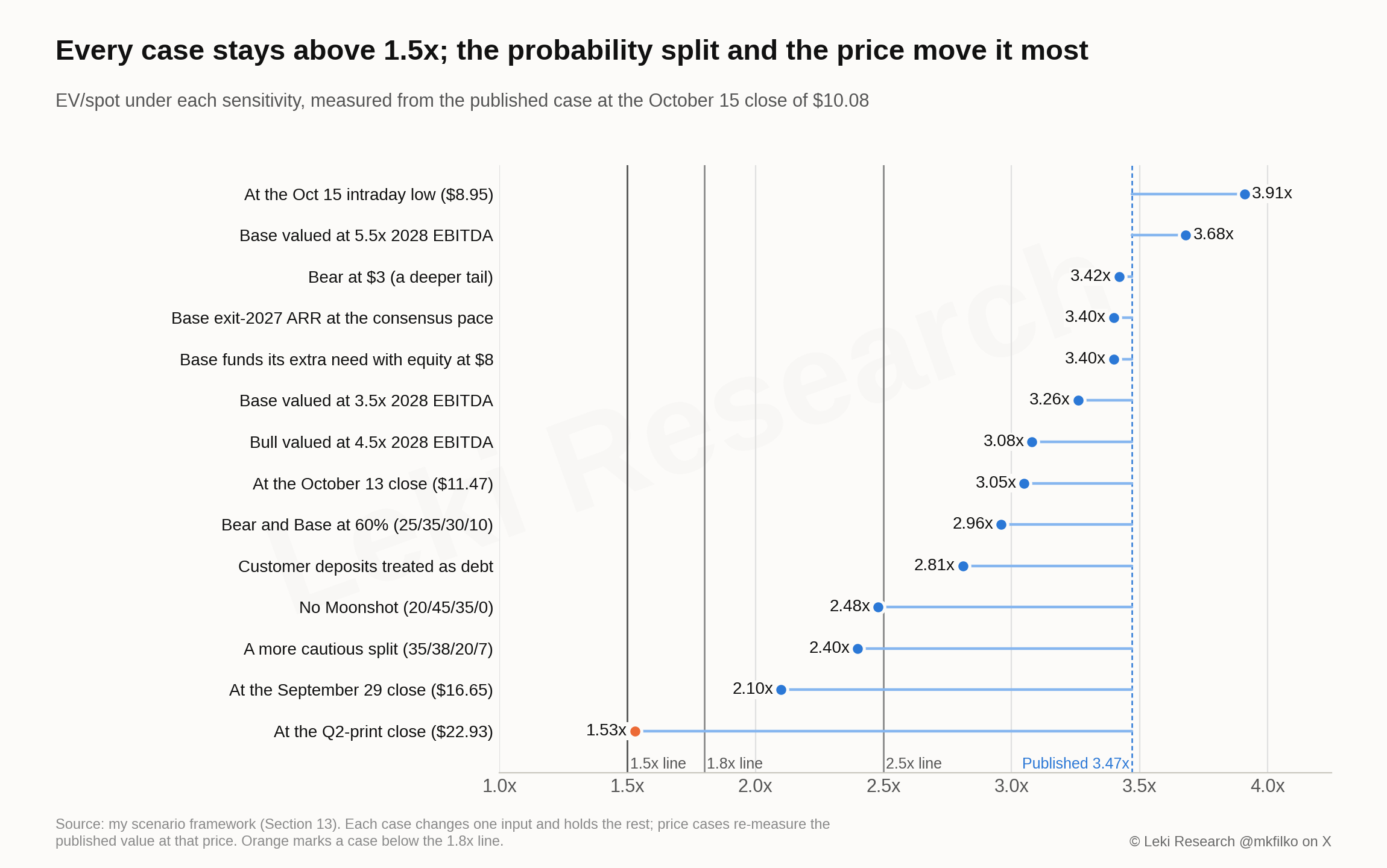
The probability split moves the answer more than any valuation input. A more cautious 35/38/20/7 split takes the ratio to 2.40x, and removing the Moonshot entirely, with its weight moved to the Base, gives 2.48x; both are still in the strong zone. Among the valuation inputs the harshest is treating customer deposits as debt, the conservative accounting reading since prepaid revenue brings EBITDA without new cash, at 2.81x; the market does not value peers that way. Price moves the answer as much as the split does. The stock was a 1.53x on the day of the Q2 print and is a 3.47x now, on a business with more contracts.
Conviction Gap: 7.5.
What is unknown today:
- whether the exit-2026 ARR lands near $400 million or slips into 2027;
- what the financing structure is, what it costs and whether it dilutes;
- how much of Thinking Machines is live, and whether its raise closes;
- who the four unnamed counterparties and the $4 to $5 billion pipeline are;
- 2026 customer concentration;
- whether Cohere's acceptance clears July 15, 2027;
- whether the material weaknesses get fixed.
How the evidence points. Most of it points the right way. A second named lab signed in September with a prepayment, and contract value rose from $1.9 billion to more than $2.6 billion in one quarter. The company says it is delivering more than 3,000 GPUs a quarter, it put a 2026 revenue projection into a filing, it has an already-powered 20 MW site for Q4, and contracted prices have risen from $3.45 to $4.13 per GPU-hour. Against that sit the first-print miss and no facility two months after one was promised for "the next quarter", the September grants and the director sales, the trimmed top of the revenue range, NVIDIA's program in redesign, and a credit market that turned on GPU landlords this week.
What converts the gap: the Q3 print and the financing announcement, both within the next five weeks; then the exit-ARR number in the Q4 print in March 2027; then Cohere acceptance in Q2 2027.
Timeline: about five weeks for the Q3 print and the financing; March 2027 for the exit-ARR number; July 15, 2027 at the latest for Cohere.
A wide gap, evidence that points mostly one way and a conversion event within weeks put this in the 7-8 bracket. It is 7.5, not 8, because the financing delay and the controls are real negative evidence, not just thin coverage.
Gates. Asymmetry 9 clears the minimum of 5. On quality, Moat is 6, below 7, but Conviction Gap at 7.5 carries the gate. Leadership 6 clears 5. The composite of 7.33 clears 5.5. The bear case is bounded: dilution, not insolvency. Every gate clears.
13. PRICE TARGET FRAMEWORK AND VERDICT
How the values are built. For each scenario I set an ARR path to end-2028. Revenue follows the average ARR in each quarter, and capex follows each new dollar of ARR one quarter ahead, at about $2.20 per $1 of ARR ($2.80 in the Bear). Funding follows the company's structure: prepayments cover about 31% of capex and equipment debt about 69%, amortized over three years. Any shortfall below $60 million of cash is met with extra debt in the Base, Bull and Moonshot, and with equity at $5 in the Bear. I then take a multiple of 2028 adjusted EBITDA at end-2027 and deduct that scenario's end-2027 debt: the existing and new equipment leases, the remaining software plan and any extra funding, less cash. Shares include the 4.59 million RSUs, about 2 million further grants and any equity issued. Growth builds its own debt in this model, so equity value does not rise in line with ARR.
For multiples, 4.0 times is a stalled, levered GPU lessor. The Base's 4.5 times is about 2.9 times 2028 revenue and about 3.4 times exit-2027 ARR, just below the 3.5 to 4.4 times that IREN and CoreWeave trade on today for their end-2026 targets, applied a year later. The Bull's 5.5 times reflects Odeon's 7-8 times forward EBITDA less a discount for scale and rates. The Moonshot's 6.5 times is a re-rated platform valued like a scaled neocloud.
| Scenario | Prob. | Price | vs $10.08 | What has to be true | Value basis and anchor |
|---|---|---|---|---|---|
| Bear | 20% | $5.40 | −46% | The ramp slips: exit-2026 ARR ~$300M, exit-2027 ~$520M (2027 revenue ~$415M, below BTIG's $428M). Hardware is bought on the guided schedule but bills late. New leases cost ~11%, and ~$265M of equity is raised at $5. 2028 EBITDA $336M (56% margin) | 4.0x, a stalled levered lessor. End-2027 debt ~$555M; ~147M shares. Precedents: BRUN −74% from its June closing high; WhiteFiber −61%; Applied Digital ~−80% in 2022-23 |
| Base | 30% | $20.50 | +103% | Exit-2026 ARR ~$380M. The signed book converts on the filed dates, the unfiled contract value at about 60 cents on the dollar, and new signings stay modest. Exit-2027 ARR ~$850M (2027 revenue ~$605M, consensus plus Cohere); 2028 revenue ~$1.0B. Equipment debt at ~9% plus ~$160M of extra funding | 4.5x 2028 EBITDA of $651M (64% margin). End-2027 debt ~$1.08B; ~90M shares. Below every published target (lowest: Northland $36) |
| Bull | 35% | $42 | +317% | Base plus a named secured facility in the high single digits and the first ~$1B of the procurement contracted to a named lab or investment-grade buyer. Exit-2027 ARR ~$1.2B; 2028 revenue ~$1.5B | 5.5x 2028 EBITDA of $977M (66% margin). End-2027 debt ~$1.6B. Anchored to the Street: $45 from BTIG, D.A. Davidson and Craig-Hallum; Odeon $40 |
| Moonshot | 15% | $87 | +763% | ~$4.3B of hardware financed and energized by end-2027. Exit-2027 ARR ~$2.0B (about 188 MW of the 253 MW accessible); 2028 revenue ~$2.4B | 6.5x 2028 EBITDA of ~$1.66B (68%). End-2027 debt ~$2.9B. Above the Street high, as the framework requires; top of Odeon's published $60-90 scenario for a $1.5-2B exit |
Probability-weighted EV: $34.98. EV/spot: 3.47x.
How the market prices the peers. The cleanest check on the scenarios is to put Boost Run next to the three listed neoclouds that investors already own, on the same lease-inclusive enterprise value basis, at the October 15 close:
| $BRUN | $CRWV | $IREN | $NBIS | |
|---|---|---|---|---|
| Share price | $10.08 | $69.69 | $30.39 | $188.41 |
| Enterprise value (incl. leases) | ~$1.07B | ~$84B | ~$14B | ~$54B |
| Current run-rate | $145M (June ARR) | ~$10.3B (Q2 revenue x4) | ~$1.0B (August ARR) | ~$3.0B (June ARR) |
| EV / current run-rate | 7.4x | 8.2x | 13.9x | 17.9x |
| End-2026 run-rate target | ~$400M | $18.5-19.5B | $4B contracted | $7-9B |
| EV / end-2026 target | 2.7x | 4.4x | 3.5x | 6.7x |
| Contracted backlog | $1.55B filed ($2.6B headline) | ~$129B ($103.7B at June 30 plus $25B+ signed in early Q3) | $16.6B | $37.5B RPO |
| EV / backlog | 0.69x | ~0.65x | 0.84x | 1.43x |
| Adjusted EBITDA margin, Q2 | 39.5% | 59% | 14% | 41% |
| New financing since June 30 | $85M of warrant cash | ~$5.4B | ~$2.4B | ~$6.5B |
Backlog definitions differ: CoreWeave reports revenue backlog, which I raise by the more than $25 billion it said it signed early in Q3, Nebius reports remaining performance obligations, IREN adds the contracted value of lease arrangements, and for Boost Run I use only contracts on file. IREN's end-2026 figure is contracted run-rate due by December 31, not formal guidance.
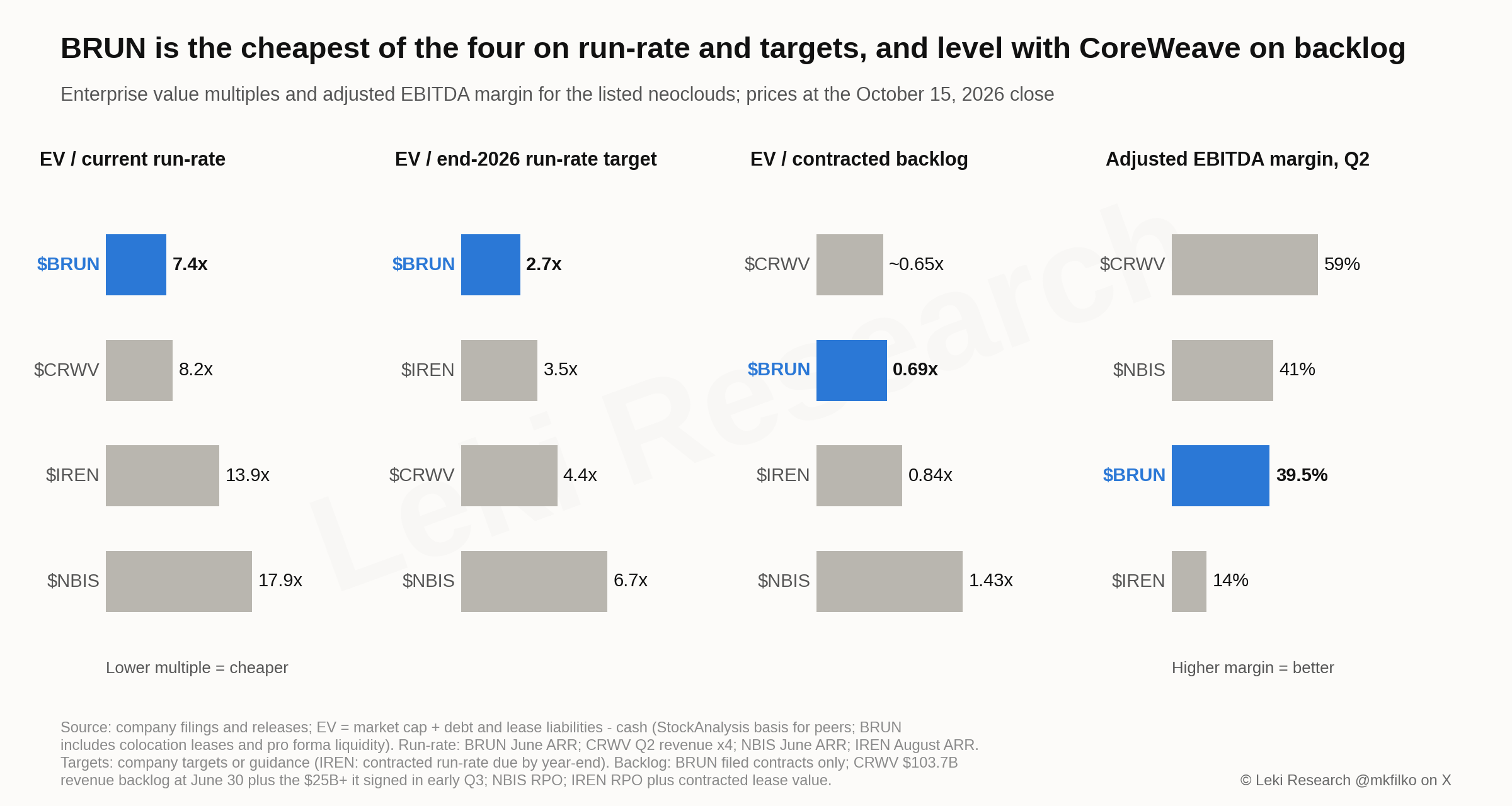
Boost Run is the cheapest of the four on current run-rate and on year-end targets, level with CoreWeave on backlog once CoreWeave's post-quarter signings are counted, and in the middle of the pack on margin, with a third of its revenue going to rent on sites that were still filling. Some discount is deserved. CoreWeave's and Nebius's backlogs are anchored by Microsoft, Meta and OpenAI, they hold billions of cash and raise money through convertibles, and their run-rates are reported while Boost Run's $400 million is a target. Its controls are behind and its float is small. But a discount of about 40% to CoreWeave and about a quarter to IREN on the year-end number, and about 60% to Nebius, already charges for most of that. At IREN's 3.5 times its target, Boost Run's lease-inclusive enterprise value would be about $1.40 billion, roughly $13 a share counting the RSUs; at CoreWeave's 4.4 times, about $1.76 billion, roughly $17. That is arithmetic, not a target, and it prices only what is signed and the December number, with nothing for 2027.
The price lines.
| EV/spot | Price |
|---|---|
| 2.5x | $13.99 |
| 1.8x | $19.43 |
| 1.5x | $23.32 |
| 1.35x | $25.91 |
| 1.2x | $29.15 |
At $10.08 the stock sits 48% below the 1.8x line and 28% below the 2.5x line. It has closed below $23.32 every day since July 23, below $19.43 every day since August 27, and below $13.99 on each of the last seven trading days.
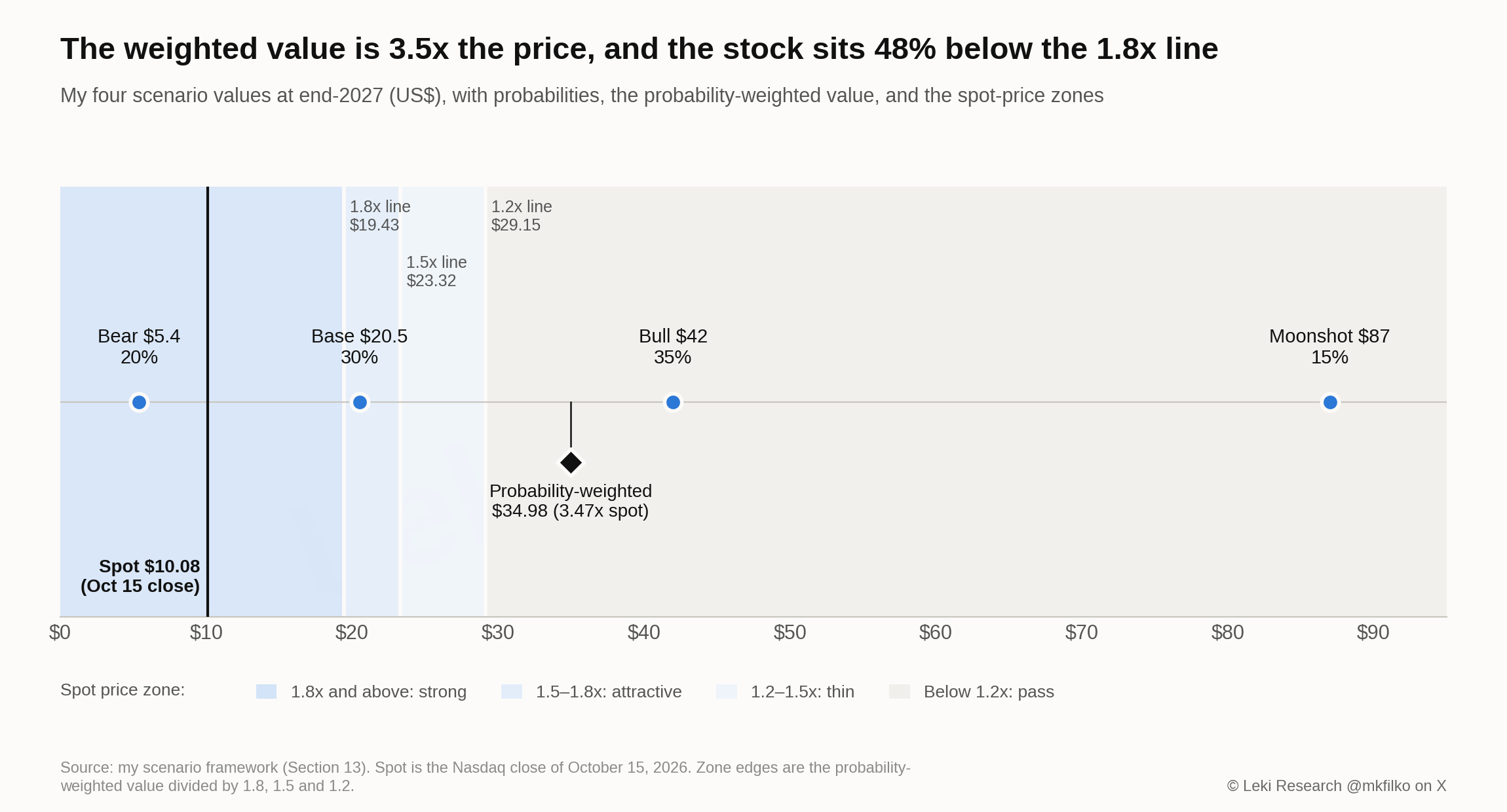
The Street, read with its conflicts. The four targets in the S&P average ($36 to $45, average $42.75) and Odeon's $40 all sit between my Base ($20.50) and just above my Bull ($42). I do not use them to set the Base. BTIG was the SPAC's bookrunner and capital-markets adviser and expects to seek banking fees. Odeon's analysts disclose that they hold the stock, and the firm expects to seek banking fees. D.A. Davidson has not changed its target since June. Odeon's own math is the closest to mine: about $500-550 million of annualized 2027 EBITDA at 7-8 times, less about $1 billion of net obligations, on about 80 million shares. I land lower because I value a year later on 2028 EBITDA, at a lower multiple, and charge the full fleet debt the growth needs. The sell-side models I can see do not include the $4 to $5 billion procurement: BTIG's 2027 revenue is $428 million and consensus is $551 million. That is why the Bull needs no override of the anchoring rule. It sits just below the Street high, and the Moonshot, which carries the procurement, sits above it.
What spot implies. At 4.5 times, $10.08 needs about $440 million of 2028 EBITDA, about $690 million of 2028 revenue at the Base margin. That is about two-thirds of my Base, and below the roughly $830 million of ARR the full signed book produces once it is all live: the filed contracts at about $430 million, the reseller and on-demand base at about $80 million and the unfiled balance at about $320 million. Put another way, the market is pricing a business about a sixth smaller than the one already under contract, and a third smaller than my Base, before any dilution.
Why the probabilities sit where they do. I put half the weight on the upside because this team has done what it said it would on the metrics that drive the stock. Contract value went from $940 million at listing to more than $2.6 billion, ARR landed on the deck path in June, the exit target was raised and then held, power went from a 20 MW plan to 253 MW, two labs signed with prepayments, and contracted prices have risen with every signing. Cohere signing a prepaid five-year contract is not what a sophisticated buyer does with a vendor it expects to fail. The Bear is at 20%, not lower, because the financing promised for "the next quarter" has not appeared in two months, the one aged revenue forecast missed by 15%, and the credit market turned on GPU landlords this week; whether the next billion comes as debt is decided by lenders as much as by management. The Base is at 30%: the signed book goes live roughly on schedule with conventional financing at about 9%, and no more. The Bull is at 35% and the Moonshot at 15%. Both need a financing structure that does not exist yet, and the Moonshot needs it inside fifteen months, so these are the weights most exposed to the Q3 answer. A more cautious 35/38/20/7 split would give 2.40x, still in the strong zone (Section 12).
The bet, stated plainly. At $10.08 a buyer pays about $1 billion for a cloud that already runs at $145 million of ARR and holds more than $2.6 billion of prepaid contracts with two named AI labs, the lowest multiple of its December target among the four listed neoclouds, and about three times the power it needs for my Base. In exchange the buyer accepts no committed financing for the next billion dollars of hardware, thin per-contract economics that depend on the residual, a founder who can issue shares at will, and controls that are not yet fixed. If the signed book goes live on roughly the filed dates and the financing comes as debt, I think the stock is worth about $20 at end-2027. Getting to the low 40s takes a named facility and the first billion of the procurement. If the ramp slips and the financing comes as equity at these prices, I think it is worth about $5.
Verdict: investable at $10.08, but sized with caution. The scores support it: the composite is 7.33, Asymmetry is 9, every gate clears, the bear case is bounded by a take-or-pay book with no bank debt, and the probability-weighted value is 3.5 times the price. At 3.47x it is probably the most asymmetric opportunity I have covered so far at current prices, the highest EV/spot of any stock I have run through this framework. The reason not to size it aggressively is size and structure. A market cap of about $0.85 billion, a float of about 29 million shares, a founder with 87% of the vote who can issue stock without a shareholder vote, and a 16% fall on a peer's bond yield mean any position has to survive the path, not just the destination. Whether this works depends on a financing event that has not happened, at a moment when the credit market has turned on GPU landlords.
That leaves two reasonable ways to approach it. More risk-averse investors can wait for the Q3 print in mid-November and a named financing facility, which together should show whether the ramp is on time and whether the next billion comes as debt, accepting that the price may be higher by then. For those willing to take more risk, the risk/reward at $10.08 is attractive. The price sits 48% below the 1.8x line, and even the miss case below leaves EV/spot above 2.6x.
If Q3 confirms, with revenue at or above $45 million, September 30 ARR at or above $250 million, the exit target reaffirmed and a named facility, the probabilities move to 12/30/41/17. The probability-weighted value rises to about $38.81, which is 3.85x the $10.08 price. The 1.5x line moves to about $25.87 and the 1.8x line to about $21.56. If it disappoints, with revenue below $40 million or September 30 ARR below $220 million, the exit target moved into 2027, or an equity raise near today's price, the probabilities move to 35/30/25/10 and the Bear falls to about $5. The value falls to about $27.10, or 2.69x, and the 1.5x line drops to about $18.07 and the 1.8x line to about $15.06. Even the miss case clears 2.5x at today's price. That is how much of the bad outcome the price already carries.
If a restatement, an auditor change or a regulatory inquiry appears, the Leadership floor applies; a counterparty default beyond its prepayment would unbound the Bear. Either makes it a pass regardless of price.
Re-score triggers (any two would justify a full re-run):
- Financing: a named secured facility of $500 million or more under 10% is an upgrade; an S-3, an ATM program or an equity raise near today's price is a downgrade.
- The Q3 print: revenue, September 30 ARR and the exit-target language, against the lines in Section 9.
- Counterparties: Thinking Machines closing its round; a name for any of the four unnamed filed contracts; a hyperscale or government customer, which would also move Moat to 7.
- Disclosure: an on-time, clean 10-Q with a concentration note and the Thinking Machines live percentage; progress on the material weaknesses, which would lift the Leadership cap toward the floor of 7.
- Deadlines: Pryor starting on December 15; the exit-ARR number in March; Cohere acceptance before July 15, 2027.
- Price and the downside: a rise above $25.91 (the 1.35x line); new-contract pricing below about $3 per GPU-hour or on-demand B300 below about $5; a deferred software installment; CEO open-market sales of size.
14. THESIS FIT
Boost Run is on-thesis, from the demand side. It is the compute layer itself: the GPU cloud that buys the servers, optics, switches, cooling and power that the rest of the AI data-center supply chain sells. A book built around those suppliers owns the demand side only indirectly, and a neocloud is that demand side. That makes it diversifying in thesis terms and concentrating in factor terms. On days the AI-infrastructure trade sells off, this name falls harder than the suppliers. On October 14 it fell 15.9% while CoreWeave fell 15.5%, IREN 12.2% and Nebius 10.1%.
It does not stack with the optical-interconnect or substrate layers except through sector beta, although its customers are the end demand for both. Its correlation risk sits with the listed neocloud group: CoreWeave, Nebius, IREN, WhiteFiber, Sharon AI and Applied Digital. The relevant risk is the combined neocloud exposure, not each name separately. What it adds that the suppliers do not is direct exposure to GPU rental pricing, which rose through 2026 on Blackwell while many supplier stocks fell, to NVIDIA's decisions about financing its channel, and to the sovereign and regulated adoption curve. What it lacks is proprietary technology, qualification-cycle switching costs and a moat that survives a pricing downturn.
The stock is a $0.85 billion small cap. Average daily volume over the last 20 sessions is about 2.9 million shares, roughly $29 million a day at $10. The float is about 29 million shares and short interest about 17% of it, so the stock gaps on news in both directions; it has moved 8% or more in a day nine times since September 1. It joined the Russell 2000 after the close on September 18. Coverage is five firms with one Sell rating outside them, and two of the five are conflicted, so the gap between the Street and the tape is wide and only partly meaningful.
15. KEY CATALYSTS
- October 2026: the first $20 million software installment. Paid on time is fine; a deferral or amendment would be a red flag.
- Mid-November 2026 (not yet scheduled; Q2 was reported August 14): Q3 results and 10-Q. Revenue against $45 million, September 30 ARR against $250 million, the exit-target language, equipment not in service, a concentration note and an on-time filing.
- By the Q3 report: the financing structure promised in August. A named facility, its size and rate; under 10% secured is the upgrade, an S-3 or equity the downgrade.
- Any time: Thinking Machines' $5-6 billion raise closing, which would largely remove the main counterparty risk.
- November 30, 2026: the June 8 contract starts ($207.6 million, 36 months), with a $37.9 million prepayment due and about $69 million a year of run-rate.
- December 9, 2026: FOMC, where markets expect a hike; the sector's cost of capital.
- December 15, 2026: the Pryor, Oklahoma lease starts (144 months), the largest site.
- Q4 2026: the first 20 MW 10X site into production and four project handovers.
- December 31, 2026: exit-2026 ARR against the ~$400 million target, reported with the Q4 print.
- March 2027: the July 9 contract starts (1,536 B300, 48 months); Q4 2026 results and the first 10-K.
- April 2027: the Dell agreement's year-2 minimum of $215.5 million begins.
- Q2 2027: Cohere acceptance begins.
- May 15, 2027: first RSU vesting.
- July 15, 2027: Cohere's minimum-acceptance deadline, with a refund and termination right if missed.
- Through 2027: 10X scales to up to 111 MW; Vera Rubin ships in volume.
- Ongoing: neocloud credit (CoreWeave's bonds and funding), GPU rental pricing, and NVIDIA's redesigned partner program.
16. WHAT I DO NOT KNOW YET
- How much of the Thinking Machines contract is billing today, and therefore how much of the December target is already in the run-rate.
- What the financing structure is, who provides it, what it costs, and whether any of it is equity.
- Who the four unnamed filed counterparties are, and what share of 2026 revenue Thinking Machines represents.
- What the roughly $1.05 billion of unfiled contract value consists of: orders, letters of intent or renewal options.
- The residual terms on the 2026 GPU leases. The 2025 leases capped Boost Run's buyout at 20% of cost, but the 10-Q is silent on the new ones.
- Whether Thinking Machines' raise has closed, and on what terms.
- Which site will host Cohere's liquid-cooled GB300 racks, and whether it is ready in time.
- Whether the material weaknesses will be remediated by year-end, as the company expects.
- What NVIDIA's redesigned compute-partnership program will look like, and whether Boost Run is in it.
Items 1, 2 and 8 should become clearer with the Q3 report. Item 6 could arrive at any time. Items 3, 4, 5 and 7 depend on whether the company improves its disclosure, and on its record so far I would not count on it.
Sources: Q2 2026 Form 10-Q (SECSift); Q2 2026 results 8-K and investor presentation (SECSift); Cohere agreement 8-K, October 6, 2026 (SECSift); RSU and cash award 8-K, October 5, 2026 (SECSift); post-effective amendment to the resale registration, October 8, 2026 (SECSift); Thinking Machines agreement 8-K, May 28, 2026 (SECSift); Form S-1 resale registration, July 2, 2026 (SECSift); Form 4s (SECSift): Goodrich, September 16, Goodrich, August 28, Guckel, Georgakopoulos; Form S-4, January 2026 (SECSift); Q2 2026 earnings call transcript (August 14, 2026; Quartr/Yahoo Finance); Boost Run Investor Update (June 2, 2026); SPAC investor presentation (September 14, 2025); NVIDIA Exemplar Cloud release (Nasdaq) (Boost Run, April 13, 2026) and the IREN (June 29) and Nebius (October 8) B300 announcements; warrant redemption completion (Business Wire via Finviz); CoreWeave Q2 2026 results (CoreWeave); CoreWeave shares, bonds and CDS, October 15 (BNN Bloomberg); BTIG, "New Compute Contracts and More Access to Power Pushing ARR Higher" (August 14, 2026) and initiation (June 25, 2026); Odeon Capital Group, "AI Knife Fight: Finding the Bottom" (September 16, 2026); Shawarma Capital, "The Ninety Percent Illusion" (August 30, 2026) and "The Ramp Nobody Has Financed" (September 4, 2026); Cohere contract coverage (Investing.com) and TIKR; Russell inclusion (Business Wire via Finviz); analyst targets (StockAnalysis) and Northland initiation (MarketsDaily); short interest (FINRA via Curved Trading); price history and statistics (StockAnalysis); peer valuations (StockAnalysis): CoreWeave, Nebius, IREN; B300 pricing (Thunder Compute, updated October 1); Thinking Machines funding talks (TNW); neocloud sell-off and yields (Benzinga); October 14 neocloud sell-off (SiliconANGLE), Gartner research on AI infrastructure write-downs (Gartner) and coverage of Gartner's neocloud forecast (Seeking Alpha via TradingView); GPU pricing and Rothschild Redburn (TipRanks); NVIDIA program status (Tom's Hardware); and all BRUN filings (SECSift).
Not financial advice. Prices are the Nasdaq close of October 15, 2026; re-run the EV/spot lines before acting on them. Poke holes if you see them.