
$AEHR — A record year booked, a plateau priced in, Aehr Test Systems Deep Dive
Contents
- EXECUTIVE SUMMARY
- 1. SNAPSHOT
- 2. BUSINESS DESCRIPTION
- 3. THE TECHNOLOGY: WHAT BURN-IN DOES, WHERE IT HAPPENS, AND WHO ELSE CAN DO IT
- 4. THE ORDER BOOK
- 5. MARGINS, CASH AND DILUTION
- 6. GROWTH DRIVERS
- 7. LEADERSHIP ANALYSIS
- 8. FORWARD OUTLOOK: TAILWINDS AND GUIDANCE
- 9. BULL CASE
- 10. BEAR CASE
- 11. SCORING
- 12. PRICE TARGET FRAMEWORK AND VERDICT
- 13. THESIS FIT
- 14. KEY CATALYSTS
- 15. WHAT I DO NOT KNOW YET
Date: October 18, 2026 Price: $60.60 (Nasdaq close, October 16, 2026) Method: My six-dimension framework (Revenue Quality, Revenue Growth, Moat, Leadership, Asymmetry, Conviction Gap), which weighs a probability-weighted value against the spot price. I value each scenario at about mid-2028 as a multiple of fiscal 2029 non-GAAP net income (the year to June 2029), or of sales in the Bear, plus the cash each scenario holds by then, on 34.0–35.0 million diluted shares. Aehr moved its year-end in April: fiscal 2027 runs from June 27, 2026 to June 25, 2027, and the first quarter of it is reported on November 2.
Verdict: Investable at $60.60 (EV/spot 1.67x). It is still best to proceed with caution and not size it too aggressively. The reason is that the stock fell 42% in nine sessions without bad news of its own and moves about three and a half times as much as the market, two customers drive most of the AI revenue, management cut or withdrew its full-year guide in two of the last three years, and most of the probability-weighted value sits in the Bull and Moonshot cases, while the Base is worth about today's price. More risk-averse investors can wait for the Q1 print on November 2 to confirm the $130–150 million guide and show bookings that keep the effective backlog near $100 million; for those willing to take more risk, the risk/reward at $60.60 is attractive.
Aehr Test Systems makes the machines that torture chips before they ship. Burn-in, as the process is called, holds a chip at high temperature and above-normal voltage for hours so that parts with hidden defects fail in the factory rather than in a car or a data center. For most of the last five years Aehr sold one thing to one market: wafer-level burn-in for the silicon carbide power chips in electric vehicles. That market collapsed, and revenue fell from $66.2 million in fiscal 2024 to $50.0 million in fiscal 2026. In its place Aehr has built an AI business. A hyperscaler uses its Sonoma systems to burn in a custom AI processor and has ordered more for a second one. A leading AI processor supplier has moved all of its burn-in onto Aehr's FOX-XP systems at wafer level, before the chip is packaged with its memory. Bookings were $97.9 million in the second half of fiscal 2026, and management has guided fiscal 2027 revenue to $130–150 million, up 160–200%.
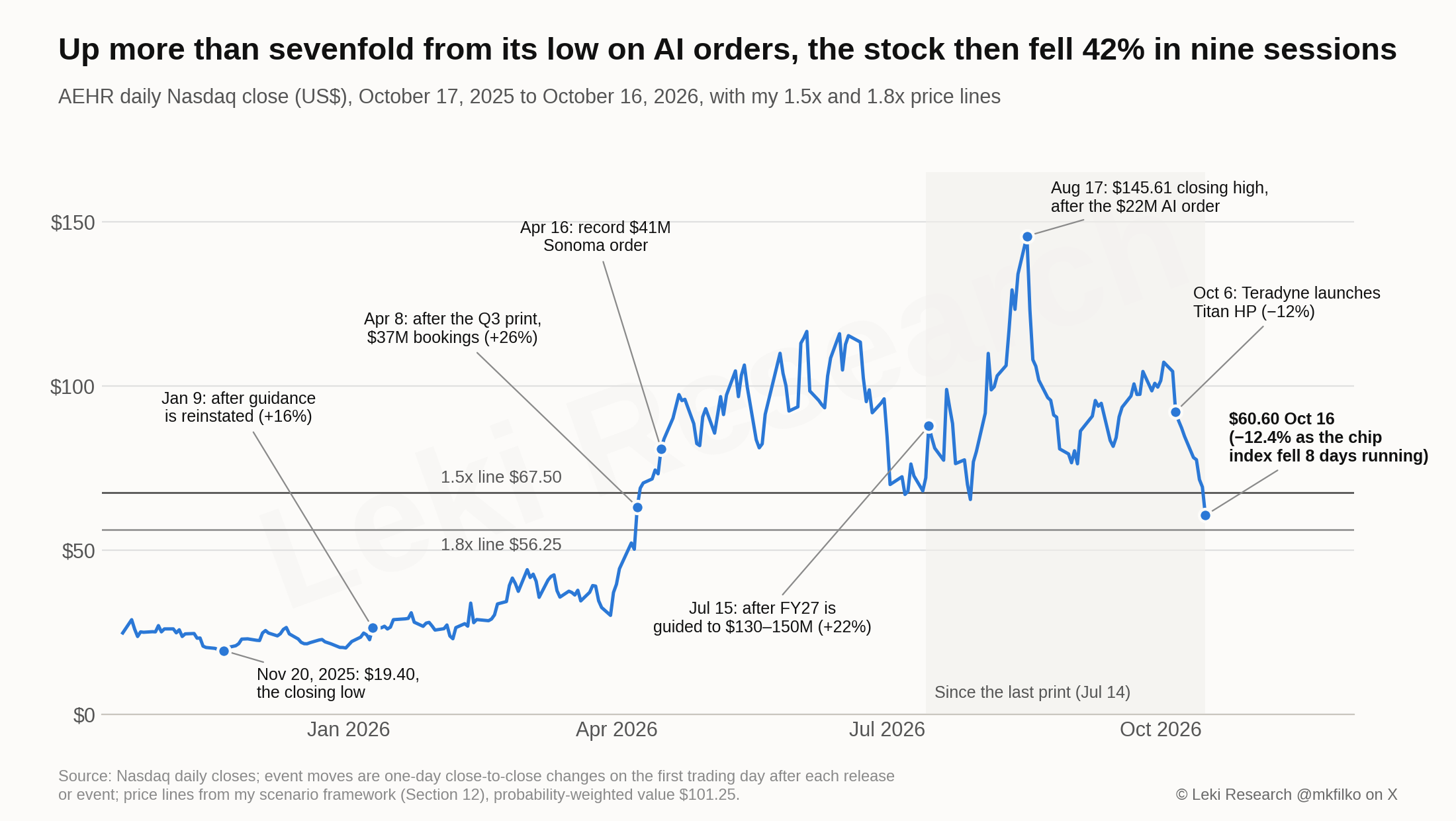
The stock has done what small, crowded AI stocks do. It closed at $19.40 last November, rose more than sevenfold to $145.61 on August 17 on a run of AI orders, and has since fallen back to $60.60. The last leg was fast. On October 6 Teradyne launched Titan HP, a test platform that adds burn-in for AI accelerators, and Aehr fell 12% that day. On October 13 NVIDIA was reported to have prepaid for test capacity at KYEC, the Taiwanese test house that builds its own burn-in ovens. And on October 16 the chip index fell for an eighth straight day, its longest losing streak since 2008, and Aehr fell another 12.4%. Between the October 5 close and October 16 the stock lost 42%. In that time the company announced one more order.
The question that matters is whether Aehr has a durable position in AI burn-in or one good year. Most of this note is about how burn-in works, where it happens in the flow of an AI chip, and who else can do it, because that decides how long the growth lasts. My conclusion is that Aehr's position at wafer level is strong and, as far as I can find, unmatched in AI production today, while its position at package level is real but contested. At $60.60 the probability-weighted value of $101.25 is 1.67 times the price. The price is roughly my Base case, in which this year's guide is met and growth fades to about 25% by fiscal 2029, and gives nothing for a second AI wafer-level customer, a higher-power Sonoma generation, co-packaged optics or memory.
EXECUTIVE SUMMARY
Aehr is a semiconductor test equipment company in Fremont, California, with 138 employees. It sells two kinds of burn-in system. FOX-XP and its smaller siblings test whole wafers at once through a custom contactor called a WaferPak, which touches every chip on the wafer in a single touchdown and is bought again for each new chip design. Sonoma, which came with the $21 million purchase of Incal Technology in 2024, burns in finished packages, each in its own socket, at up to about 2,000 watts per device. In fiscal 2026 wafer-level products were 63% of revenue and package-level 37%.
The story is a change of customer base. Electric-vehicle and power chips were 92% of revenue in fiscal 2024 and 17% in fiscal 2026. On the July call management said AI processors would be about 70% of fiscal 2027 revenue and silicon photonics 15–20%, with power chips and other markets making up the rest and no memory revenue assumed. The largest single customer's share of revenue fell from 67% to 26% over the same two years (the silicon carbide customer then, an AI customer now) and the top five from 93% to 70%, so the company is less dependent on one buyer than it was, but it still depends on a handful.
The headline numbers hide four things. First, the year is already mostly booked. Effective backlog, which counts orders received before the results release, was $100.6 million on July 14, and Aehr has since announced a $22 million wafer-level order from its lead AI customer, about $6 million of Sonoma orders for the hyperscaler's second processor and another silicon photonics system of undisclosed value. That is at least $128.6 million against a $140 million midpoint, or about 92%. Second, management's record with full-year guidance is poor: the fiscal 2024 guide of at least $100 million was cut twice and landed at $66.2 million, and the fiscal 2025 guide of at least $70 million was withdrawn in April 2025 and landed at $59.0 million. Since guidance was reinstated in January, the second-half guide and the April full-year update were both met. Third, the package-level business now has visible competition: KYEC builds its own ovens of up to 3 kW, NVIDIA has paid it in advance for capacity, and Teradyne has entered with Titan HP. Fourth, insiders have sold about $61 million of stock in twelve months, none has bought, and the company itself sold $100 million of shares in the year to May.
The technology question is narrower than the October sell-off implied. Teradyne's new system tests and burns in packaged chips. Aehr's strongest product burns in chips before they are packaged, so a bad die is thrown away on its own rather than after it has been bonded to several thousand dollars of high-bandwidth memory. Those are different steps in the flow, and Aehr's lead AI customer has said it no longer needs system-level screening at all after moving to wafer level. The overlap with Teradyne and KYEC is in package-level burn-in, where Aehr has one major customer.
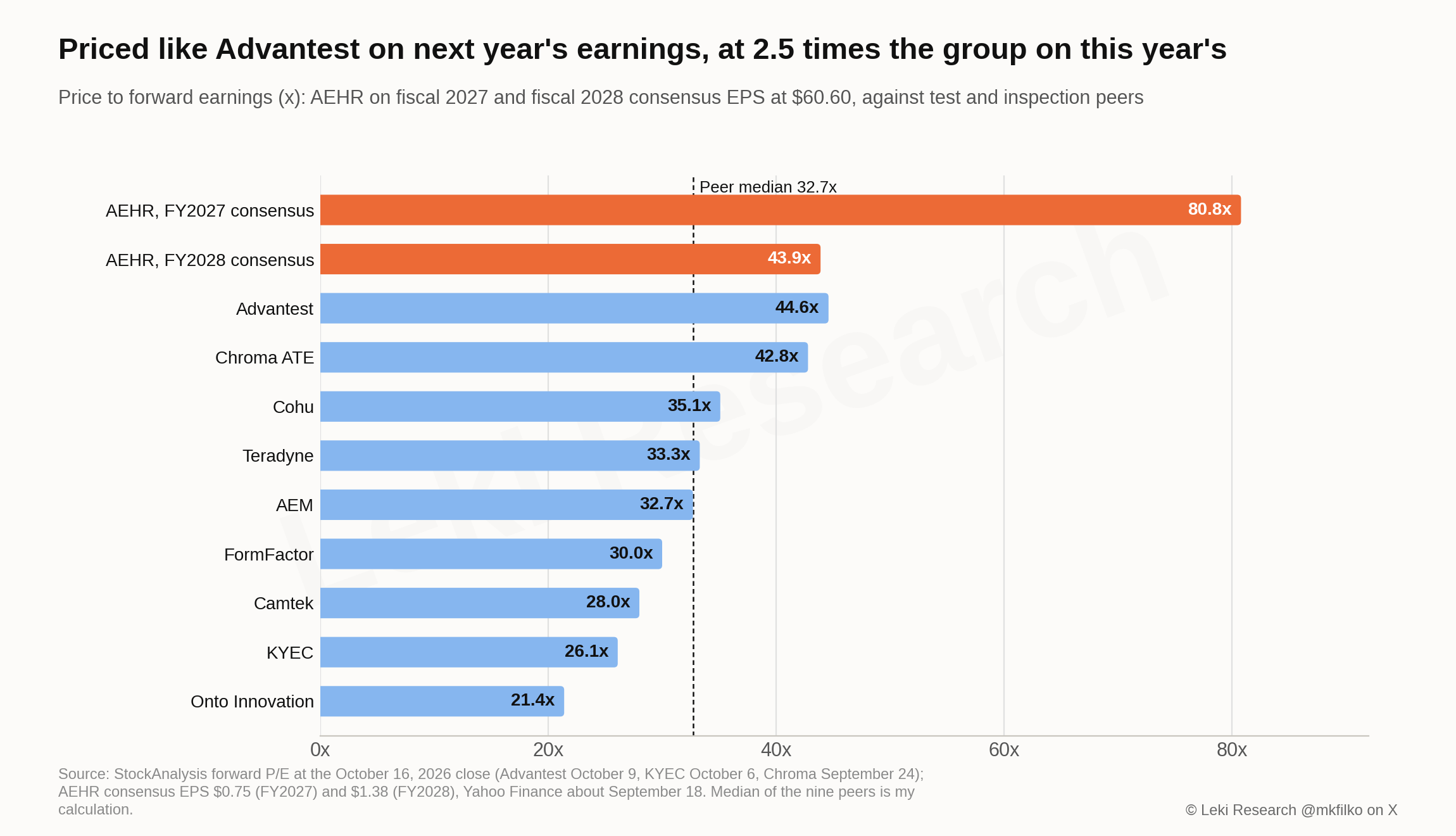
At $60.60 the market cap is about $1.98 billion and the enterprise value about $1.86 billion after $116 million of cash and no debt. That is 13.3 times the midpoint of this year's revenue guide, 81 times this year's consensus earnings and 44 times next year's. Five analysts publish targets from $110 to $175, averaging about $128.
I value each scenario at about mid-2028 on fiscal 2029 earnings:
| Scenario | Value | Probability | FY2029 revenue / non-GAAP net income | Basis |
|---|---|---|---|---|
| Bear | $13 | 25% | ~$110M / ~$11M | 3x sales |
| Base | $62 | 37% | ~$245M / ~$56M | 35x earnings |
| Bull | $171 | 27% | ~$470M / ~$127M | 45x earnings |
| Moonshot | $261 | 11% | ~$680M / ~$197M | 45x earnings |
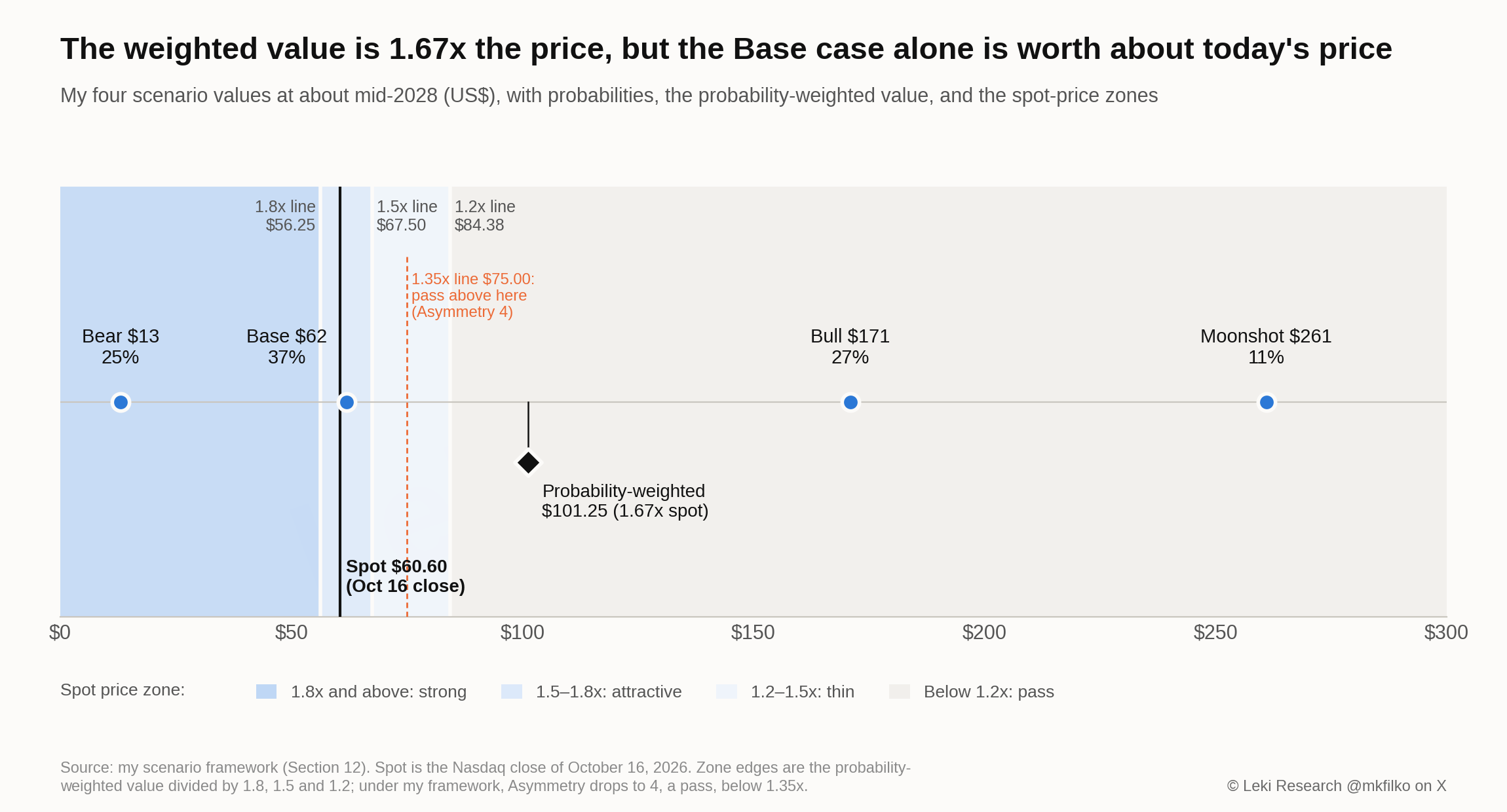
The probability-weighted value, computed on unrounded scenario values, is $101.25, or 1.67x the $60.60 price. The composite is 6.92 (RQ 5, RG 8.5, M 7, L 6, A 7, CG 8). The 1.5x line is $67.50 and the 1.8x line $56.25, so the stock sits 10% below the 1.5x line, inside the 1.5–1.8x zone.
At $60.60 a buyer pays about $1.86 billion for a company whose revenue is guided to nearly triple this year on orders already largely in hand, with the only production wafer-level burn-in for AI processors that I can find, a hyperscaler customer with a second processor coming, and a clean balance sheet. In exchange the buyer accepts a management team that has missed full-year guides before, a business that still rests on two AI customers, a package-level product facing larger competitors, heavy insider selling, the possibility of more share sales, and a stock that can halve in two months.
I think the market is pricing Aehr as if this year is the peak. At my Base multiple of 35 times earnings, $60.60 implies about $238 million of fiscal 2029 revenue, less than 20% above consensus for fiscal 2028 and only 1.7 times this year's guide midpoint. It is investable, but I would not size it aggressively. More risk-averse investors can wait for the November 2 print. For those willing to take more risk, the risk/reward at $60.60 is attractive.
1. SNAPSHOT
| Metric | Value | Note |
|---|---|---|
| Price | $60.60 | Nasdaq close, October 16. −12.4% that day; −42% from the October 5 close of $104.40; −58% from the August 17 closing high of $145.61; +200% from the December 31, 2025 close of $20.19 |
| 52-week range | $19.40–$145.61 at the close | Intraday $18.70 (November 21, 2025) to $147.40 (August 14, 2026) |
| Shares | 32.62M (July 20) | Plus 252,489 options (average strike $5.81) and 692,905 restricted units at July 23, per the shelf filing |
| Market cap | ~$1.98B | Directors and officers own 4.6%; BlackRock 6.4% (on a January 2024 filing) and Jane Street 5.0% |
| Cash and debt | $116.4M cash; no debt | At May 29, after about $97M net from two at-the-market share sales in fiscal 2026 |
| Enterprise value | ~$1.86B | |
| FY2026 (year to May 29) | Revenue $50.0M (−15%) | GAAP gross margin 35.3%; GAAP net loss $7.1M; non-GAAP net income $0.9M; operating cash flow −$3.3M |
| Q4 FY2026 | Revenue $18.8M (+34%) | Non-GAAP gross margin 44.7%; GAAP net income $1.4M; non-GAAP EPS $0.11 |
| Bookings and backlog | Q4 bookings $60.7M, a record | Backlog $80.6M at May 29; effective backlog $100.6M at July 14 |
| FY2027 guidance (July 14) | Revenue $130–150M (+160–200%) | Non-GAAP net income 18–22% of revenue; about 70% AI and 15–20% silicon photonics; first half expected to be at least as large as the second |
| Consensus | FY2027 $136.3M / $0.75 EPS; FY2028 $201.8M / $1.38 | Q1 FY2027 $26.6M / $0.09; Q2 $36.6M / $0.19 |
| Valuation | 13.3x EV/FY2027 guide midpoint; 80.8x FY2027 and 43.9x FY2028 consensus EPS | Test and inspection peers trade at 21–45x forward earnings |
| Concentration | Top five customers 70% of FY2026 revenue | Three customers at 26%, 14% and 11%; none named in filings |
| Analysts | Five targets, $110–175, average ~$128 | Jefferies Buy $175 (August); Craig-Hallum Buy $125; Oppenheimer Outperform $120 (reiterated October 14); Lake Street and Freedom Broker Buy $110; William Blair Outperform, no target |
| Short interest | 5.22M shares (September 30) | 16.9% of float, 2.4 days to cover |
| Insider activity | No open-market purchases in twelve months | About $60.8M of sales by 13 directors and officers; no 10b5-1 plans in place from August 2025 to May 2026 |
| Shelf | Automatic shelf registration filed July 27 | No dollar cap; no at-the-market programme currently announced |
| Next print | Q1 FY2027 (June 27 to September 25), November 2 after the close | Options imply a move of about ±24% |
Quarter by quarter (US$ millions):
| Q1 FY25 | Q2 FY25 | Q3 FY25 | Q4 FY25 | Q1 FY26 | Q2 FY26 | Q3 FY26 | Q4 FY26 | |
|---|---|---|---|---|---|---|---|---|
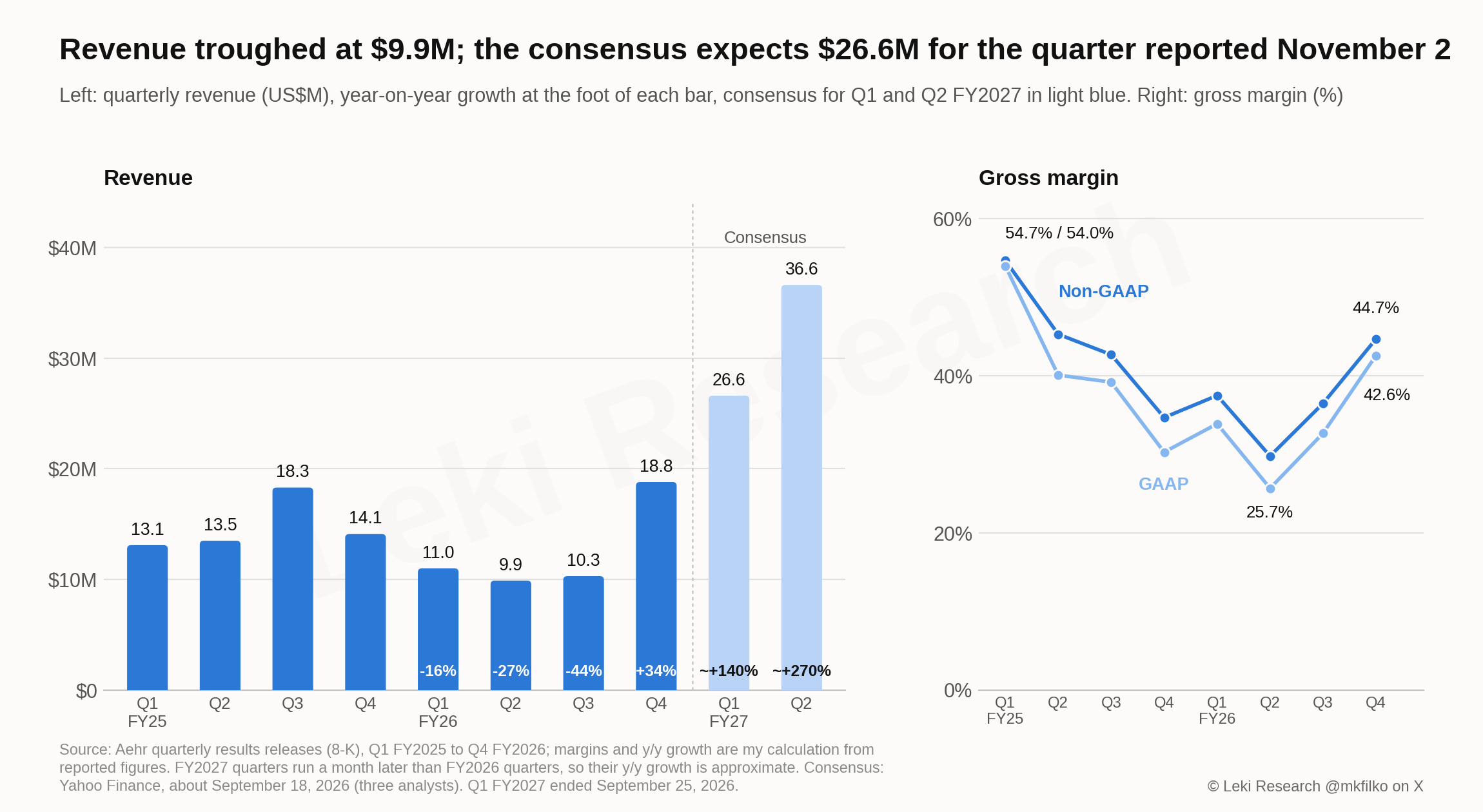
| Revenue | 13.1 | 13.5 | 18.3 | 14.1 | 11.0 | 9.9 | 10.3 | 18.8 |
| Non-GAAP gross margin | 54.7% | 45.3% | 42.7% | 34.7% | 37.5% | 29.8% | 36.5% | 44.7% |
| GAAP net income | 0.7 | (1.0) | (0.6) | (2.9) | (2.1) | (3.2) | (3.2) | 1.4 |
| Non-GAAP EPS | $0.07 | $0.02 | $0.07 | $(0.01) | $0.01 | $(0.04) | $(0.05) | $0.11 |
| Bookings | 16.8 | 9.2 | 24.1 | 11.1 | 11.4 | 6.2 | 37.2 | 60.7 |
| Backlog (quarter-end) | 16.6 | 12.4 | 18.2 | 15.2 | 15.5 | 11.8 | 38.7 | 80.6 |
From Aehr's quarterly results releases. Margins are my calculation from reported figures. Fiscal 2025 and 2026 quarters end in late August, November, February and May.
The chart below shows the trough and the turn. Revenue fell to $9.9 million in the November 2025 quarter as silicon carbide orders dried up, and the gross margin fell with it, to 29.8% on a non-GAAP basis, because a factory and engineering team sized for more volume were spread over less. The May quarter brought revenue back to $18.8 million and the margin to 44.7%. Consensus for the quarter that ended on September 25 is $26.6 million.
2. BUSINESS DESCRIPTION
A test company that lived on one market. Aehr was founded in 1977 by Rhea Posedel, who is still its chairman, and spent decades as a small supplier of burn-in systems for memory and logic. Gayn Erickson became CEO in 2012 and bet the company on wafer-level burn-in, turning the FOX and WaferPak technology Aehr had developed in the 2000s into the multi-wafer FOX-XP, launched in 2016. The bet paid off in silicon carbide. Electric-vehicle inverters use silicon carbide power chips, several of which are packaged together in a module; one weak chip can ruin the module, and silicon carbide had more latent defects than silicon. Burning in every chip on the wafer before packaging became standard for the leading supplier, and Aehr's revenue reached $65 million in fiscal 2023 and $66.2 million in fiscal 2024, almost all of it from that one market and most of it from one customer, which was 67% of fiscal 2024 revenue.
The collapse and the pivot. Electric-vehicle demand slowed in 2024, silicon carbide makers cut capacity, and Aehr's contactor sales fell from $37.6 million in fiscal 2024 to $14.9 million in fiscal 2026 as customers stopped adding new chip designs and capacity. Management responded in three ways. It agreed in July 2024 to buy Incal Technology for $21.0 million in cash and stock, which brought the Sonoma package-level burn-in system and an AI hyperscaler customer. It pushed FOX into new markets: silicon photonics, where it has shipped to at least two customers; gallium nitride power chips; hard-disk-drive components; and AI processors at wafer level. And it raised $100 million of equity in fiscal 2026 to fund the transition.
How it makes money. These are capital goods, sold by the system, with consumables attached. A FOX-XP system is sold once; each new chip design then needs its own WaferPaks, which last two to seven years and are bought again as customers add designs and capacity. Sonoma systems are sold with device-specific sockets and burn-in modules. Services were $6.4 million in fiscal 2026. Orders are lumpy and concentrated, usually land near quarter-end, and most can be cancelled with limited penalties, which is why Aehr's revenue can swing sharply from one quarter to the next: it rose 83% between the February and May quarters this year.
Where it sells. Asia took 45.6% of fiscal 2026 revenue, the United States 41.3% and Europe and the Middle East 13.1%. The AI customers' systems sit at contract manufacturers and test houses in Taiwan. Aehr assembles and tests its systems in Fremont and has qualified a contract manufacturer to build and ship Sonoma directly; management says that manufacturer can add capacity for more than 20 Sonoma systems a month and that the company is "not capacity limited even at the $150 million revenue level". It also has a branch office in Taiwan.
The customers. Aehr's filings name none. Its releases describe a "lead hyperscale customer" for Sonoma, which designs its own AI processors, and a "lead AI processor customer" for wafer-level burn-in, described as a "leading provider of advanced AI training and inference processors". A third, described as a supplier of AI accelerators, CPUs and network processors, has completed a paid wafer-level benchmark. In silicon photonics there is a lead customer and a newer one described as "a global leader in networking products and solutions". Online commentary links these descriptions to particular hyperscalers and chip companies; I treat every such identification as unconfirmed.
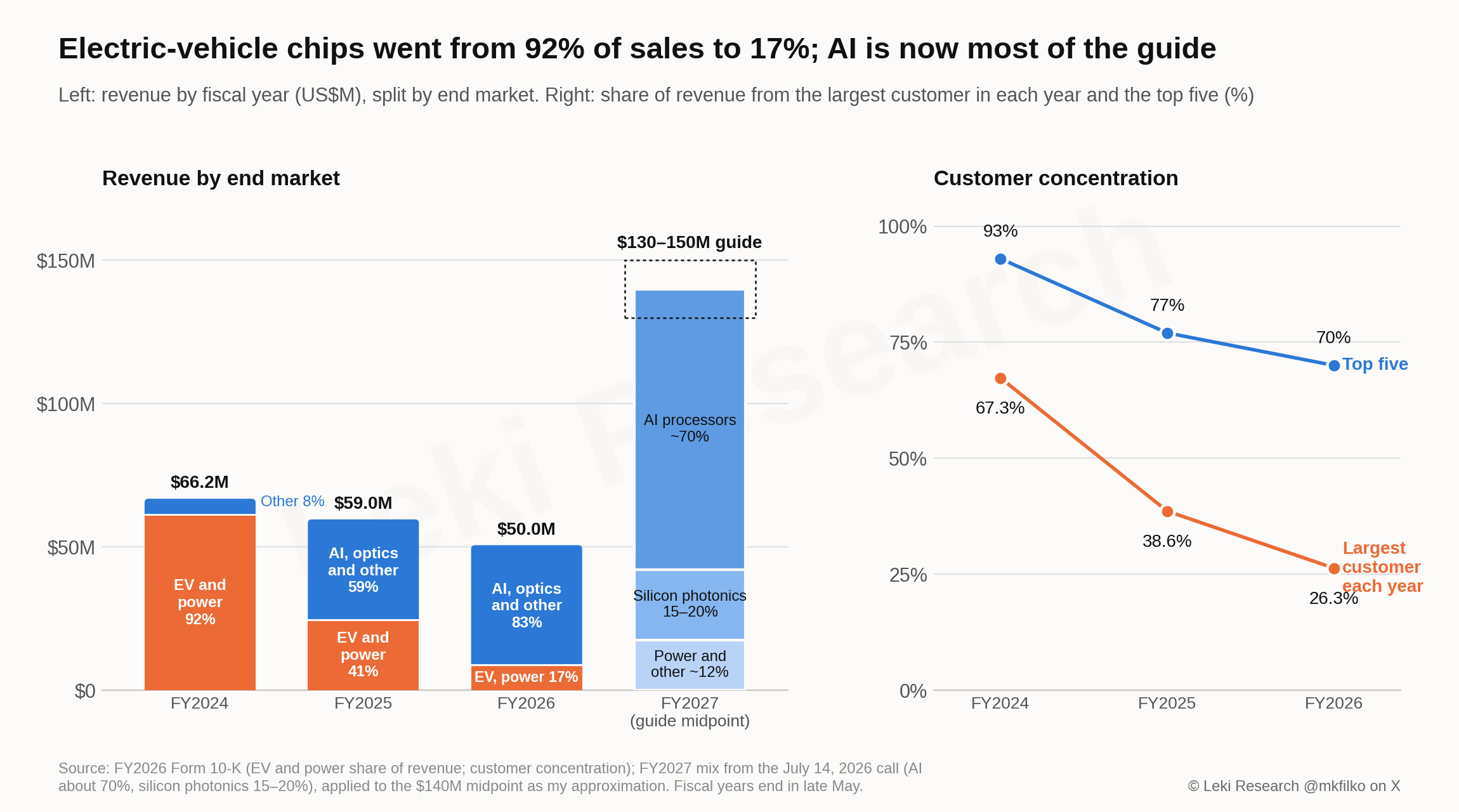
The left panel is the pivot in one picture. The orange is the market Aehr was built on; the blue is what replaced it. The fiscal 2027 bar is my approximation, applying management's stated mix to the guide midpoint. The right panel is the reason I do not score the revenue quality higher: concentration is falling, but 70% of revenue still came from five customers last year, and this year's growth comes mainly from two.
3. THE TECHNOLOGY: WHAT BURN-IN DOES, WHERE IT HAPPENS, AND WHO ELSE CAN DO IT
Every chip that leaves a factory has been tested, but a test only shows that a chip works today. A small share of chips carry defects that pass every electrical test and then fail in the first weeks of use: a thin spot in an insulating layer, a weak connection, a contaminant. Engineers call this infant mortality. Burn-in exists to make those chips fail early, in the factory, by running them hot and at higher-than-normal voltage for hours, which ages them quickly. Chips that survive go on to a long, reliable life; chips that fail are thrown away before anyone builds them into something expensive.
Why AI chips need more of it
For most consumer chips, burn-in is a cost to be minimised. For AI accelerators it has become worth more for three reasons. The first is power. An AI accelerator draws around a kilowatt, and the next generations draw more; NVIDIA's Rubin GPU is expected to draw well above 1,000 W. A burn-in system has to deliver that power to every device and remove the heat while holding each chip at a set temperature. When Blackwell arrived, test houses had to move their burn-in chambers from about 600 W to 1 kW per device, and the flow lengthened to final test, burn-in, a second final test, then system-level test. The second is value. A modern accelerator is not one chip but a package: one or two compute dies bonded beside several stacks of high-bandwidth memory (HBM) on a silicon interposer, a process TSMC calls CoWoS. If one compute die is defective, the whole package, memory included, is scrap. Aehr's 10-K puts the cost of finding a failure after packaging at "10 times or even 100 times" the cost of finding it on the wafer. The third is the customer: a hyperscaler running tens of thousands of accelerators in a cluster pays for every failure in the field in lost training time, so it wants the weak parts gone before they ship.
Two places to do it
There are two ways to burn in an AI chip, shown below. Wafer-level burn-in stresses every die while they are still on the wafer, before it is cut up. Aehr's FOX-XP does this with a WaferPak, a contactor the size of a 300mm wafer carrying thousands of pins that touch every die's pads at once. The wafer sits on a plate that holds it at temperature, and the system delivers up to 3,500 W to each wafer. A FOX-XP configured for AI holds nine wafers. Package-level burn-in waits until the chip is packaged and puts each finished device in its own socket in a chamber; Aehr's Sonoma chamber has 22 slots holding up to 88 devices, each in its own socket at its own temperature, at up to about 2,000 W per device. Package-level burn-in also catches defects introduced by packaging, which wafer-level burn-in cannot. Wafer-level burn-in catches the die defects before the memory is attached, which package-level burn-in cannot.
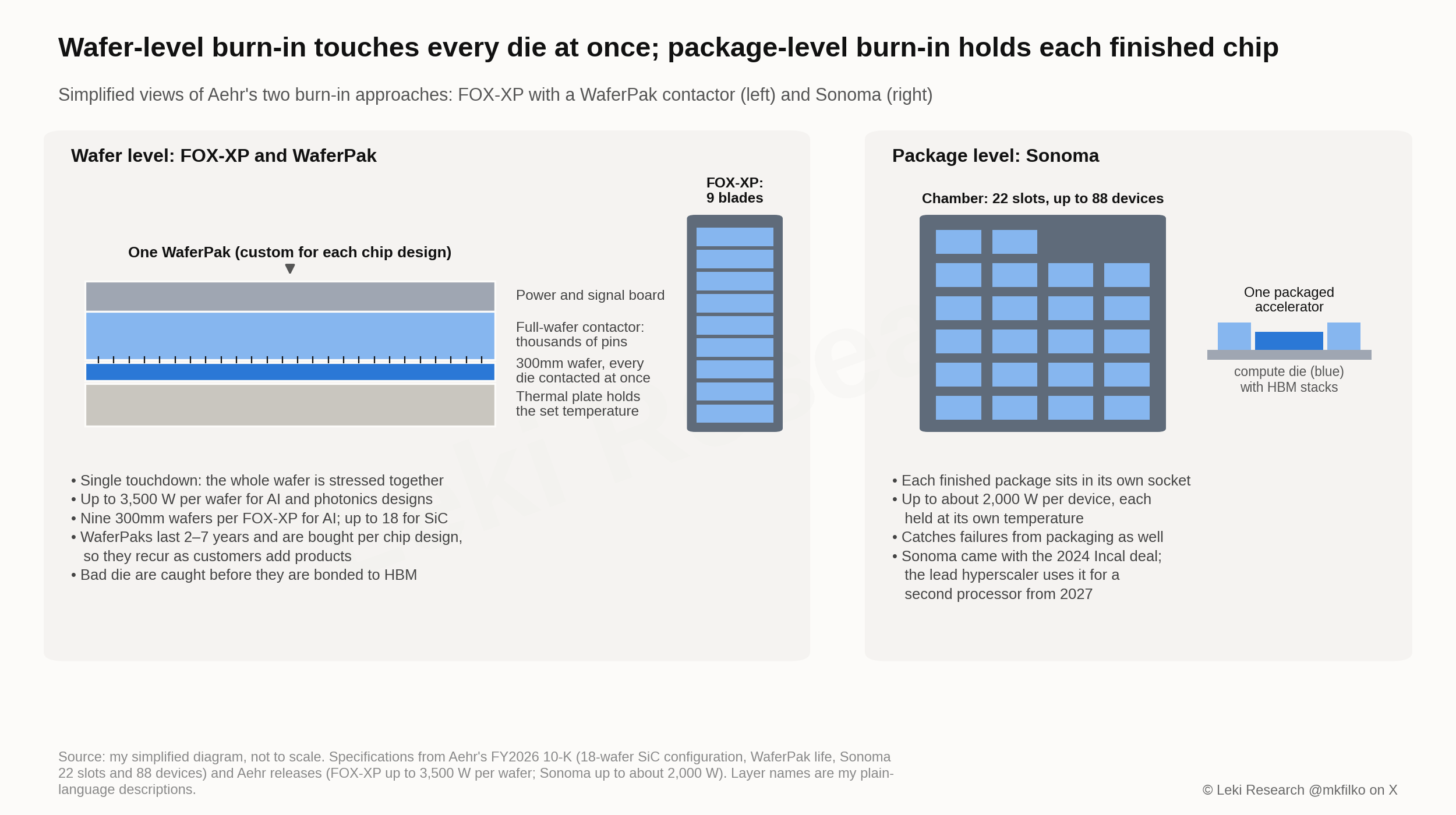
The hard part of wafer-level burn-in is the contactor. Touching thousands of pads on every die across a 300mm wafer, with even pressure and good electrical contact, while pushing kilowatts through it and holding the wafer at temperature for hours, is a precision mechanical and thermal problem. Aehr has been refining the WaferPak for over a decade, first for silicon carbide and then for photonics and AI, and it is the reason a competitor cannot simply put a wafer into an oven. It is also the recurring part of the business, because every new chip design needs a new WaferPak.
Where it sits in the flow
The diagram below follows an AI accelerator from wafer to server. After the wafer is made, a fast electrical test at wafer sort checks each die in seconds; this is the market for Advantest's and Teradyne's testers and FormFactor's probe cards. Wafer-level burn-in, if it is used, comes next. The good dies are then packaged with HBM, tested again, and in most flows burned in at package level and run through system-level test, in which the packaged chip runs real workloads on a board. Advantest, Teradyne, Cohu, AEM and Chroma sell system-level test equipment.
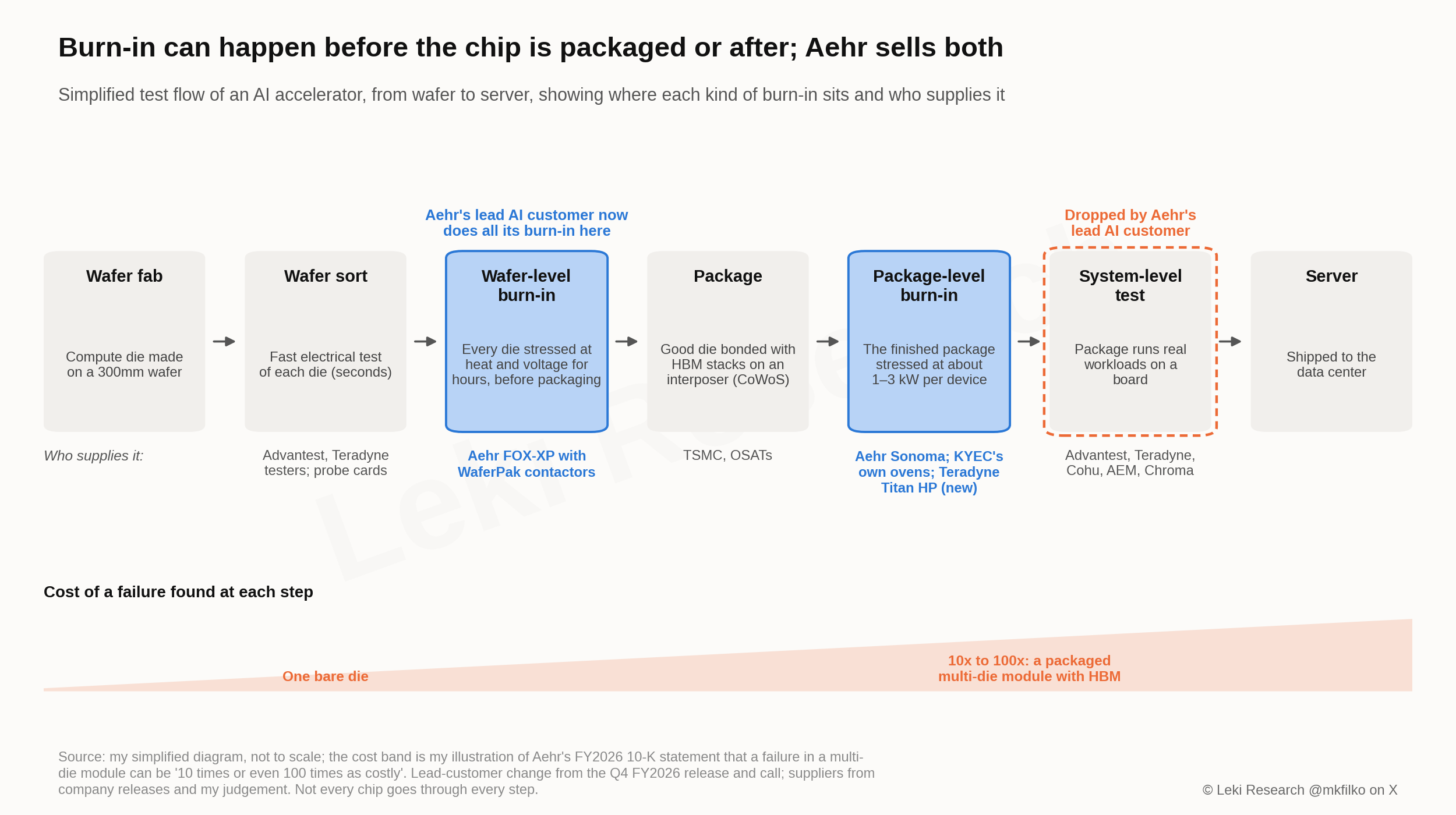
The box marked in orange is the most important fact in this note. Aehr says its lead AI customer moved all of its production burn-in screening to wafer level on Aehr's systems in the past year and "no longer need[s] to perform any system-level screening". If that is repeatable, wafer-level burn-in does not just add a step for AI chips; it replaces two later steps, and its economics improve with every generation as packages carry more memory and cost more to scrap. A second supplier of AI accelerators, CPUs and network processors has completed a paid benchmark, reported results better than it gets at package level, and asked to move to pilot production validation and to evaluate a second device.
The key debate
The October sell-off was a vote on two questions. The first is whether wafer-level burn-in becomes standard for AI processors or stays with one customer. In its favour are the economics above, the lead customer's decision to drop system-level screening, the benchmark result, and follow-on orders of $14 million in February and $22 million in August, with the customer's "current production plans" said to "contemplate capacity beyond this order". Against it, AI chips are increasingly designed with built-in self-test circuits, which make some screening cheaper at later stages, and HBM's latest standard includes self-test as well. Wafer-level burn-in also cannot catch packaging defects, so most flows will keep some package-level step. My view is that the case for wafer level gets stronger as packages get more expensive, but the evidence today is one customer in production and one in evaluation.
The second is whether Aehr can hold its package-level position. Here the competition is real. KYEC, the test house that handles much of NVIDIA's testing, builds its own burn-in ovens rated at 1.5 kW air-cooled and 3 kW liquid-cooled, and on October 13 NVIDIA was reported to have prepaid for KYEC capacity in the United States. Teradyne's Titan HP, launched October 6, holds each packaged device at its target temperature while it runs a real workload, combining burn-in with system-level test, and Teradyne says it is already deployed in production. Oppenheimer's response on October 14 was that Titan HP tests packaged parts and is not a substitute for FOX at wafer level. I agree on wafer level. On package level, Titan HP and KYEC are direct alternatives to Sonoma for the next processor a customer designs, and Aehr has one major Sonoma customer.
Where Aehr sits against the competition
The map below is my judgement, not measured share. At wafer level for AI processors I have found no other supplier in production at this power; the threat there is a large tester maker or a customer building its own tool. At package level Aehr competes with KYEC's in-house ovens, Micro Control Company and now Teradyne. Aehr does not sell system-level test; its pitch is that wafer-level burn-in can make it unnecessary. In its other markets, Aehr's main silicon carbide rival is Suzhou Semight, a lower-cost Chinese supplier, which Aehr sued for patent infringement in China and lost at first instance in December 2025 (the case is on appeal). In memory, Digital Frontier, a subsidiary of Korea's DI Corp, has taken orders for HBM4 burn-in testers from SK hynix, and the large memory makers have their own tools.
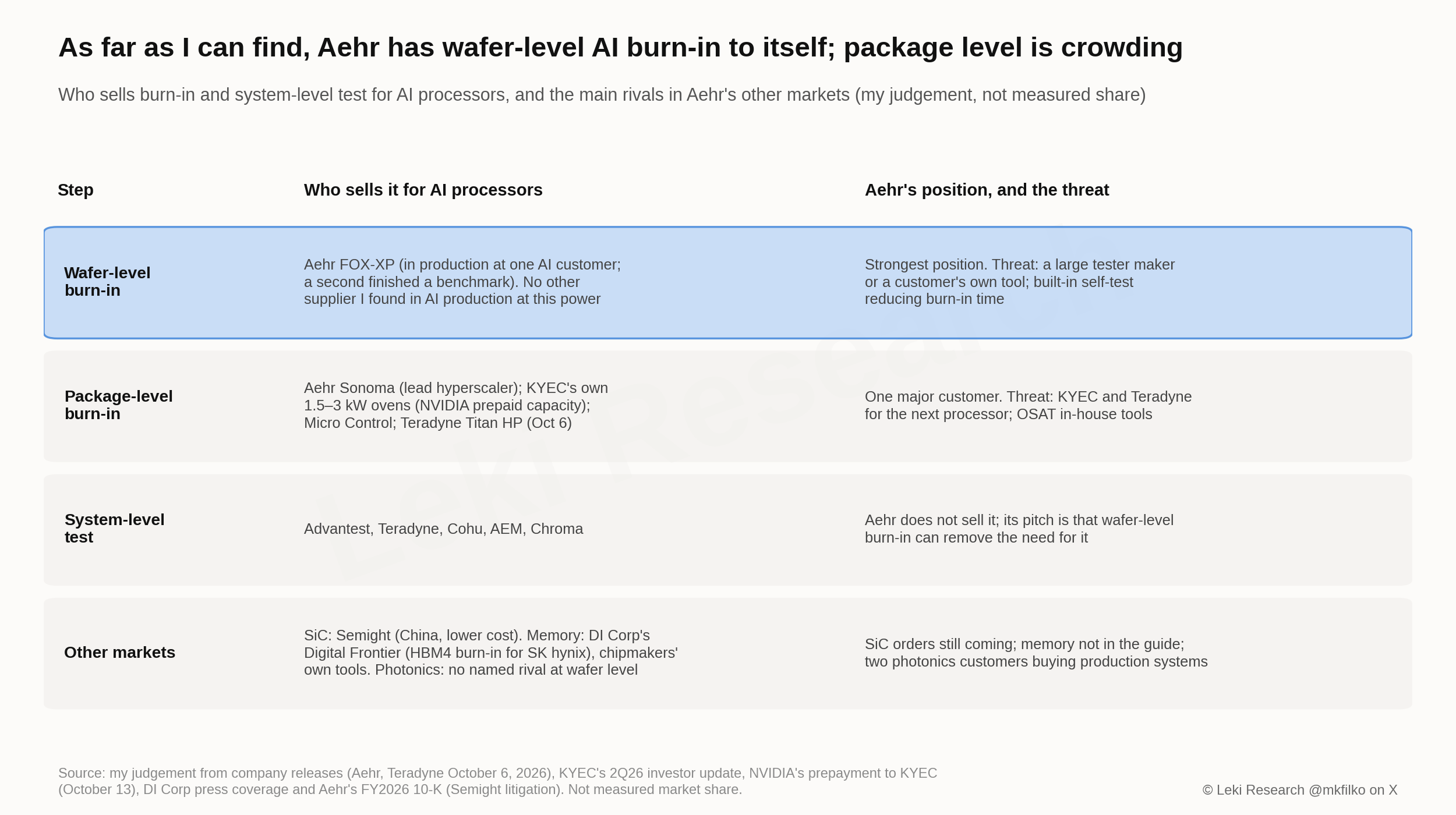
The asymmetry between the two positions matters for the numbers. Fiscal 2027's guide includes both: the $41 million Sonoma order from April and the newer second-processor orders on one side, the $14 million and $22 million wafer-level orders on the other. The bear case does not need Aehr to lose wafer level. It only needs the hyperscaler to split its next processor between Sonoma and a rival, and the wafer-level customer to finish its capacity build, for fiscal 2028 to fall.
Why the customers signed
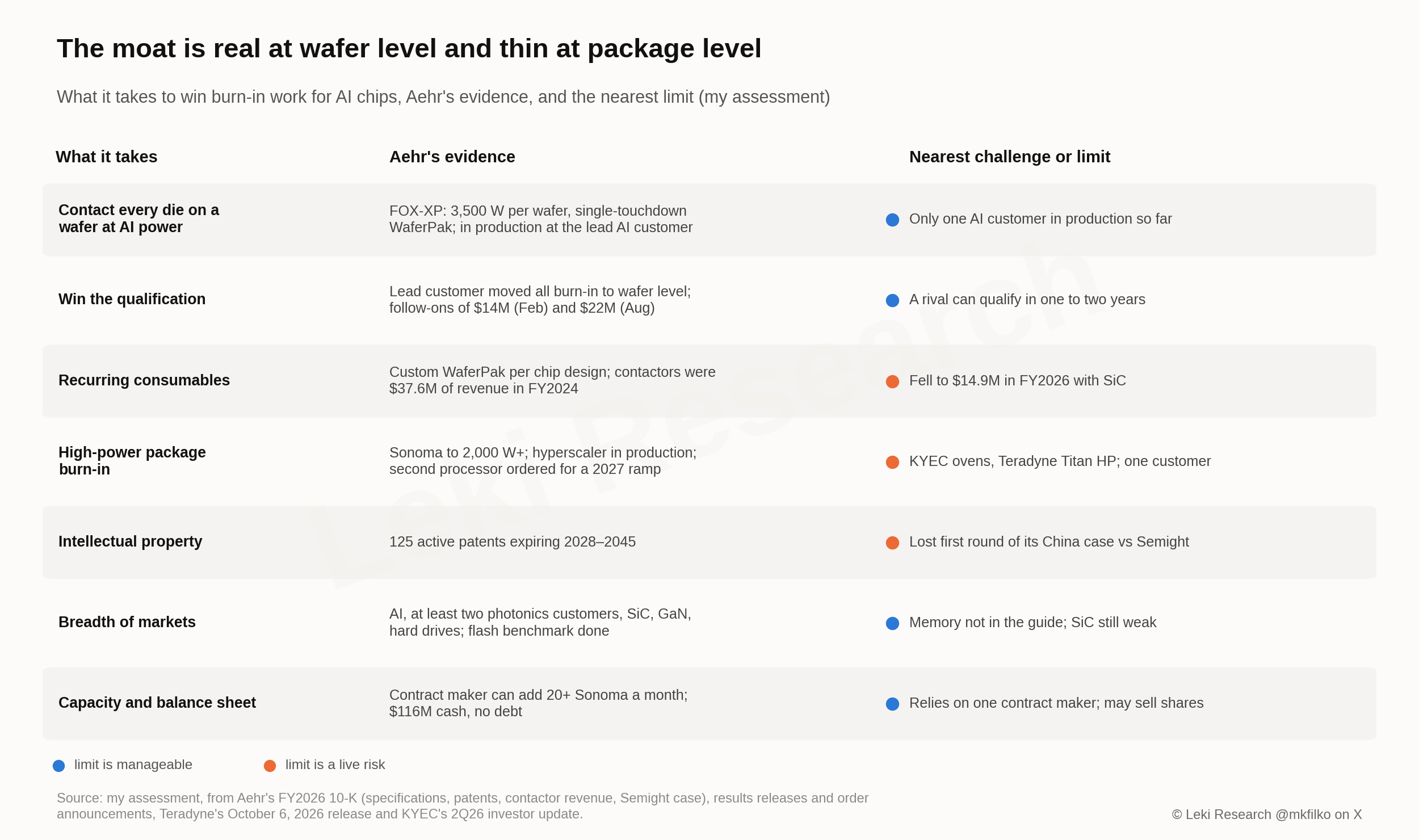
The table below is my assessment of what wins AI burn-in work and where Aehr stands. Its strengths are a contactor that can touch every die on a wafer at AI power, a production qualification at a leading AI chip company, consumables that recur with each new design, a high-power package system already in production at a hyperscaler, a patent portfolio running to 2045, and a balance sheet with $116 million of cash. Its limits are concentration, a recurring revenue stream that fell by more than half when silicon carbide slowed, a package-level product that larger companies can match, and a patent position that has already lost one round in China.
What could break the position
Five things could break it. The first is the lead AI customer finishing its build. Burn-in systems are capacity: once a customer has enough for its volumes, orders fall to replacements, upgrades and WaferPaks for new designs. The second is the next Sonoma decision. The hyperscaler's second processor draws about twice the power of the first and is expected to ship in larger volumes; if part of that volume goes to KYEC or Teradyne, Sonoma revenue can fall even as the customer grows. The third is design change. Better built-in self-test, better yields or a change in how packages are assembled could shorten burn-in times or move screening to another step. The fourth is a large competitor at wafer level. Advantest and Teradyne are each many times Aehr's size, and either could buy or build a wafer-level product; a customer could also build its own. The fifth is silicon carbide: Aehr's old market has not recovered, and the $8 million of new orders in July, while encouraging, is a fraction of what it was.
How I treat the technology in the numbers
I score the moat at 7: strong at wafer level, weaker at package level, and resting on few customers. In the Base, fiscal 2027 revenue is $138 million, just below the guide midpoint, fiscal 2028 rises to $195 million, just below consensus, as the second Sonoma processor ramps and the wafer-level customer adds capacity, and fiscal 2029 reaches $245 million, growth of about 25%, with no second wafer-level AI customer and no memory revenue. The Bull needs the benchmark customer to convert and the second Sonoma processor to ramp at full volume; the Moonshot adds memory and co-packaged optics. The Bear assumes Aehr keeps its wafer-level customer but loses share at package level and that the wafer-level build ends, so revenue falls to $90 million in fiscal 2028 and recovers only to $110 million in fiscal 2029.
4. THE ORDER BOOK
Aehr's revenue follows its bookings with a lag of one to three quarters, so the order book is the best guide to the next year. For two years it was thin. Quarterly bookings ran between $4 million and $24 million from mid-2024 to late 2025, and backlog hovered between $7 million and $19 million. Then the AI orders arrived: $37.2 million of bookings in the February quarter and a record $60.7 million in the May quarter, taking backlog to $80.6 million and effective backlog, which adds orders received before the results release, to $100.6 million.
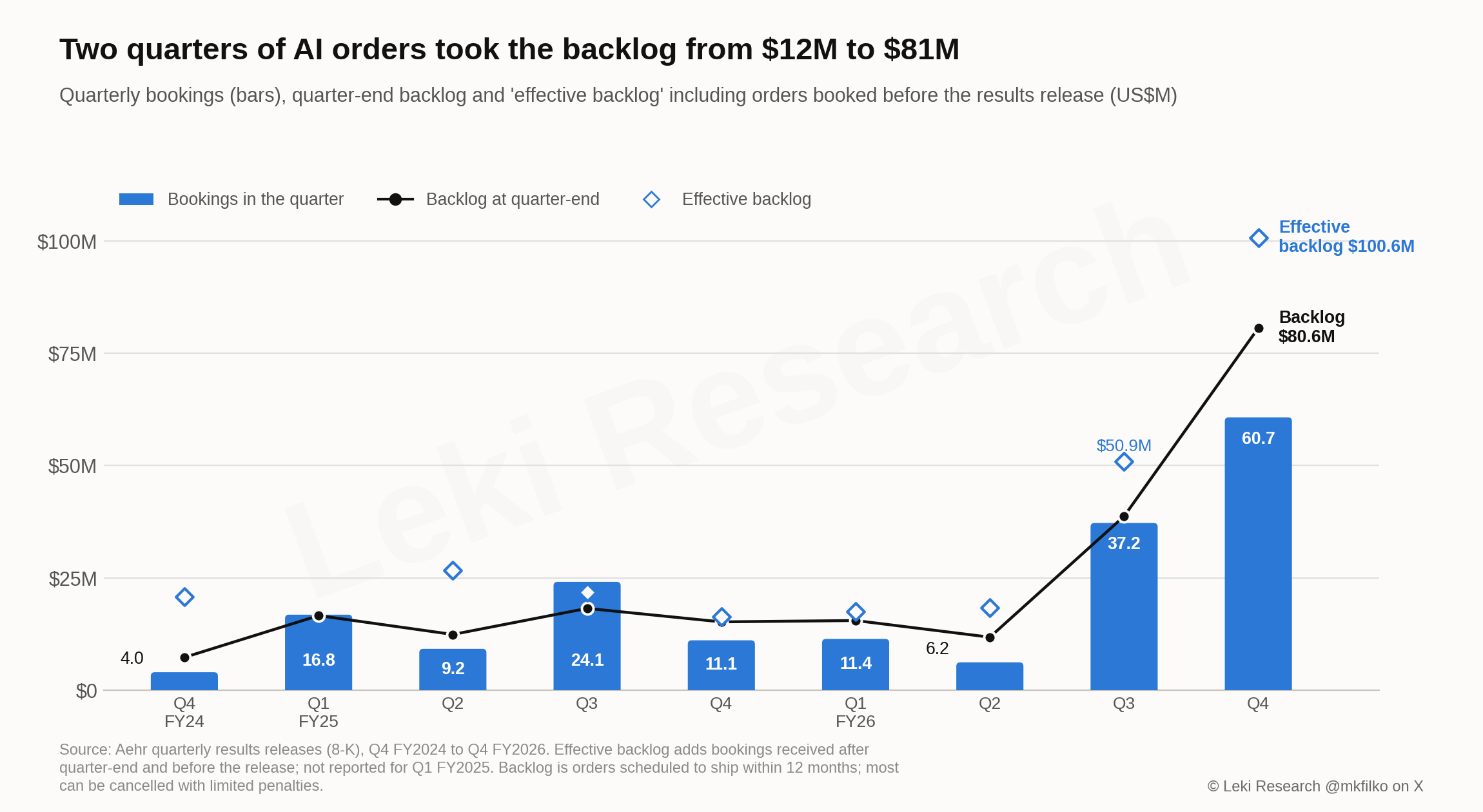
The orders behind that jump are public. The hyperscaler placed a record $41 million Sonoma order on April 16. The lead AI processor customer ordered $14 million of fully automated FOX-XP systems in February. Both silicon photonics customers placed follow-on orders between March and July. And in July Aehr announced about $8 million of silicon carbide orders, one placed directly by "one of the top two leading automotive companies in the world", the first sign of life in that market for more than a year.
Since the July 14 results, three more orders have been announced, shown below: a $22 million wafer-level follow-on from the lead AI customer on August 12, shipping over six months to its production partner in Taiwan; another FOX-XP for the lead silicon photonics customer on August 4, shipping in the first half of 2027, value undisclosed; and about $6 million of Sonoma orders on October 7 for the hyperscaler's second processor, shipping over six months ahead of a production ramp in calendar 2027.
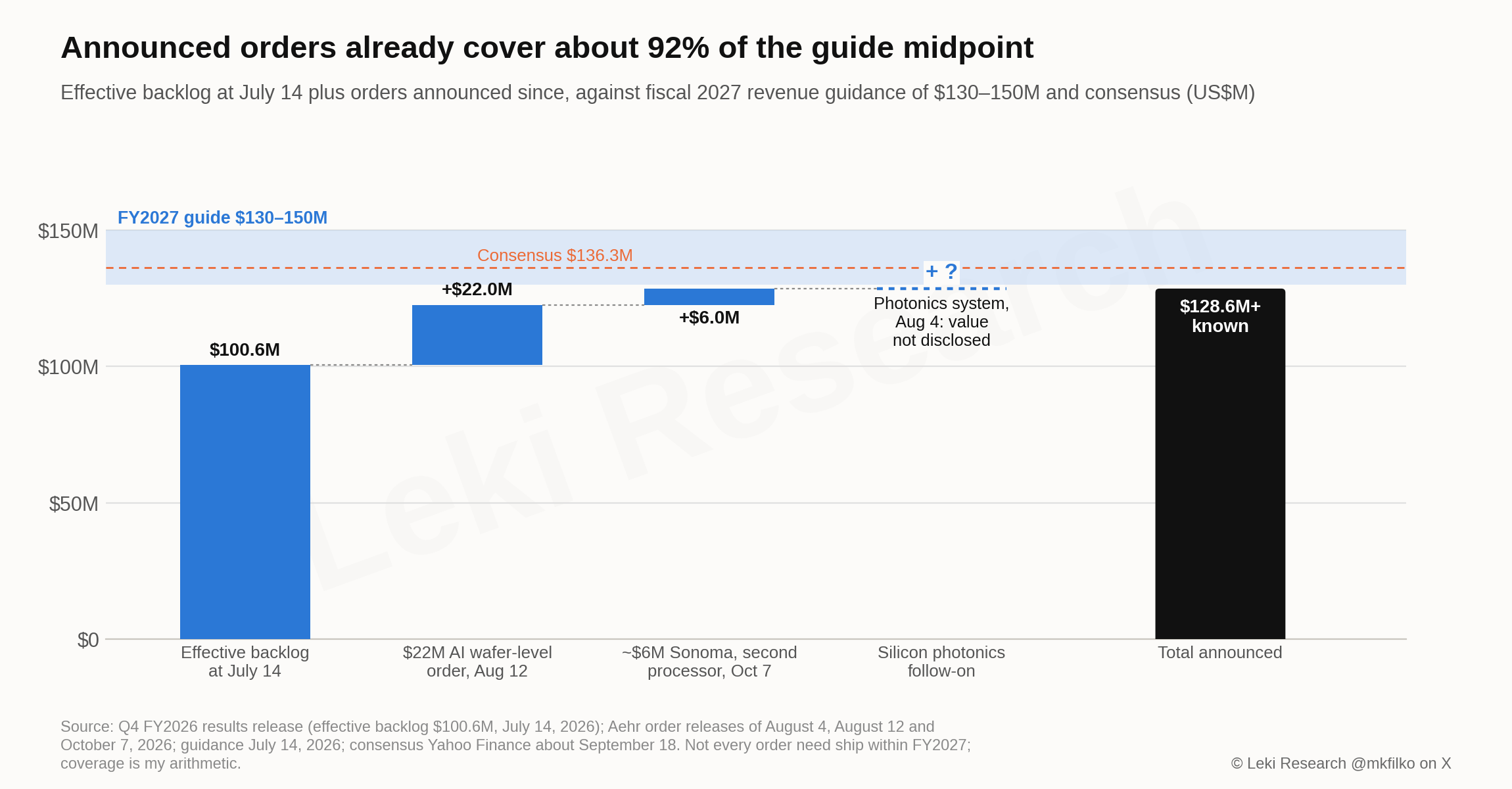
That is at least $128.6 million of known orders against a $140 million guide midpoint, about 92%, with eight months of the fiscal year still to book and ship. Two caveats apply. Not every order in effective backlog will necessarily ship inside fiscal 2027, and backlog can be cancelled with limited penalties. But on the evidence available, the risk to this year's revenue is timing within the year more than the total. The real question for the stock is what fills the order book after the current builds are delivered, which is why I care more about the next two quarters of bookings than the next two quarters of revenue.
There is one timing wrinkle worth knowing before November 2. Management said on the July call that there was "a high likelihood that the first half might be the same or even better than second half" of fiscal 2027, with the second quarter "very strong" and the third "flattish". At the $140 million midpoint that points to first-half revenue of about $70 million or more. Consensus for the first two quarters is $26.6 million and $36.6 million, or $63.2 million. Either the first half beats consensus by about $7 million or more, or the year is tracking nearer the low end of the guide. The Q1 print and any Q2 commentary should tell us which.
5. MARGINS, CASH AND DILUTION
Margins. Aehr's gross margin depends on volume and mix. At $66 million of revenue in fiscal 2024, with a high share of WaferPaks, the GAAP gross margin was 49.1%. It fell to 40.6% in fiscal 2025 and 35.3% in fiscal 2026 as volume fell, contactors shrank and tariffs raised the cost of imported parts. In the May quarter, at $18.8 million of revenue, it recovered to 42.6% GAAP and 44.7% non-GAAP. Non-GAAP operating expenses have run at about $5.4–7.5 million a quarter. The fiscal 2027 guide of non-GAAP net income at 18–22% of revenue implies roughly $23–33 million on $130–150 million of revenue; on the call the CFO described the margin as pretax. With $23.8 million of deferred tax assets to absorb most of the tax, I treat it as close to net income this year. I model non-GAAP net margins of 19% in fiscal 2027, 21.5% in fiscal 2028 and 23% in fiscal 2029 in the Base, which assumes a gross margin in the mid-40s and operating expenses growing more slowly than revenue.
Cash flow. Aehr burned cash through the downturn: operating cash flow was −$7.4 million in fiscal 2025 and −$3.3 million in fiscal 2026, and capital spending fell from $5.0 million to $2.1 million. Inventory has stayed at about $41–44 million for two years, about 83% of fiscal 2026 revenue, which means some of the working capital for this year's growth is already on the balance sheet. Customer deposits rose from $1.8 million to $4.6 million. In my Base, free cash flow is roughly break-even in fiscal 2027, as receivables and inventory grow with revenue, and about $25 million in fiscal 2028.
Dilution. Aehr raised $100 million gross in fiscal 2026 through two at-the-market programmes, in which a company sells new shares into the market over time: $40 million between November 2025 and March 2026 at $25.89–40.88 a share, and $60 million in nine days in April 2026 at an average of $73.87. That added 1.94 million shares, about 6.5% of the count at the start of the year. In July it filed an automatic shelf registration with no dollar cap. With $116 million of cash, no debt and a profitable year guided, Aehr does not need to raise money, but it has shown it will sell shares when the price is high. I assume a $60 million raise in the Bull and $100 million in the Moonshot, at prices well above today's, and none in the Base or Bear. In every case I count the outstanding options and restricted units and about two more years of stock awards, which takes the share count to 34.0–35.0 million by fiscal 2029.
Two accounting points. Aehr carries $23.8 million of deferred tax assets with no valuation allowance, despite pretax losses in fiscal 2025 and 2026; the 10-K says that judgement relies on a return to profitability in fiscal 2027. If the year disappoints badly, a write-down would hit GAAP earnings, though not cash. And the auditor, BPM, named inventory valuation as its critical audit matter, citing limited history for new sales channels. Neither changes my numbers, but both are worth watching if the guide slips.
6. GROWTH DRIVERS
1. Wafer-level burn-in for AI processors
This is the driver that decides whether Aehr is a one-cycle stock. The lead AI processor customer placed an initial production order of about $10 million in December 2024, $14 million in February 2026 and $22 million in August 2026, and has moved all of its burn-in for its AI accelerators to wafer level. Management said on the July call that this customer "no longer need[s] to perform any system-level screening". The second customer, which supplies AI accelerators, CPUs and network processors, completed a paid benchmark that began in August 2025, reported results better than its package-level process, and has asked to move to pilot production validation and to test a second device. If it converts, Aehr will have two of the largest AI chip suppliers on FOX at wafer level, and the evidence that wafer-level burn-in is a standard rather than one customer's preference becomes much stronger. Jefferies, whose $175 target is the Street high, explicitly leaves this conversion out of its model.
2. Sonoma for the hyperscaler's second processor
The hyperscaler has used Sonoma in production since 2025 at its test house in Taiwan, and it ordered 14 systems in July and August 2025 and placed a record $41 million order in April 2026. On October 7 Aehr announced about $6 million of orders for the customer's second processor, which management says draws twice the power per package and is "expected to ultimately reach production volumes exceeding those of the customer's first processor", with a ramp in calendar 2027. The timing has moved: in April Aehr said the next-generation processor was expected to move to production later in 2026. Management also said on the July call that the customer "is forecasting a substantial expansion of Sonoma system purchases" for that device. Higher power per device means more value per system, and Aehr has upgraded Sonoma to about 2,000 W per device with a fully automated handler. This is also the driver most exposed to competition from KYEC and Teradyne.
3. Silicon photonics and co-packaged optics
Silicon photonics chips carry lasers, which drift in output and wavelength early in their lives and need burn-in before calibration. Aehr has sold FOX systems for this for several years, and wafer-level systems revenue rose $10.4 million in fiscal 2026, "primarily from customers in the silicon photonics market". The lead silicon photonics customer placed follow-on orders in March, July and August; the newer networking customer placed its first order in March and a follow-on in June. Management expects silicon photonics to be 15–20% of fiscal 2027 revenue, and its August release said that what began with optical transceivers "is now expanding into optical switching, co-packaged optics". Co-packaged optics, which put optical engines in the same package as a switch or accelerator, would raise the value of screening the lasers before they are packaged.
4. Power semiconductors: silicon carbide and gallium nitride
Electric-vehicle and power chips, mostly silicon carbide, were 92% of revenue two years ago and are now a small part of it. Management sees "encouraging signs of recovery", including the $8 million of orders in July, and onsemi expects its silicon carbide sales into Chinese electric vehicles and AI data center power to grow strongly in 2026, with 800-volt direct-current data center racks ramping from about the end of 2027. Gallium nitride is newer: Aehr took its first production order from a gallium nitride supplier in January 2025 and says it has the first 300mm wafer-level burn-in solution for it, with an automotive customer entering qualification. I give these markets modest growth in the Base and treat a return to the fiscal 2024 level as upside.
5. Memory: HBM and flash
Memory is the option that could change the size of the company. HBM stacks many memory dies on top of each other; one defective die can ruin a stack, so screening before stacking has obvious value, and the 10-K lists HBM as an opportunity. Aehr has completed a benchmark for flash memory and proposed a solution for high-bandwidth flash. Management said memory "could drive orders in fiscal 27 with ramps in fiscal 28", but the CEO also said "I would be hesitant for you to build models with a lot of revenue in that yet", and the fiscal 2027 guide includes none. I include memory only in the Moonshot.
7. LEADERSHIP ANALYSIS
Key executives
Gayn Erickson, President and CEO since January 2012, aged 61. Before Aehr he ran the memory test business at Verigy, the Agilent spin-off later bought by Advantest, as senior vice president and general manager from 2006 to 2011, and before that held senior roles at Agilent and in Hewlett-Packard's automated test group. He is the architect of the wafer-level strategy, the silicon carbide win, the Incal acquisition and the move into AI. His record on strategy is good: he found a market for wafer-level burn-in, rode it to $66 million of revenue, and when it collapsed he had already bought the product and the customer that are now driving the recovery. His record on forecasting is not.
Chris Siu, CFO since June 2023. Previously senior vice president of finance, treasurer and chief accounting officer at Ultra Clean Technologies, and corporate controller at GlobalFoundries, with earlier roles at PDF Solutions, Trident, Varian, Deloitte and EY. He ran both at-the-market programmes in fiscal 2026 and the change of fiscal year-end.
Rhea Posedel, founder and chairman since 1977, aged 83. He was CEO until 2012 and executive chairman until 2013. The board treats him as independent; there is no lead independent director.
Other operationally important executives are Didier Wimmers, executive vice president of research and development since March 2025, after his predecessor Avi Ray Chaudhuri died; Alberto Salamone, who runs the package-level business and joined with Incal; Adil Engineer, chief operating officer; Vernon Rogers, executive vice president of sales and marketing; and Donald Richmond, chief technology officer.
Insider ownership and trading
Directors and officers own 4.6% of the company, 1.49 million shares, of which Posedel holds 1.5% and Erickson about 260,000 shares. In the twelve months to October 18, 13 directors and officers made about 50 open-market sales, on my count of the Forms 4, of roughly 705,000 shares worth about $60.8 million, and none bought. Erickson sold 152,824 shares at $70.58 on April 10 and 40,000 at about $131 on August 12, about $16.0 million in all. A director, Mr. Scott, sold $12.7 million and Posedel $9.5 million.
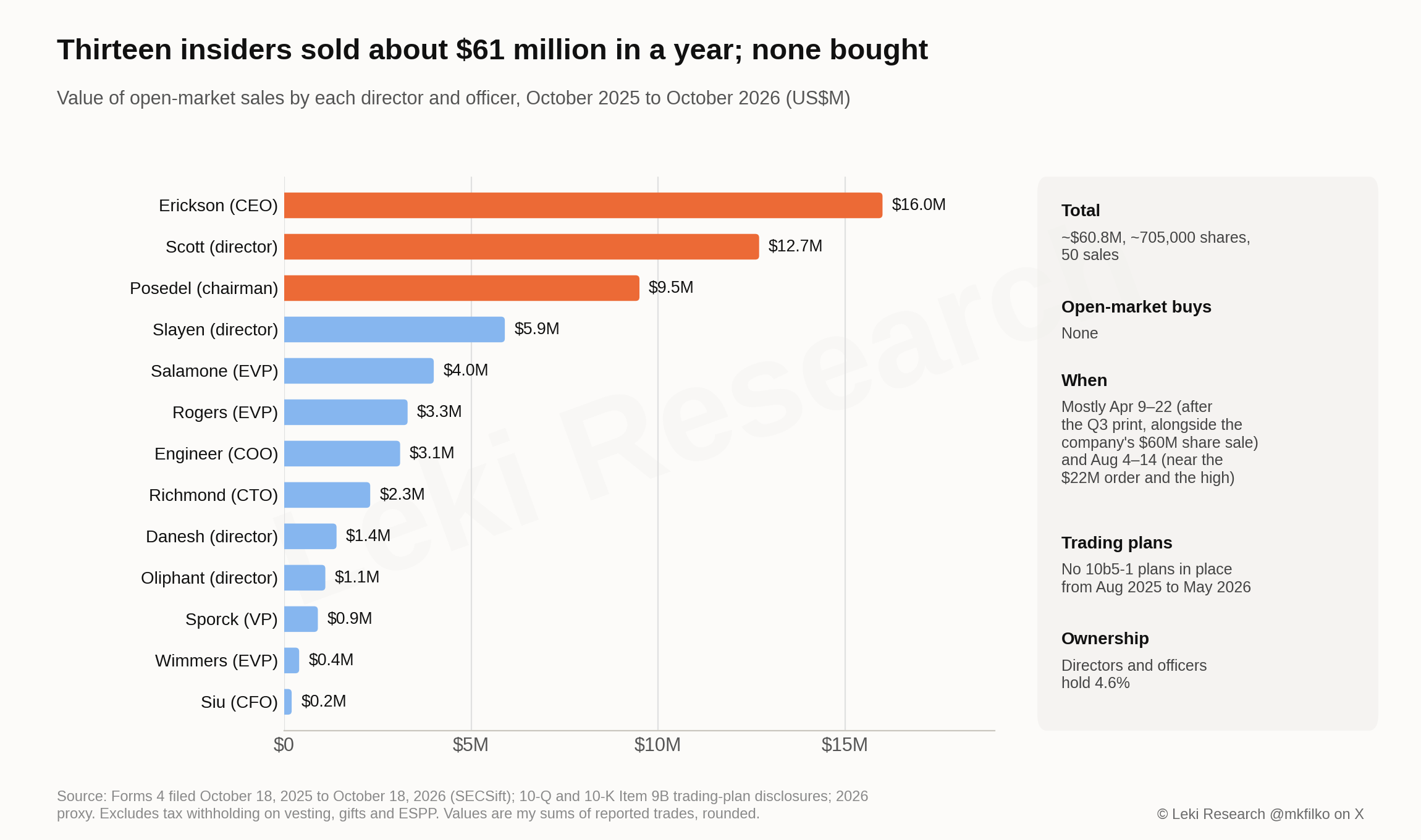
The timing matters as much as the size. Most of the sales clustered in two windows: April 9–22, right after the Q3 print and while the company was running its own $60 million share sale, and August 4–14, around the $22 million order and the stock's peak. The company's filings say no director or officer had a 10b5-1 pre-arranged trading plan in place from August 2025 to May 2026, so the April sales were discretionary; whether any plan covered the August sales will be disclosed in the next 10-Q. Selling after a stock has risen several times over is not wrongdoing, and directors who held through the silicon carbide collapse are entitled to take money off the table. But a management team selling heavily alongside a company share sale, and buying nothing when the stock halves, tells me how much of the upside they see as already priced. The CEO's pay is mostly in stock, with performance units tied to cumulative revenue targets in certain markets through June 2027; his fiscal 2026 revenue and profit bonus was not earned (he received a $40,000 personal-performance bonus) and one tranche of performance units was cancelled when its goals were missed.
Guidance track record
| Fiscal year | Guide given | Changes | Outcome | Verdict |
|---|---|---|---|---|
| FY2024 (to May 2024) | Revenue ≥$100M (July 2023, reaffirmed in October) | Cut to $75–85M (January 9, 2024); cut to ≥$65M (March 25, 2024) after electric-vehicle orders were delayed | $66.2M | Cut twice |
| FY2025 (to May 2025) | Revenue ≥$70M; pretax profit ≥10% (July 16, 2024) | Reaffirmed October and January, with the profit measure changed to non-GAAP; withdrawn April 8, 2025, citing tariffs | $59.0M; non-GAAP pretax margin 7.1% | Withdrawn, then missed |
| H2 FY2026 (December 2025 to May 2026) | Revenue $25–30M; non-GAAP EPS $(0.09) to $(0.05); bookings $60–80M (January 8, 2026) | April 7: full year "on the high side" of $45–50M | Revenue $29.1M; non-GAAP EPS about +$0.06; bookings $97.9M; full year $50.0M | Met or beat on every line |
| FY2027 (to June 2027) | Revenue $130–150M; non-GAAP net income 18–22% of revenue (July 14, 2026) | None | First data November 2 | Pending |
From Aehr's results releases and 8-Ks. H2 FY2026 EPS is my derivation from the reported quarters.
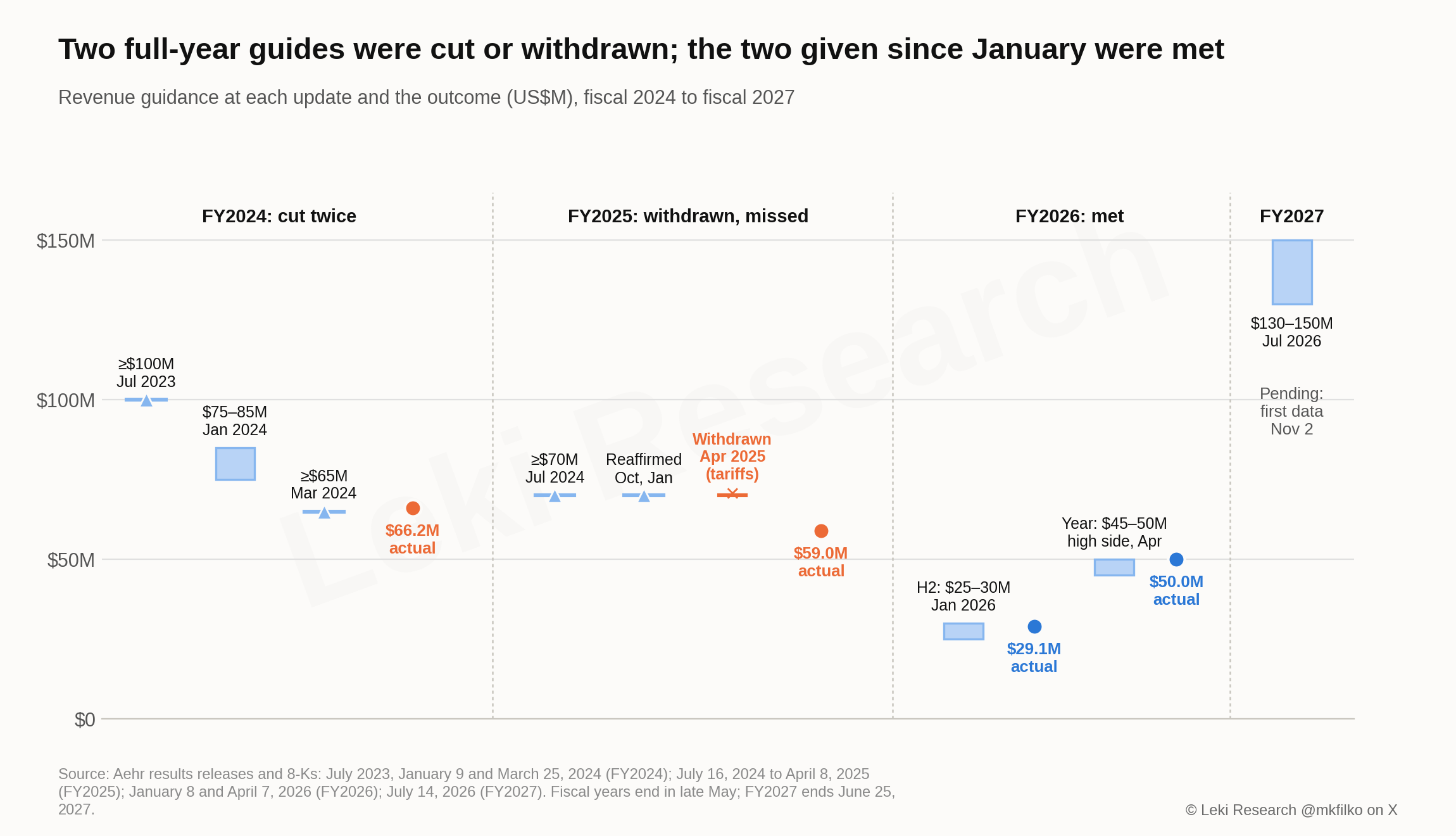
This is the weakest part of the case. In two consecutive years management gave a full-year number at the start of the year and then cut it or withdrew it, and both years ended well below the original guide. The reasons were real, a silicon carbide downturn and a tariff shock, but they are the kind of reasons a business with concentrated customers will always face, and the guides were set without enough margin for them. Since guidance was reinstated in January the record has been good: the second-half guide was met at the top of the range and bookings came in well above it. The fiscal 2027 guide is also better supported than the earlier ones, with about 92% of the midpoint already in announced orders. Under my framework a reset-the-bar pattern caps Leadership at 6, and two full-year resets in three years is that pattern. One more year of guides that hold would lift the cap.
Capability for the next step
The transition Aehr faces is from a $50 million company with one dominant market to a $140 million company serving several large AI customers at once, with systems built by a contract manufacturer and installed at test houses in Taiwan. It has never reported revenue above $70 million in a year. It has done parts of this before: it scaled silicon carbide production with one customer, integrated Incal, and qualified its contract manufacturer to ship directly in the May quarter. Erickson's Verigy background is in exactly this kind of high-volume test business. I do not see a capability gap at the top; I see a forecasting gap and a thin bench below the CEO, with a research head who has been in the job for 19 months and a 10-K that notes there is no key-person insurance on Erickson.
Red flags
I found no restatements, material weaknesses, going-concern language, related-party transactions in fiscal 2026 or SEC actions, and the auditor, BPM, has not changed. The governance points are the founder-chairman, aged 83, being counted as independent with no lead independent director; the volume and timing of insider sales described above; and the deferred tax asset carried without an allowance. Aehr's own patent suit against Semight in China was dismissed at first instance for insufficient evidence of infringement, and it is appealing. None of these is disqualifying. Together they keep Leadership at the cap rather than above it.
8. FORWARD OUTLOOK: TAILWINDS AND GUIDANCE
Structural tailwinds
Rising power and value per AI package (captured). Each generation of AI accelerator draws more power and carries more HBM, which raises both the difficulty of burn-in and the cost of finding a failure late. Burn-in chambers had to move from about 600 W to 1 kW per device for Blackwell, Rubin is expected to draw well above 1,000 W, and the hyperscaler's second processor draws twice the power of its first. This is the trend Aehr is directly paid for, through Sonoma's higher-power configurations and through FOX at wafer level.
The shift of screening to the wafer (captured, early). The lead AI customer's decision to move all burn-in to wafer level and drop system-level screening is the clearest evidence for a broader shift. If a second large AI chip supplier follows, the addressable market for wafer-level burn-in in AI grows from one customer's capacity to a share of the whole accelerator industry.
Optical interconnect in AI data centers (partly captured). Silicon photonics transceivers and, later, co-packaged optics all carry lasers that need burn-in, and Aehr has production customers in this market today. The co-packaged optics opportunity is adjacent until volumes arrive, which most of the industry expects from 2027–28.
Power conversion for AI data centers (adjacent). onsemi expects 800-volt direct-current rack power, which uses silicon carbide and gallium nitride, to ramp from about the end of 2027. That would help Aehr's old market, but on a timeline beyond fiscal 2027.
The overall burn-in equipment market is small: one research firm, which the publisher does not name, puts burn-in test systems at $756 million in 2024 rising to $1.45 billion by 2031, about 10% a year. Aehr's guide alone is nearly a fifth of the 2024 figure. That is a reason for caution about the size of the prize at package level, where Aehr competes for a slice of a modest market, and a reason to focus on wafer level, where Aehr is effectively creating the market for AI chips.
Latest guidance, in management's words
From the July 14 release: "For the fiscal year ending June 25, 2027, Aehr expects total company revenue to be between $130 million and $150 million, representing approximately 160%-200% year-over-year growth. Aehr also expects non-GAAP net income to be 18% to 22% of total revenue." On the call, management said AI would be "70-ish percent" of revenue and silicon photonics 15–20%, that there was "a high likelihood that the first half might be the same or even better than second half", that the company is not capacity limited at $150 million, and that memory "could drive orders in fiscal 27 with ramps in fiscal 28".
What management did not guide to is as useful. It gave no quarterly revenue, no fiscal 2028 outlook, no GAAP margin, no customer-by-customer split and no memory revenue. It also has not said how the four-week transition period between the old and new fiscal years will be presented; that period had minimal shipments, and together with the first two weeks of fiscal 2027 it brought about $20 million of bookings.
Gap analysis
The valuation needs more than the guide. At my Base multiple of 35 times earnings and a 23% net margin, $60.60 implies about $238 million of fiscal 2029 revenue, 1.7 times this year's guide midpoint and 18% above fiscal 2028 consensus. That is a modest growth path after this year, roughly what my Base assumes. Applying a discount for management's forecasting record, I take the guide's low end, $130–140 million, as the realistic outcome for fiscal 2027 and the existing order book as the main support for it. The gap that matters is fiscal 2028: consensus of $202 million needs about 44% growth from the guide midpoint, which needs either the second Sonoma processor at full volume or a second wafer-level AI customer. Neither is in hand yet.
What I am watching on November 2
| Data point | Confirms | Disappoints |
|---|---|---|
| Q1 FY2027 revenue (consensus $26.6M) | $27M or more, with first-half commentary at or above $70M | Below $24M, or a first half that implies the low end of the guide |
| Bookings and effective backlog | Bookings of $25M or more and effective backlog of $100M or more | Bookings below $15M and effective backlog falling below $85M |
| FY2027 guide | Reaffirmed at $130–150M or raised | Narrowed to the low end or cut |
Beyond the numbers, I want a date for the benchmark customer's pilot production validation or a first production order, confirmation of the second Sonoma processor's volume and timing with no sign that the customer is splitting it with another supplier, any mention of a second hyperscaler on Sonoma, and how management describes Teradyne's Titan HP. A specific answer on the last would tell me how worried it is.
9. BULL CASE
The November 2 print shows a first quarter near or above consensus, bookings that hold effective backlog above $100 million, and a guide reaffirmed at $130–150 million, and fiscal 2027 lands at the top of the range. The benchmark customer moves to pilot production in the first half of calendar 2027 and places its first production order, so that two of the largest AI chip suppliers burn in at wafer level on FOX. The lead customer keeps adding capacity as its next generation ramps. The hyperscaler's second processor ramps on Sonoma in calendar 2027 at twice the power and more than the first processor's volume, and Aehr keeps most of it despite KYEC and Teradyne. Silicon photonics grows with co-packaged optics.
In that world revenue reaches about $290 million in fiscal 2028 and $470 million in fiscal 2029, the non-GAAP net margin rises to about 27% as volume spreads the fixed costs, and fiscal 2029 non-GAAP net income is about $127 million, or $3.67 a share. That is about three times this year's output. Management says its capacity is measured in hundreds of millions of dollars and its contract manufacturer can add more than 20 Sonoma systems a month, so I treat capacity as something to watch rather than a cap, but it has not been tested at that scale. At 45 times, about where Advantest trades today, plus about $213 million of cash after a $60 million share sale at a much higher price, the stock is worth about $171, just under Jefferies' $175 target.
The Moonshot adds memory. Aehr wins wafer-level burn-in for HBM or flash at one of the large memory makers, co-packaged optics arrives at volume, and a second hyperscaler adopts Sonoma. Revenue reaches about $680 million in fiscal 2029 at a 29% margin, and the market pays 45 times. That is about $261, above every published target. It requires memory, which management has told investors not to model yet, and several large customer decisions to go Aehr's way inside two years, which is why it carries 11%.
The argument underneath both is that the market is pricing this year as the peak. The order book says this year is mostly done, the customers keep ordering more, and the economics of burning in before packaging improve with every generation of AI chip.
Bull value: $171. Moonshot: $261.
10. BEAR CASE
The bear is not a balance-sheet case. Aehr has $116 million of cash, no debt and a profitable year guided. It is a demand case: that this year's AI orders are a capacity build that ends, and that Aehr's share of the next one is smaller.
Leg one: the builds end. The lead AI customer finishes equipping its wafer-level line with the $22 million order, the hyperscaler's first processor reaches full capacity, and orders fall to WaferPaks, upgrades and replacements. Aehr's history shows how fast that happens: contactor revenue fell by more than half in two years when silicon carbide customers stopped adding capacity.
Leg two: the next processor is shared. The hyperscaler splits its second processor between Sonoma and KYEC or Teradyne Titan HP, or moves package-level burn-in in-house at its test house. NVIDIA's prepayment to KYEC shows the largest buyer prefers a test house that builds its own equipment. Sonoma revenue falls even as the customer's volumes rise. The second processor has already slipped once: in April Aehr expected it in production later in 2026, and in October it put the ramp in calendar 2027.
Leg three: wafer level stays with one customer. The benchmark customer decides package-level burn-in with better self-test is good enough, or builds its own approach. Wafer-level burn-in for AI remains one company's choice rather than an industry standard.
Leg four: management misses again. The guide is cut in the second half as orders slip, as happened in fiscal 2024 and fiscal 2025. The stock has already fallen 27% in a day on a miss (January 2025) and 17% in a day on a print without guidance (October 2025).
Leg five: the tape, the insiders and the shelf. The stock has a beta of about 3.5, short interest of 17% of the float, and fell 42% in nine sessions this month. Insiders sold about $61 million in a year and bought nothing. An uncapped shelf is on file, and the company sold $60 million of stock in nine days in April.
Bounded? Yes. In my Bear, fiscal 2027 comes in at $115 million, below the guide, fiscal 2028 falls to $90 million and fiscal 2029 recovers to $110 million at a 10% net margin. At 3 times fiscal 2029 sales, about where the company's enterprise value traded relative to sales at its April 2025 low, plus about $121 million of cash, that is about $13 a share, 78% below today. The precedents are the stock's own path: $6.78 at the close on April 8, 2025, when revenue was falling, and $19.40 last November. Cash of about $3.55 a share and a business that still sells to AI, photonics and power customers put a floor under the value, but the fall to that floor would be long.
11. SCORING
| Dimension | Score |
|---|---|
| Revenue Quality (RQ) | 5 |
| Revenue Growth (RG) | 8.5 |
| Moat / IP (M) | 7 |
| Leadership (L) | 6 |
| Asymmetry (A) | 7 |
| Conviction Gap (CG) | 8 |
| Composite | 6.92 (41.5 / 6) |
Revenue Quality: 5. The revenue is real and audited, sold to some of the largest and best-funded chip buyers in the world, and it has started to diversify: the largest single customer's share fell from 67% of revenue to 26% in two years. Against it, this is lumpy capital equipment with orders that can be cancelled, the top five customers were still 70% of revenue last year, this year's growth comes mainly from two customers, and the recurring consumables stream more than halved when its main market slowed. The score is descriptive, not predictive.
Revenue Growth: 8.5. Revenue is guided up 160–200% this year, about 92% of the midpoint is already in announced orders, and consensus has it growing another 48% in fiscal 2028 from its own fiscal 2027 estimate. There are five separate drivers, two of them with orders in hand for 2027 ramps. It is not 9 or 10 because the growth after this year depends on decisions customers have not yet made, management has guided a flattish third quarter, and memory, the largest option, is not in the numbers.
Moat / IP: 7. The base is 7. At wafer level, Aehr has the only production burn-in for AI processors that I can find, a contactor that took a decade to develop, a qualification that a customer has used to remove a later test step, consumables that recur with each new design and 125 patents. At package level the position is weaker: Sonoma is good equipment in a market where KYEC builds its own and Teradyne has just entered. What would lift it further is evidence I do not yet have: a second hyperscaler (the AI chip and networking customers are not hyperscalers), a partner with its own capital at risk (customer deposits of $4.6 million are not that), alignment with a platform leader's reference design, or five or more named deployments (no customer is named). So it stays at 7. A second AI processor customer in wafer-level production, or a second hyperscaler on Sonoma, would move it to 8.
Leadership: 6. Erickson's strategy has been right more often than not: he built the wafer-level business, found the AI market before the silicon carbide market collapsed, and bought the product and customer that drive this year. Since January his guides have been met. But the fiscal 2024 guide was cut twice and the fiscal 2025 guide was withdrawn, both ending well below the original number, which is the reset-the-bar pattern that caps Leadership at 6 under my framework. The board structure, with an 83-year-old founder-chairman counted as independent and no lead independent director, would hold it at 6 on its own, and the heavy insider selling alongside the company's own share sale is a further reason not to go higher.
Asymmetry: 7. The probability-weighted value is $101.25 against $60.60, so EV/spot is 1.67x (Section 12), in the upper half of the 1.5–1.8x band (6–7). The sensitivities show where it is fragile:
| Change | EV/spot |
|---|---|
| Published case | 1.67x |
| Bear probability 30% (30/37/24/9) | 1.51x |
| No Moonshot (25/48/27/0) | 1.31x |
| Bear and Base at 70% (30/40/22/8) | 1.44x |
| Base valued at 30x ($54) | 1.62x |
| Base valued at 42x ($74) | 1.74x |
| Bull valued at 35x ($135) | 1.51x |
| Moonshot valued at 35x ($204) | 1.57x |
| Base FY2029 revenue 15% lower ($54) | 1.62x |
| Base FY2029 net margin 19% ($52) | 1.61x |
| Bear at $6.78, the April 8, 2025 closing low | 1.64x |
| At the October 15 close ($69.21) | 1.46x |
| At the October 5 close ($104.40) | 0.97x |
| At the August 17 closing high ($145.61) | 0.70x |
| At the November 20, 2025 closing low ($19.40) | 5.22x |
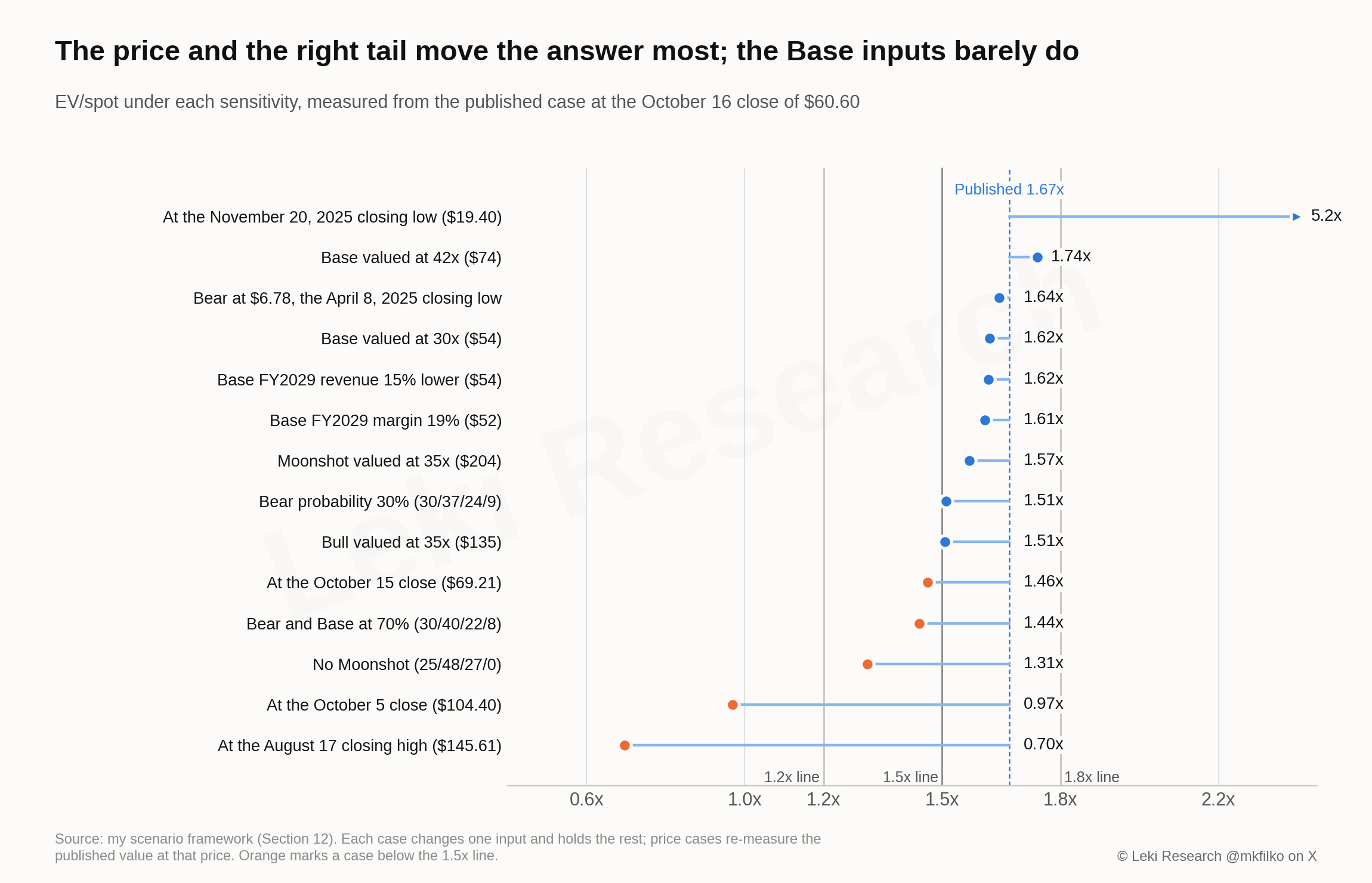
Changes to the Base barely matter, because the Base is worth about the price whatever reasonable inputs I use. What matters is the right tail and the entry price. The Bull and Moonshot together contribute about $75 of the $101.25, or 74%. Remove the Moonshot and the ratio falls to 1.31x, into the zone where Asymmetry scores 4 and the framework says pass. Move to Bear and Base at 70% and it is 1.44x. And the price does a lot of the work: two weeks ago, at $104.40, this was a 0.97x. Anyone buying here is buying the option on a second wafer-level customer and a larger Sonoma generation, with a bounded but deep downside if neither arrives.
Conviction Gap: 8.
What is unknown today:
- the first quarter's revenue and bookings, and whether the first half supports the full-year guide;
- whether the benchmark customer moves to pilot production and then production;
- how much of the hyperscaler's second processor Sonoma wins, against KYEC and Teradyne;
- what follows the lead AI customer's current wafer-level build;
- whether memory becomes a real opportunity;
- what fiscal 2028 looks like.
How the evidence points: mostly the right way. Record bookings, effective backlog of $100.6 million, follow-on orders from every AI and photonics customer since July, a second Sonoma processor ordered ahead of its ramp, a benchmark customer reporting better results than its current process, and two guides met since January. Against that sit a new package-level competitor from a company 25 times Aehr's size, a second Sonoma processor whose production start has moved from late 2026 to 2027, NVIDIA's prepayment to KYEC, a history of guide cuts, and insiders who sell and do not buy.
What converts the gap: the Q1 print on November 2; the Q2 print around late January or early February, which management has called "very strong"; any announcement of pilot production or a production order from the benchmark customer (no date given); the fiscal 2027 results and fiscal 2028 guide around July 2027.
Timeline: two weeks for the first event, about three to four months for the second, and nine months for the fourth.
A wide gap with evidence pointing mostly one way and a conversion event within weeks puts this in the 7–8 bracket. I score it 8 because the next two prints and one customer decision will settle most of what is unknown, and thin, crowded coverage is part of why the price can move so far from the evidence.
Gates. Asymmetry 7 clears the minimum of 5. Moat 7 clears the quality gate on its own, and Conviction Gap 8 would too. Leadership 6 clears 5. The composite of 6.92 clears 5.5. The bear case is bounded by $116 million of cash, no debt and a diversified if small business. Every gate clears.
12. PRICE TARGET FRAMEWORK AND VERDICT
How the values are built. For each scenario I set revenue for fiscal 2027 to 2029 and a non-GAAP net margin for each year. I value the business at about mid-2028 as a multiple of fiscal 2029 non-GAAP net income, or of fiscal 2029 sales in the Bear, where earnings are too small to carry a multiple, and add the cash each scenario holds by then. Cash starts at $116.4 million and moves with non-GAAP net income plus about $2 million a year of depreciation, less capital spending of $3–8 million a year and working capital of 25% of each year's change in revenue, plus the share sales assumed in the Bull and Moonshot. Diluted shares are 34.0 million in the Bear and Base, 34.6 million in the Bull and 35.0 million in the Moonshot.
For multiples, 3 times sales in the Bear is about where the company's enterprise value traded relative to sales at its April 2025 low. 35 times earnings, the Base, is near the median of nine test and inspection peers today (32.7x) and is applied to earnings two and a half years out. 45 times, the Bull and Moonshot, is about Advantest's multiple today, for a company that would by then be growing faster than Advantest.
| Scenario | Prob. | Price | vs $60.60 | What has to be true | Value basis and anchor |
|---|---|---|---|---|---|
| Bear | 25% | $13 | −78% | The AI builds end and the next Sonoma processor is shared; revenue ~$115M (FY27), ~$90M (FY28), ~$110M (FY29) at a 10% net margin | 3x FY2029 sales of ~$110M; cash ~$121M. Precedents: $6.78 on April 8, 2025; $19.40 on November 20, 2025 |
| Base | 37% | $62 | +3% | Guide met just below its midpoint; ~$138M, ~$195M, ~$245M as the second Sonoma processor ramps and the lead customer adds capacity; no second wafer-level customer and no memory; net margin 19%, 21.5%, 23% | 35x FY2029 non-GAAP net income of ~$56M ($1.66 a share); cash ~$143M. Below every published target (lowest: $110) |
| Bull | 27% | $171 | +183% | Benchmark customer converts; second Sonoma processor at full volume; photonics grows; ~$150M, ~$290M, ~$470M at a 27% margin by FY2029 | 45x FY2029 non-GAAP net income of ~$127M ($3.67); cash ~$213M after a $60M share sale. Anchored to the Street high: Jefferies $175 |
| Moonshot | 11% | $261 | +330% | Memory wins, co-packaged optics at volume, a second hyperscaler; ~$680M in FY2029 at 29% | 45x FY2029 non-GAAP net income of ~$197M ($5.63); cash ~$255M after a $100M share sale. Above every published target |
Probability-weighted EV: $101.25. EV/spot: 1.67x.
How the market prices the peers. On consensus, Aehr trades at 81 times fiscal 2027 earnings and 44 times fiscal 2028. Nine test and inspection peers trade at 21–45 times forward earnings, with a median of 32.7: Advantest at 44.6, Chroma at 42.8, Cohu at 35.1, Teradyne at 33.3 and AEM at 32.7 at the top of the group. On next year's numbers Aehr is priced like Advantest, the leader in AI test; on this year's, it is priced at about two and a half times the group. That premium is the market paying for growth of 48% in fiscal 2028 on consensus, against single digits to the low twenties for most of the peers.
The price lines.
| EV/spot | Price |
|---|---|
| 2.0x | $50.63 |
| 1.8x | $56.25 |
| 1.5x | $67.50 |
| 1.35x | $75.00 |
| 1.2x | $84.38 |
At $60.60 the stock sits 10% below the 1.5x line and 8% above the 1.8x line. Since April 8 it has closed below $67.50 on four days (April 8, July 7, July 29 and October 16), and it has not closed below $56.25 since April 7. Between $67.50 and $75.00 the risk/reward is thin, and above about $75.00, where EV/spot falls below 1.35x and Asymmetry to 4, it is a pass; the chart below marks that line. The stock was above that line as recently as October 13.
The Street. The five published targets run from $110 (Lake Street and Freedom Broker) to $175 (Jefferies), with Craig-Hallum at $125 and Oppenheimer at $120, averaging about $128. Every one sits well above my Base; all but Jefferies' sit below my Bull. Oppenheimer reiterated its rating and target on October 14, after the Titan HP launch. I use the Street only to anchor the Bull. Jefferies' model excludes memory, co-packaged optics, the benchmark customer and a return to peak silicon carbide, so even the Street high assumes less than my Bull in some respects and more in others.
What spot implies. At 35 times earnings and a 23% margin, $60.60 needs about $238 million of fiscal 2029 revenue. That is about my Base: this year's guide met, then about 40% growth in fiscal 2028 and 25% in fiscal 2029, with no second wafer-level customer and no memory. Put another way, the market is paying for the orders it can see and nothing for the decisions customers have yet to make.
Why the probabilities sit where they do. The Bear is at 25%, higher than I would use for a management team with a cleaner forecasting record, because the guides for fiscal 2024 and 2025 both broke, two customers carry most of this year, and larger competitors have just entered the package-level market. It is not higher because the order book covers most of this year and every AI customer has come back for more. The Base is at 37% because it asks only for the guide and the orders already in view. The upside is at 38%: Bull 27%, which needs one more large customer decision to go Aehr's way, and Moonshot 11%, which needs memory.
The bet, stated plainly. At $60.60 a buyer pays about $1.86 billion for a company with revenue guided to $130–150 million this year, about 92% of it already ordered, the only production wafer-level burn-in for AI chips that I can find, a hyperscaler customer ordering for its next processor, and $116 million of cash. In exchange the buyer accepts two dominant customers, a management team that has broken two full-year guides, larger competitors at package level, insiders who sell, and a stock that halved in two months. If the guide is met and growth fades, I think the stock is worth about $62. It takes a second wafer-level AI customer or a full Sonoma win on the next processor to reach $171. If the builds end and the next processor is shared, I think it is worth about $13.
Verdict: investable at $60.60. The scores support it: the composite is 6.92, Asymmetry is 7, every gate clears, the bear case is bounded by cash and no debt, and the probability-weighted value is about 67% above the price. The reason not to size it aggressively is the shape of the bet. The Base is worth about the price, so the asymmetry comes from the Bull and Moonshot, and the downside if they fail is deep. The stock fell 42% in nine sessions this month on a competitor's launch and a sector sell-off, it moves about three and a half times as much as the market, and management's record with full-year guides means a disappointing quarter can arrive without much warning. Removing the Moonshot alone takes the ratio to 1.31x.
That leaves two reasonable ways to approach it. More risk-averse investors can wait for the Q1 print on November 2, which should show whether first-half revenue supports the $130–150 million guide and whether bookings keep effective backlog near $100 million, accepting that the price may be higher by then. For those willing to take more risk, the risk/reward at $60.60 is attractive. The price sits 10% below the 1.5x line, and the 1.8x line at $56.25 is 7% lower.
If Q1 confirms, with revenue of $27 million or more, effective backlog of $100 million or more, the guide reaffirmed or raised and progress at the benchmark customer, the probabilities move to 20/36/31/13. The probability-weighted value rises to about $112.03, 1.85x the $60.60 price. The 1.5x line moves to about $74.69 and the 1.8x line to about $62.24. If it disappoints, with revenue below $24 million, effective backlog below $85 million, the guide narrowed to its low end or cut, or any sign the hyperscaler is splitting its next processor, the probabilities move to 32/40/21/7 and the Bear falls to about $12. The value falls to about $83.06, or 1.37x, in the thin zone at today's price. The 1.5x line drops to about $55.38 and the 1.8x line to about $46.15.
Re-score triggers (any two would justify a full re-run):
- The Q1 print: revenue against $26.6 million, bookings and effective backlog against the lines in Section 8, and the first-half commentary.
- The benchmark customer: pilot production or a production order (Moat to 8, Bull probability up), or a pause (Bull probability down).
- The second Sonoma processor: further orders and volume confirmation, or any sign of a second supplier.
- Guidance: the fiscal 2027 guide held through the second half (Leadership cap lifted after a full year), or cut (Leadership to 5).
- Capital: a new at-the-market programme or other share sale under the shelf; any open-market insider purchase.
- Price: a fall below $56.25 (the 1.8x line) or a rise above $75.00 (the 1.35x line).
13. THESIS FIT
Aehr is on-thesis. It sits in the test layer of the AI semiconductor supply chain: the equipment that screens AI accelerators before they are built into servers. Its growth comes from the same hyperscaler and AI chip spending that drives the compute, memory, packaging and optical layers, and from rising power and HBM content per package, which raises the value of catching a bad die early. About 15–20% of this year's guide comes from silicon photonics, which overlaps directly with the optical-interconnect layer; anyone already exposed to that layer should count Aehr's photonics revenue as more of the same theme, while the rest of the business is a separate layer.
Its correlation risk is with the chip index and with small, crowded AI names. It fell with the index through the eight-day sell-off to October 16, and on October 16 it fell more than three times as far as the index. Short interest of 17% of the float cuts both ways: it can add to a rally on good news and to a fall on bad.
The stock is a $2 billion small cap with five analysts publishing targets, a 52-week closing range of $19.40 to $145.61, and options pricing a move of about 24% on the next print.
14. KEY CATALYSTS
- October 19, 2026: annual meeting.
- November 2, 2026, after the close: Q1 FY2027 results (June 27 to September 25); first quarter of the new fiscal year and the first view of how the transition period is reported.
- Through about February 2027: shipments of the $22 million wafer-level order of August 12.
- Through about April 2027: shipments of the October 7 Sonoma orders for the hyperscaler's second processor.
- Late January or early February 2027 (my estimate; not announced): Q2 FY2027 results, the quarter management called "very strong".
- First half of calendar 2027: the silicon photonics FOX-XP ordered August 4 ships.
- Calendar 2027: the hyperscaler's second processor ramps in production on Sonoma.
- No date given: pilot production validation and a possible production order from the benchmark AI customer; possible memory orders, which management said could come in fiscal 2027.
- About July 2027 (my estimate): fiscal 2027 results and the first fiscal 2028 guide.
- Ongoing: Teradyne Titan HP and KYEC capacity announcements, insider Forms 4, any share sale under the shelf, and AI capex guidance from the hyperscalers.
15. WHAT I DO NOT KNOW YET
- Who the lead AI customer, the benchmark customer and the hyperscaler are, and how large their next generations will be.
- Whether the lead AI customer's wafer-level build is near its end or has another phase.
- How much of the hyperscaler's second processor Sonoma will win, and how seriously Titan HP and KYEC's ovens compete for it.
- Whether built-in self-test in AI chips and HBM will shorten burn-in times enough to matter.
- How fiscal 2027 revenue will fall between the halves, and how the four-week transition period will be presented.
- Whether memory is a real market for Aehr or a benchmark that goes nowhere.
- Whether the company will sell more shares, and at what price.
Items 2 and 5 should become clearer with the Q1 and Q2 prints. Items 1 and 3 depend on disclosures the company and its customers have so far not made. Items 4 and 6 will take a year or more to settle.
Sources: FY2026 Form 10-K (SECSift), with the fiscal year change, the cost-of-failure passage, the HBM passage, customer concentration, the ATM completion and the Semight judgment; results 8-Ks (SECSift): Q4 FY2026, with the FY2027 guidance and the wafer-level shift quote, Q3 FY2026, Q2 FY2026, with the reinstated guidance, Q1 FY2026, Q4 FY2025, Q3 FY2025, with the guidance withdrawal, Q2 FY2025, Q1 FY2025 and Q4 FY2024; Q3 FY2026 Form 10-Q (SECSift); Q1 FY2026 Form 10-Q, trading-plan disclosure (SECSift); 2026 proxy (SECSift); shelf registration, July 27, 2026 (SECSift); ATM agreement (SECSift) and completion (SECSift); Incal acquisition 8-K (SECSift); CFO appointment (SECSift); Forms 4: Erickson, August 12 (SECSift), Erickson, April 10 (SECSift) and all AEHR filings and Forms 4 (SECSift); Aehr releases: FY2024 guidance revision, January 2024, FY2024 guidance update, March 2024, Q4 FY2026 results, Q3 FY2026 results, Q2 FY2026 results, $41 million Sonoma order, $14 million AI wafer-level order, $22 million AI wafer-level order, second-processor Sonoma orders, silicon photonics follow-on, August 4, new silicon photonics customer, silicon carbide orders, July 2026, AI wafer-level evaluation order, August 2025, Sonoma orders, August 2025 and Q1 FY2027 results date; Q4 FY2026 call transcripts (Investing.com, Webull, Mitrade); FY2024 guidance at $100 million (TipRanks/The Fly); Teradyne Titan HP launch; Oppenheimer on the Titan HP sell-off (Finimize); NVIDIA prepayment to KYEC (Dealroom); KYEC 2Q26 investor update; Blackwell test flow and burn-in power (DatacenterDynamics); burn-in market size (Semiconductor Digest); wafer-level burn-in for silicon carbide and photonics (SemiAnalysis); DI Corp HBM burn-in for SK hynix (Asia Economy); onsemi Q2 2026 call (Motley Fool); chip-index losing streak (24/7 Wall St.); analyst targets: Benzinga, Craig-Hallum (TipRanks/The Fly), Investing.com consensus and Jefferies initiation (24/7 Wall St.); consensus estimates (Yahoo Finance); short interest (Benzinga); options-implied move (Market Chameleon); statistics and peer valuations (StockAnalysis): AEHR, Teradyne, Cohu, FormFactor, Camtek, Onto Innovation.
Not financial advice. Prices are the Nasdaq close of October 16, 2026; re-run the EV/spot lines before acting on them. Poke holes if you see them.